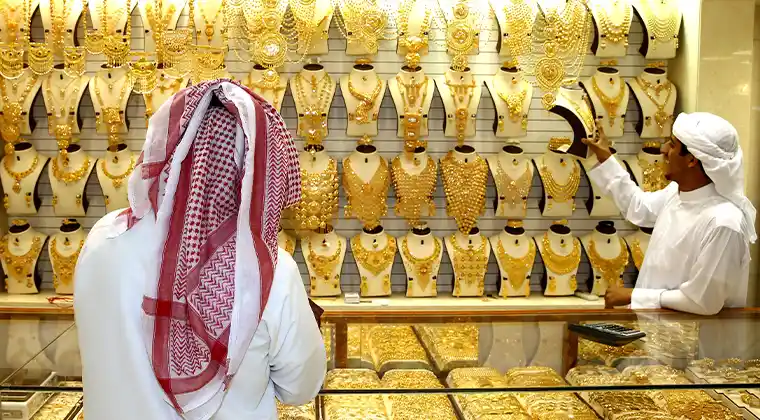
Shoppers in Dubai can now purchase 18-karat gold more affordably as market rates experience a downward trend, pushing the price of the precious metal to comfortably under the notable threshold of Dh400 for each individual gram.
18K Gold Costs Less in Dubai as Prices Fall Under Dh400 per Gram.

Experts predict that upcoming precious metal values will be primarily shaped by American inflation data, upcoming monetary policy choices from the Federal Reserve, and ongoing geopolitical tensions across the turbulent Middle East region.
Dubai Gold Market Trends and Global Economic Influences
As trading commenced for the week, precious metal valuations in the United Arab Emirates experienced a slight downward correction. Market participants responded cautiously amid growing anticipation of tighter monetary policy measures and broader inflationary pressures originating from the United States.
Local Pricing Breakdown Across Purity Tiers
Figures released by the Dubai Jewellery Group outlined a minor retreat in local retail bullion rates:
- 24-Carat Gold: Opened the week trading at Dh525.0 per gram, sliding downward from the weekend closing mark of Dh527.5.
- 22-Carat Gold: Adjusted downward to settle at Dh486.0 per gram.
- 21-Carat Gold: Eased to reach Dh466.0 per gram during morning sessions.
- 18-Carat Gold: Slipped to hit Dh399.5 per gram.
Meanwhile, international spot transactions reflected similar cooling trends. Spot gold decreased by approximately 0.45 percent to register at $4,357 per ounce, whereas silver remained relatively resilient, holding firm at $66.16 per ounce. These movements followed a robust session late last week where bullion climbed roughly 1 percent, maintaining a strong baseline near $4,380 per ounce prior to the latest round of profit-taking.
Macroeconomic Drivers and Central Bank Policies
The recent fluctuations arrive directly on the heels of aggressive policy adjustments by the US Federal Reserve, which implemented an interest rate increase last week alongside hawkish projections indicating that additional tightening could follow in subsequent months.
Despite these persistent headwinds, gold has demonstrated notable structural resilience. Industry experts point to shifting geopolitical dynamics as a major stabilizing factor for the market. Simon-Peter Massabni, head of business development at XS.com, noted:
“The metal recovered as immediate fears of Middle East energy supply disruptions subsided after Saudi Arabia rerouted crude oil exports. That relief enabled gold to withstand headwinds from the Federal Reserve after the central bank raised interest rates for the first time in three years. Energy market anxiety spiked after attacks targeted a pumping station along the East-West pipeline and an export terminal at the port of Yanbu. The incident threatened to remove nearly 4 per cent of global crude supply.”
Looking Forward
As global markets digest the dual pressures of regional geopolitical stabilization and aggressive central bank maneuvers, analysts expect precious metal valuations to remain sensitive to upcoming US economic indicators, inflation data prints, and central bank commentary. For local buyers in Dubai, the slight market dip offers a brief window of improved pricing amid a historically high valuation cycle.
Geopolitical Shifts, Crude Oil Logistics, and Their Ripple Effects on Global Gold Markets
Recent geopolitical developments and major adjustments in international energy infrastructure have once again demonstrated the profound interconnectedness of global commodity markets. Recent reports from major news agencies highlight a critical turning point in Middle Eastern energy logistics, carrying direct implications for crude valuations, inflationary trends, and investor appetite for safe-haven assets like gold.
Strategic Re-routing of Crude Exports
The international energy landscape faced intense scrutiny following security disruptions that threatened vital petroleum transit corridors. In response to these vulnerabilities, Saudi Arabia executed a swift and highly effective logistical pivot to secure its petroleum shipments.
Rather than relying entirely on conventional routes, authorities successfully rerouted a massive volume of crude sales—estimated at roughly 60 million barrels—through alternative channels. By leveraging the terminal facilities at Ras Tanura and utilizing the strategic Omani port of Sohar, shipments were successfully diverted outside the heavily monitored and sensitive Strait of Hormuz.
This decisive operational adjustment yielded immediate stability:
- Export Restoration: Crude export flows were successfully restored to levels matching or exceeding those recorded in August.
- Market Cool-Down: The mitigation of immediate supply-choke fears helped alleviate panic buying, driving crude prices downward from their recent speculative peaks.
Despite experiencing a downward slide during early Monday morning trading sessions, global crude benchmarks remained resilient, continuing to hover near the significant threshold of $100 a barrel.
The Macroeconomic Transmission: Energy Relief and Inflation
The cooling of energy markets extends far beyond petroleum tankers and fuel pumps; it serves as a major macroeconomic shock absorber. Addressing the broader financial ramifications of this crude price correction, market analysts have emphasized the cascading benefits for international monetary stability.
According to financial experts, the easing of petroleum values plays a pivotal role in dampening persistent consumer and producer price pressures. Lower energy costs directly constrain input expenses across global supply chains, helping to put a lid on runaway inflation metrics that have troubled central bankers worldwide.
Furthermore, this stabilization trickles down into fixed-income markets:
- Bond Yield Suppression: As inflationary fears recede, sovereign bond yields experience downward pressure, relieving the aggressive debt-servicing costs that have burdened developing and developed economies alike.
- Alleviating Liquidity Squeezes: The moderation in yields helps lift the severe liquidity constraints that previously restricted the free flow of international capital, freeing up resources for institutional and private deployment.
Capital Rotation Back into Precious Metals
With financial conditions becoming more accommodating, investors are reassessing their asset allocations. The easing of sovereign yields has opened up strategic pathways for capital mobility, particularly among major regional players.
Market commentators note that investors from across Asia and the Middle East are discovering newfound financial flexibility, allowing them to actively rotate capital back into gold assets. As the immediate panic in energy markets subsides, bullion continues to attract portfolio managers seeking a balanced hedge against lingering structural uncertainties, ensuring that precious metals remain a cornerstone of modern financial strategy.