Nepal faces devastating floods despite contributing little to global emissions, demanding climate justice, greater international support, compensation, resilience funding, and urgent climate action.
Nepal demands climate justice for devastating floods caused by emissions
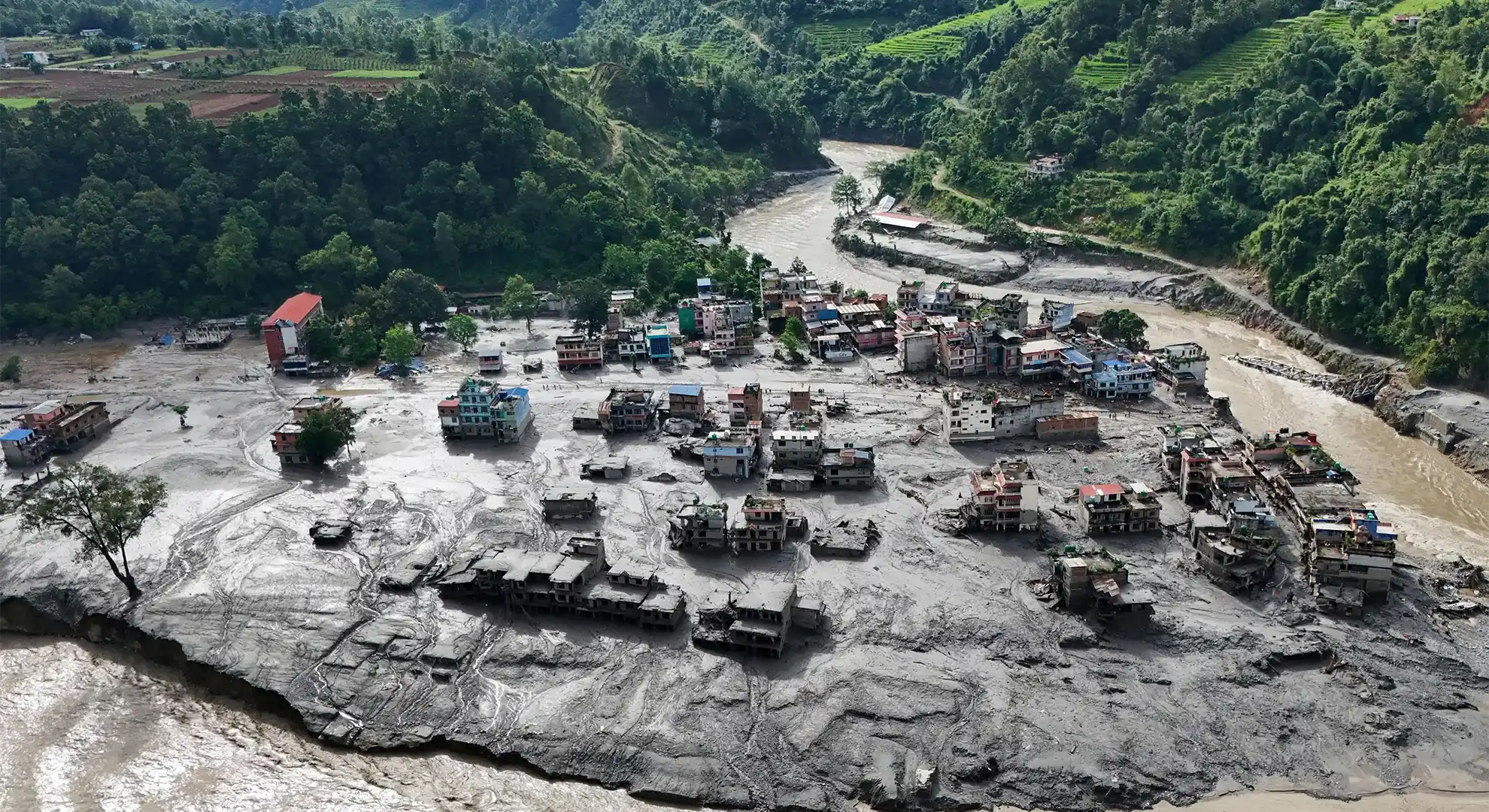
For generations, people living in Nepal’s Himalayan valleys have learned to live alongside mountains, rivers and glaciers. But the catastrophic disaster that struck on August 26 showed how quickly that familiar environment can become deadly. A sudden collapse of glacial ice and debris near the China-Nepal border sent a powerful flood through villages in Nepal’s Rasuwa district, destroying homes, infrastructure and livelihoods.
Among those who witnessed the destruction was 57-year-old Pemba Chhring Tamang. Rescued from his village, he described the flood as unlike anything he had experienced during his lifetime. Homes were swept away, familiar landscapes disappeared and entire communities were left struggling to understand the scale of the destruction.
The disaster has brought not only sorrow but also a difficult question for Nepal: why should a country that has contributed relatively little to global warming continue to suffer some of its most severe consequences?
Nepal is considered one of the world’s most vulnerable countries to climate change. Its economy and millions of livelihoods depend heavily on agriculture, natural resources and mountain ecosystems. Yet the country’s contribution to the greenhouse-gas emissions responsible for global warming is comparatively small.
Climate activist and politician Tashi Lhazom expressed this frustration by asking what Nepal had done to deserve such suffering. She argued that Nepalis were effectively paying the price for a global problem they had done little to create. Her words capture a growing demand for climate justice: countries that have historically produced large quantities of greenhouse gases should provide greater support to vulnerable nations facing the consequences.
The scale of the August disaster was enormous. More than 1,200 people were reported dead, while over 4,750 remained missing across Nepal and China’s Tibet region. The flood and debris destroyed settlements, roads and bridges and damaged several hydropower projects. Emergency teams continued searching for victims while helicopters transported essential food and medical supplies to isolated communities.
Although the precise reason for the glacial collapse remains uncertain, scientists warn that a warming planet is changing conditions in the Himalayan region. Rising temperatures are accelerating glacier loss and increasing the instability of mountain environments. As ice and snow formations change, communities downstream can face greater risks from floods, landslides and other cascading disasters.
Experts say the Himalayas are warming particularly rapidly. Saswata Sanyal of the International Centre for Integrated Mountain Development noted that temperatures in the region are increasing at roughly twice the global rate. He also pointed to the danger of cascading disasters, in which one extreme event triggers several others, multiplying the damage.
For Nepal, the problem is not simply about recovering from one flood. Reconstruction could require billions of dollars, while the long-term challenge is preparing communities for an increasingly uncertain climate.
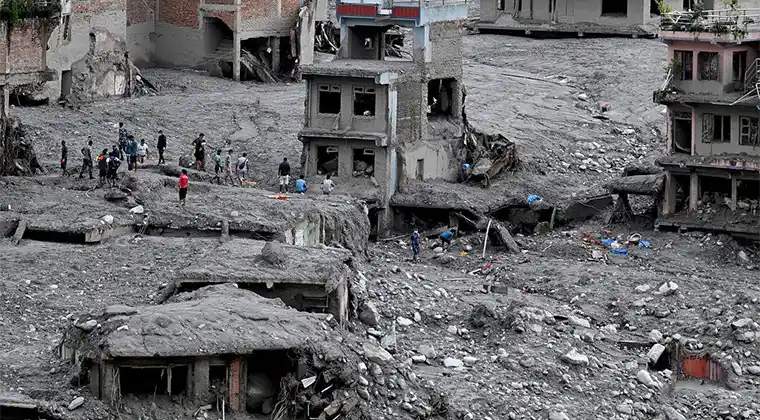
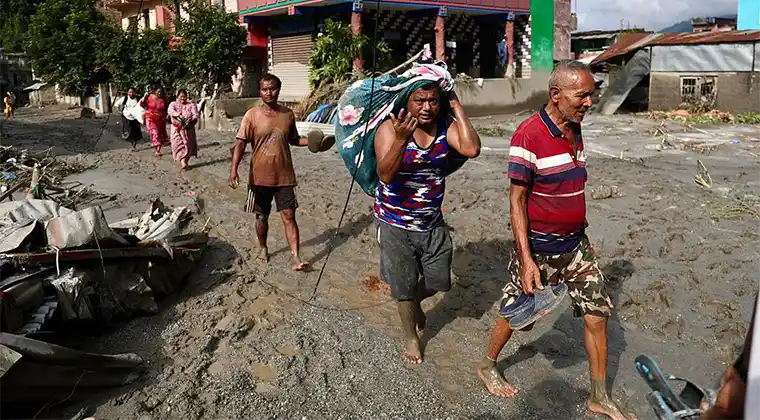
Nepal’s government has therefore called for stronger international cooperation. Prime Minister Balendra Shah has said the country must make its climate-related disasters a stronger issue in discussions with the international community. Foreign Minister Shisir Khanal argued that assistance should not be treated merely as charity. Instead, it should be understood through the principle of climate justice, because vulnerable countries are experiencing serious losses from a crisis they did not cause to the same extent.
The concept of “loss and damage” has become increasingly important in international climate negotiations. A United Nations fund established to help countries deal with climate-related losses represents an attempt to address this issue, although its resources remain limited and have not yet reached the scale required by vulnerable communities.
A preliminary UN assessment estimated that the physical damage from Nepal’s floods alone had reached about $158 million. The true economic cost, however, is expected to be much greater when damaged roads, bridges, farmland, homes, livelihoods and humanitarian needs are included.
The disaster also highlights the importance of regional cooperation. The Hindu Kush-Himalayan region provides water to around 240 million people living in the mountains and supports another 1.65 billion people downstream across South and Southeast Asia. A disaster in one Himalayan area can therefore affect communities far beyond the original site.
India and other neighbouring countries are also vulnerable to the consequences of changes in the Himalayas. Rivers, ecosystems and agricultural systems cross national boundaries, meaning that extreme events in the mountains can have consequences throughout South Asia. Climate experts have consequently called for stronger data-sharing systems, better early-warning mechanisms and cooperation between countries.
For communities like Tamang’s, however, international climate discussions can seem distant compared with the immediate reality of losing homes, relatives and livelihoods. People cannot simply relocate their lives after every disaster, particularly in remote mountain regions where economic opportunities are limited.
Nepal’s tragedy is therefore more than a story about a devastating flood. It is a warning about the unequal effects of climate change. Wealthier countries have historically contributed far more to global emissions, while poorer and more vulnerable nations often face disproportionate risks.
The disaster in Rasuwa demonstrates that climate change is no longer a distant environmental issue. It is a human crisis affecting homes, families, economies and entire communities. Nepal is asking the world not only for emergency assistance, but also for responsibility, accountability and long-term partnership.
The Himalayan mountains may be far from many of the world’s major industrial centres, but the consequences of a changing climate do not respect borders. What happens in the mountains can ultimately affect rivers, food systems, ecosystems and millions of people across Asia.