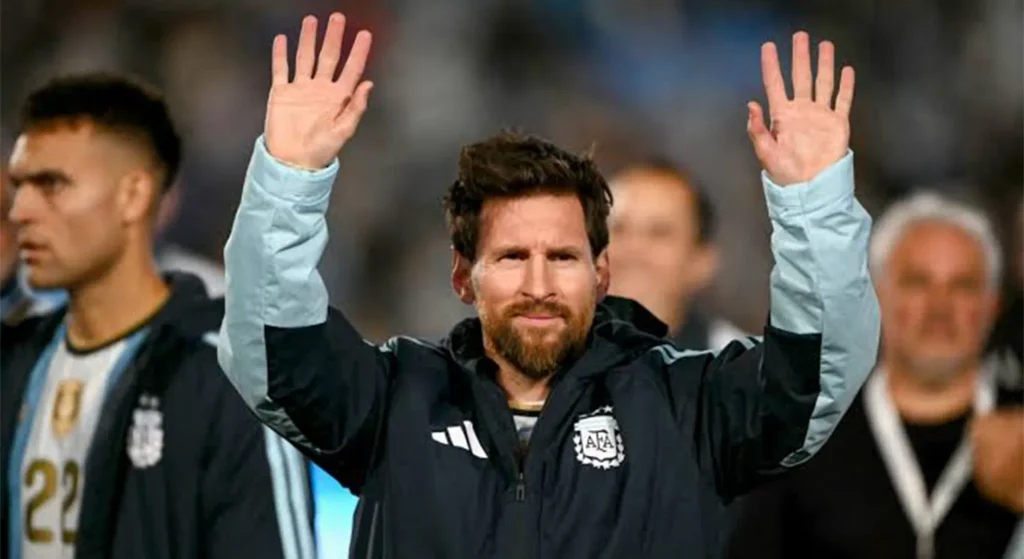
Lionel Messi’s Argentina farewell was filled with heartfelt moments as the football icon prepared to step away from international duty. Emotional scenes surrounded his departure, reflecting the enormous impact he has had on the national team and supporters.
Tears and Emotion Mark Messi’s Farewell From Argentina’s National Team.
Messi Says Goodbye to Argentina in Emotional Final Appearance
Lionel Messi’s extraordinary international career reached its emotional conclusion in Buenos Aires on Tuesday, with the Argentina captain receiving a farewell worthy of one of the country’s greatest sporting figures.
The 39-year-old forward made his final appearance for the national side in front of approximately 85,000 supporters at the Monumental Stadium, bringing an end to a 21-year journey with Argentina.
The night could hardly have been scripted more fittingly.
Messi scored his 126th international goal as Argentina defeated Benin 3-0, adding another memorable moment to a career that has already produced almost every major honour available to a footballer.
He also played a role in Argentina’s opening goal, providing the assist for veteran defender Nicolas Otamendi before Nico Paz added another goal.
But the result was secondary to the occasion.
The match had been promoted as Messi’s “Last Tango” with the national team, and the atmosphere inside the stadium reflected the significance of the moment.
For more than two decades, Messi had represented Argentina through triumph, disappointment, criticism and redemption.
On Tuesday night, he was finally able to say goodbye on his own terms.
An emotional final chapter
Messi admitted that leaving Argentina’s national team would be painful despite believing that the time had come to step away.
Addressing supporters after the match, he reflected on what wearing the Argentina shirt had meant throughout his career.
He said representing his country for more than 20 years had been an enormous source of pride and acknowledged that not returning to the national team would be difficult.
At the same time, Messi explained that he had reached a point where continuing indefinitely was no longer realistic.
His comments captured the conflicting emotions surrounding the farewell.
The footballer who had spent much of his life competing for Argentina still wanted to play, but he also recognised the physical and emotional demands of international football.
The decision came after years of intense competition and several major tournaments.
Messi also referred to Argentina’s most recent World Cup campaign, describing it as an especially demanding experience.
The tournament had taken place while his father was seriously ill, adding another emotional burden to an already difficult period.
For Messi, that experience contributed to his belief that the moment had arrived to close the international chapter of his career.
A night designed around No. 10
The farewell ceremony began before the football itself.
Messi arrived at the stadium alongside his three children as thousands of supporters gathered to celebrate the player who had become synonymous with Argentina’s famous No. 10 shirt.
His wife, Antonela Roccuzzo, and his mother, Celia Cuccittini, watched from a VIP area and exchanged affectionate gestures with him.
Earlier in the evening, Messi was visibly emotional as the team bus travelled through crowds of supporters on its way to the stadium.
The scenes outside reflected the scale of his popularity.
Inside the Monumental, supporters prepared their own tribute.
A giant Argentina shirt carrying Messi’s famous No. 10 was displayed on the pitch.
Above the number was the word “Gracias” — a simple message that captured the feelings of supporters who had followed his career through both difficult and triumphant periods.
The crowd responded with loud applause and chants.
For a player who had experienced so many major moments inside the stadium, the setting provided an appropriate stage for his farewell.
Tears during the national anthem
The emotion continued when the national anthem was performed.
Messi became visibly moved as Falklands War veteran Fabio Santana sang alongside a banner carrying the words “The Malvinas are Argentine.”
The same message had previously been displayed by Argentina players following their 2-1 World Cup semi-final victory over England.
The symbolism was particularly significant in a country where football and national identity are closely intertwined.
For Messi, the anthem represented another reminder of the connection he had maintained with Argentina throughout his career.
Although his professional life took him around the world, the national team remained an important part of his identity.
The 10th-minute tribute
The stadium then paid tribute to Messi in a manner fitting for the player who had worn No. 10 for so many years.
The match was stopped in the 10th minute.
Supporters stood and applauded for a full minute in honour of Argentina’s most celebrated modern footballer.
The gesture was deliberately linked to his shirt number.
Messi’s No. 10 had become one of the most recognisable symbols in world football, associated with his time at Barcelona, Paris Saint-Germain, Inter Miami and, most importantly for Argentine supporters, the national team.
The ovation gave fans an opportunity to celebrate him while he was still on the pitch.
Messi responded in the best way possible for a footballer.
He scored.
A final international goal
With Argentina already controlling the match, Messi converted a penalty in the 71st minute.
The goal took his international tally to 126.
It was another statistic to add to an extraordinary record that includes appearances, goals, assists and major tournament achievements.
For the thousands inside the stadium, however, the significance was not simply numerical.
It was Messi’s final goal in an Argentina shirt.
The moment provided the kind of ending that supporters could scarcely have hoped to design themselves.
He had scored in his farewell appearance, Argentina had won and the night remained focused on celebrating his contribution to the national team.
Argentina complete a comfortable victory
While Messi’s farewell dominated attention, Argentina still had a match to play.
The home side defeated Benin 3-0.
Otamendi scored first after receiving Messi’s assistance, while Nico Paz also found the net.
Messi then completed the scoring from the penalty spot.
The victory ensured that the evening ended with another positive memory rather than simply becoming a ceremonial goodbye.
Yet the scoreline was never likely to overshadow the main event.
The supporters had come to celebrate a player who had spent 21 years representing the country.
The end of a remarkable international journey
Messi’s relationship with Argentina has been one of the defining stories of his career.
His international journey included periods when he faced criticism and disappointment, particularly after major tournament defeats.
At times, questions were raised about whether he could reproduce his club success with the national team.
Those doubts were eventually answered through a remarkable period of success.
Argentina won the Copa America in 2021 and again in 2024.
The greatest achievement came at the 2022 World Cup, when Messi led Argentina to the title in Qatar.
That victory ended a 36-year wait for Argentina’s third World Cup championship and placed Messi firmly alongside the country’s most celebrated football legends.
For many supporters, winning the World Cup also completed a career that had previously been judged harshly because of the absence of that particular trophy.
From criticism to national hero
Messi’s early years with Argentina were not always easy.
Despite his extraordinary performances at club level, he faced criticism whenever Argentina failed to win major international tournaments.
The disappointment reached a peak after repeated defeats in major finals.
Argentina finished as World Cup runners-up in Brazil in 2014.
The team also suffered setbacks in other major competitions.
Messi eventually stepped away from international football briefly before returning.
The later success changed the relationship between the player and supporters.
The Copa America triumph in 2021 provided the breakthrough.
The 2022 World Cup victory then transformed his legacy.
By the time he lifted the trophy in Qatar, Messi was no longer simply Argentina’s most talented footballer.
He had become the central figure in one of the country’s most important sporting stories.
The World Cup triumph
Argentina’s 2022 World Cup victory was the defining achievement of Messi’s international career.
The team defeated France in a dramatic final in Qatar, securing the country’s third World Cup title.
The victory was particularly significant because Argentina had waited 36 years since its previous World Cup triumph.
Messi played a decisive role throughout the tournament and became the leader of a team that ultimately delivered the trophy supporters had been waiting for.
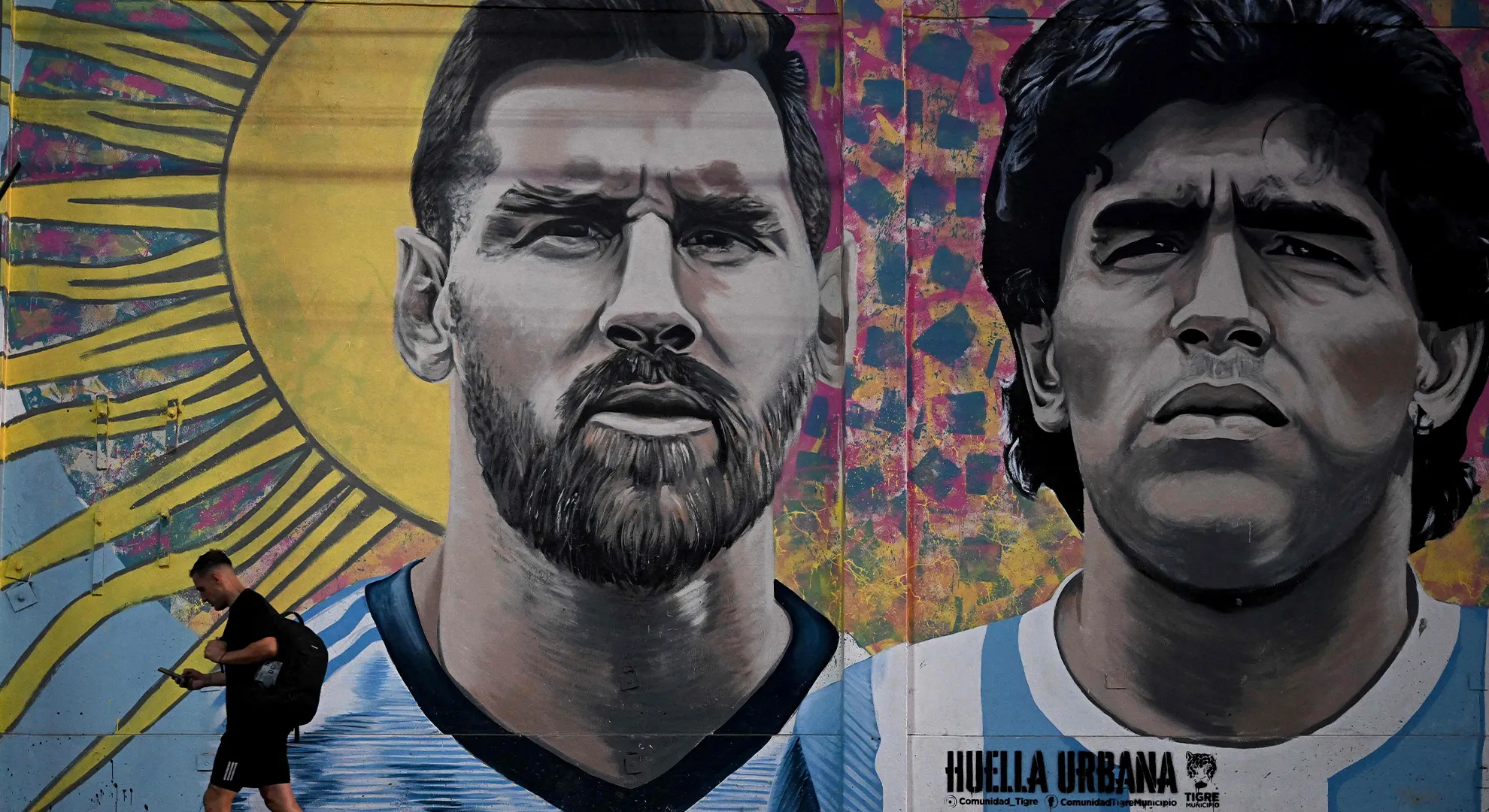
The achievement also strengthened comparisons between Messi and Diego Maradona.
Maradona had led Argentina to the 1986 World Cup, and Messi’s triumph in 2022 allowed a new generation to celebrate another Argentine No. 10 lifting the game’s most prestigious trophy.
A career beyond international football
Although Messi is ending his Argentina career, his playing career is not necessarily over.
He remains under contract with Inter Miami through 2028.
However, his plans have become less certain following the death of his father, Jorge, two months ago.
Messi has indicated that he could consider ending his club career earlier than previously expected.
That means Tuesday’s farewell may eventually become part of a larger retirement story.
For now, however, Messi remains a professional footballer at club level.
His departure from international football represents the closing of one specific chapter rather than necessarily the end of his time on the pitch.
A difficult decision
Messi has acknowledged that leaving Argentina is emotionally difficult.
He has spent more than half his life involved with the national team.
For a player who once said he would like to continue representing Argentina for as long as possible, deciding to stop required him to accept the realities of age and the demands of elite football.
His comments also suggested that he believes the next generation deserves opportunities.
Argentina has a growing group of younger players capable of taking on larger roles.
Messi’s departure creates space for those players to establish themselves and develop their own relationship with the national team.
For Messi, that is part of the reason he feels comfortable walking away now.
Supporters say goodbye
The emotional reaction from fans showed just how deeply Messi’s career has affected Argentina.
Supporters gathered outside football headquarters carrying flags and banners celebrating his contribution.
One enormous Argentine flag featured an image of Messi alongside the words “The joy of my life.”
Inside the stadium, supporters transformed the farewell into a collective celebration.
The atmosphere was less about mourning the end of an era and more about thanking the player for everything he had delivered.
That sentiment was also reflected by former teammates and fellow football stars.
Neymar’s tribute
Among those paying tribute was Neymar, Messi’s former Barcelona teammate.
In a message on X, the Brazilian star thanked Messi not only on behalf of Argentina but also on behalf of football fans around the world.
Neymar said Messi’s career had influenced his own love of football and praised the Argentine for what he had given to the sport.
Their relationship developed during their years together at Barcelona and later continued at Paris Saint-Germain.
The tribute from Neymar highlighted Messi’s influence beyond Argentina.
His significance extends far beyond the national team and even beyond the clubs for which he played.
A career measured in trophies
Messi’s Argentina career ended with an extraordinary collection of achievements.
He won one World Cup.
He helped Argentina finish as World Cup runners-up twice, in 2014 and 2026.
He also led the country to Copa America victories in 2021 and 2024.
Those accomplishments sit alongside his individual records.
His 126 international goals and 208 appearances underline the extraordinary longevity of his career with Argentina.
The numbers tell only part of the story.
The more significant legacy may be the transformation in Argentina’s relationship with him.
He began his international career as a young prodigy carrying enormous expectations.
He leaves as a national icon.
A farewell fitting for an era
The final match contained nearly every element that could have made Messi’s goodbye memorable.
There were tears before kickoff.
There were tributes from supporters.
His family was present.
The stadium celebrated his No. 10 shirt.
A minute-long ovation honoured him during the 10th minute.
Argentina won comfortably.
Messi assisted a goal.
He scored another himself.
And after the final whistle, a drone display filled the sky with images celebrating his career.
It was an elaborate farewell to a player whose career has been defined by extraordinary moments.
The final whistle
When the match ended, the result was almost an afterthought.
Argentina had won 3-0, but the real story was that Messi had played his final international match.
The stadium had given him one last opportunity to experience the affection of Argentine supporters.
For Messi, it was the conclusion of a relationship that had lasted more than two decades.
He leaves international football as Argentina’s record appearance holder and one of its leading scorers.
More importantly, he leaves after delivering the trophies that once seemed beyond reach.
A legacy secured
Messi’s international career contained disappointment, controversy, extraordinary success and emotional turning points.
He endured criticism after defeats.
He experienced the pain of losing major finals.
He briefly stepped away from international football.
Then came the transformation.
The 2021 Copa America victory was followed by the 2022 World Cup triumph and another continental title in 2024.
Those achievements fundamentally changed the way his international career will be remembered.
Instead of asking whether Messi could win a major trophy with Argentina, future generations will look back at how he helped the country collect some of its most important honours.
His final appearance therefore comes at a moment when his legacy is already secure.
Argentina without Messi
The national team will now have to begin preparing for an era without its most influential player.
That transition will not be simple.
Messi’s presence affected how opponents defended Argentina, how teammates positioned themselves and how supporters approached major tournaments.
Replacing his creativity, scoring ability and leadership will require more than finding another No. 10.
It will require the team to develop a different identity.
Argentina, however, already has a group of younger players emerging.
Messi himself has recognised that those players deserve opportunities.
His departure could therefore become the beginning of another generation rather than simply the end of the previous one.
More than a footballer
Messi’s importance to Argentina extends beyond statistics.
For supporters, he represented a connection between generations.
Older fans remembered Maradona.
Younger supporters grew up watching Messi.
The 2022 World Cup allowed those two eras to feel connected.
That is one reason his farewell carried such emotional weight.
The supporters were not simply saying goodbye to a footballer.
They were marking the end of an era that had shaped their relationship with the national team.
A fitting conclusion
Few players could have asked for a more appropriate final international appearance.
Messi entered the stadium surrounded by his family and thousands of supporters.
He experienced an emotional anthem ceremony.
He received a dedicated tribute during the 10th minute.
He helped create Argentina’s opening goal.
He scored from the penalty spot.
And he watched the night finish with a spectacular drone tribute above the stadium.
The occasion captured the full range of emotions associated with his career.
There was sadness because the journey was ending, but there was also gratitude for what had already been achieved.
The next chapter
Messi’s Argentina story is now the challenge is to move forward without the player who has complete.
The 39-year-old leaves international football after 21 years, 208 appearances and 126 goals.
He departs as a World Cup champion, a two-time Copa America winner and one of the most decorated players in international football.
For Argentina, the challenge is to move forward without the player who has been at the centre of its footballing identity for so long.
For Messi, attention will now turn primarily to his future with Inter Miami and the possibility that his club career could eventually reach its own conclusion.
Whatever comes next, his international legacy is unlikely to change.
Argentina’s fans have watched him grow from a young prodigy into the leader who finally delivered the World Cup.
His final night in Buenos Aires provided one last reminder of why he and the tributes all pointed to the same conclusion: an extraordinary international knowing that he gave Argentina what generations of supporters had hoped to see — another World Cup and a footballing legacy that will endure long after his final appearance. became so important to them.
The tears, the applause, the goals and the tributes all pointed to the same conclusion: an extraordinary international era had reached its end.
Messi walked away from Argentina with the gratitude of a nation that had spent more than two decades watching him represent its colours.
And after years of searching for the ultimate prize, he leaves knowing that he gave Argentina what generations of supporters had hoped to see — another World Cup and a footballing legacy that will endure long after his final appearance.