UAE students explain how they are incorporating ChatGPT into their education, while schools introduce clearer policies and expectations around the use of artificial intelligence for assignments, research, revision and everyday classroom learning.
UAE Students Share How ChatGPT Supports Their Studies as Schools Set New AI Guidelines.
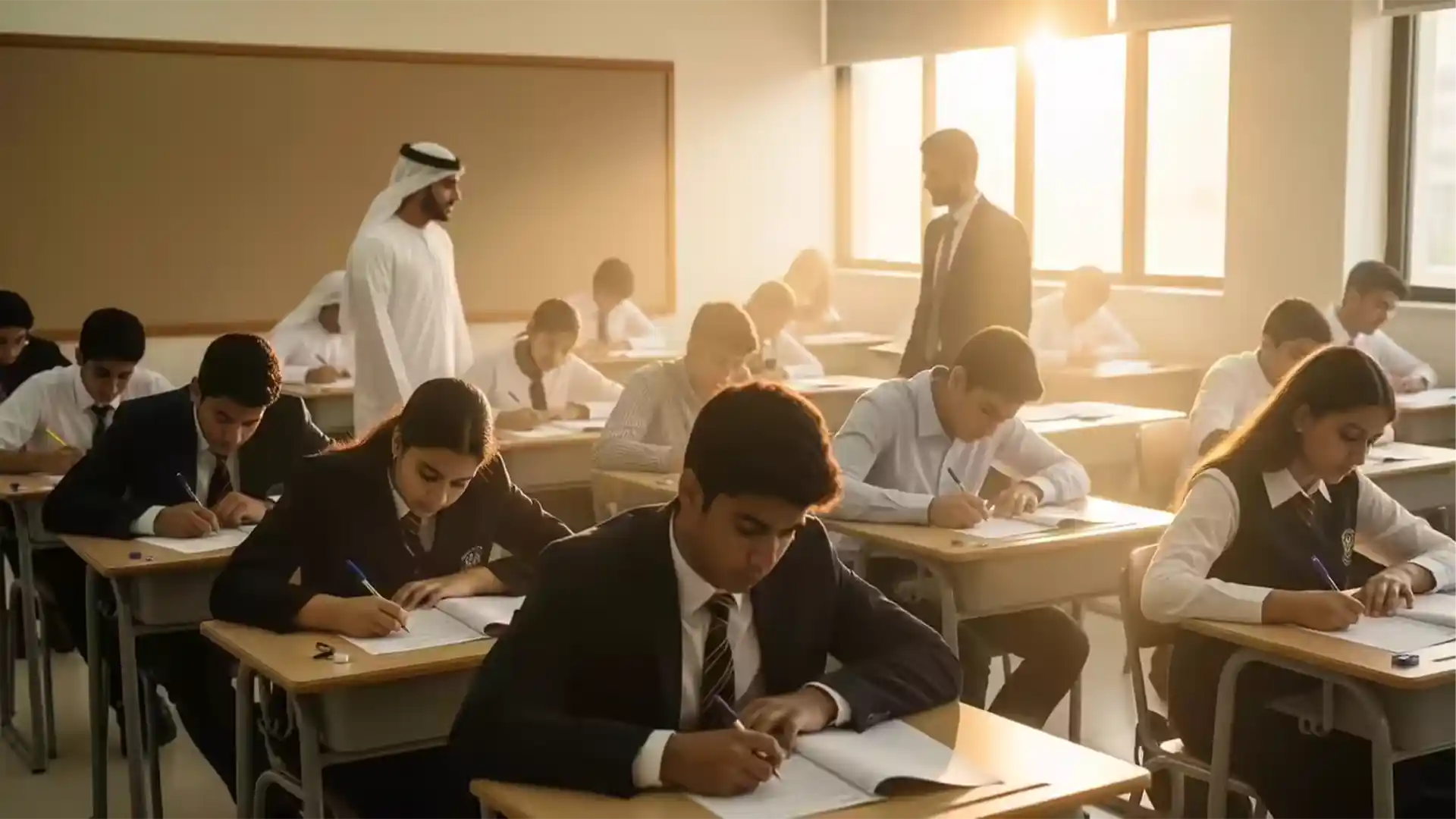
Schools are placing greater emphasis on responsible AI use, allowing students to use tools such as ChatGPT for research, explanations and study support, while discouraging them from relying on AI to complete assignments or present machine-generated content as their original work.
AI Becomes an Everyday Study Companion for UAE Students
Artificial intelligence is gradually becoming part of everyday school life for many students in the UAE. What was once viewed mainly as an emerging technology is now being used by children as an additional source of academic support, particularly when they are struggling with a difficult topic or need an explanation outside normal classroom hours.
For some students, tools such as ChatGPT have become a convenient way to revisit lessons, understand unfamiliar concepts and receive step-by-step explanations. The technology can also be useful when students have missed classes and need help getting back up to speed.
However, the growing use of AI has also prompted schools and parents to consider where the boundaries should lie.
Educators are increasingly distinguishing between using artificial intelligence as a study resource and allowing it to complete academic work on a student’s behalf. While AI can provide explanations, suggest ideas and help students identify mistakes, schools say pupils must continue to demonstrate their own understanding and take responsibility for work submitted under their names.
The issue is becoming particularly relevant as AI tools become easier for children to access.
Students Turn to AI When They Need Extra Help
For Grade 7 student Yahiya Mohammed, ChatGPT became useful after he missed an extended period of school.
Yahiya was away from the UAE for two weeks shortly before the summer holiday and found it difficult to fully reconstruct the lessons he had missed after returning.
He initially relied on classmates and friends to help him catch up. While that gave him some information about what had been covered in class, it did not completely resolve his difficulties with certain subjects and concepts.
He then decided to use ChatGPT as an additional learning resource.
Rather than asking the technology to complete his schoolwork, Yahiya entered the topics he had missed and asked the AI tool to explain them using simpler language.
The approach helped him revisit material at a pace that suited him.
“I missed two weeks of classes just before the summer break because I had travelled back home. I tried to catch up by speaking to my classmates and friends, but I still couldn’t fully understand some of the topics I had missed,” he said.
After turning to ChatGPT for explanations, he found that the simplified responses helped him understand the material and close some of the gaps created by his absence.
“That really helped me understand them and catch up with what I had missed,” he said.
His experience illustrates one of the ways students are using generative AI as an additional educational resource rather than as a replacement for classroom teaching.
Instant Answers Raise Questions for Parents
While students may appreciate the convenience of being able to ask an AI tool a question at any time, parents are also considering what could be lost when answers become instantly available.
Traditionally, a child struggling with homework might consult a textbook, search for information, ask a teacher or parent, or work through the problem independently.
AI can compress that process into a few seconds.
For parents, the concern is whether this convenience could discourage children from spending enough time wrestling with challenging questions themselves.
Amal Khalil said her son sometimes turns to artificial intelligence when he encounters difficulties during homework.
She explained that the technology can be particularly useful when there is no adult available to answer a question immediately.
“My son uses AI to help him resolve problems while doing his homework. If he doesn’t understand something, he turns to ChatGPT for clarification or to resolve his doubts, especially when an adult isn’t around to help,” she said.
Khalil sees considerable value in having such a resource available, particularly because students can receive explanations immediately instead of having to wait for assistance.
At the same time, she believes parents need to be conscious of the possibility that children could become too reliant on technology.
The Value of Struggling With a Problem
Khalil described AI as highly useful but warned that instant solutions can sometimes remove an important part of the educational experience.
When children encounter a difficult question, they may need to research information, test different approaches, make mistakes and try again before reaching an answer.
That process can be frustrating, but it can also help develop independence and problem-solving skills.
“AI provides instant answers and gratification, but in the process, children can miss out on the effort of researching, trying different approaches and finding solutions on their own,” she said.
For Khalil, the process of struggling with a difficult problem is not necessarily something that should be eliminated.
“I feel that struggle and toil have their own value because they are part of the learning process,” she said.
Her comments reflect a broader question facing schools and families: how can students benefit from powerful AI tools without allowing the technology to replace the intellectual effort that education is designed to develop?
Schools Draw a Line Between Assistance and Substitution
As generative AI becomes increasingly common, schools are developing clearer expectations around how students should use it.
The central distinction is between AI supporting a student’s own learning and AI producing work that the student then submits as if they had completed it independently.
Under this approach, students may be encouraged to use AI for certain legitimate academic purposes.
These can include asking for an explanation of a difficult concept, brainstorming possible ideas, conducting preliminary research or checking whether they have made mistakes.
The situation changes when a student asks an AI system to produce an entire assignment and then presents the output as their own work.
Educators say this can undermine the purpose of the assignment because the student’s own reasoning, writing and understanding may not be reflected in the final submission.
Regent International School Takes a Responsible-Use Approach
David Williams, Principal of Regent International School, said banning artificial intelligence altogether is not considered an effective solution.
The technology is already becoming part of students’ daily lives, and schools therefore have a responsibility to teach children how to use it appropriately.
“We recognise that AI is going to be part of our students’ lives, both now and in the future. We therefore don’t believe the answer is simply to ban it,” he said.
Instead of treating AI as something that students should never use, the school focuses on helping them understand when and how it can be used appropriately.
Williams said students are taught to engage with AI in a responsible way and understand the boundaries surrounding its use.
This approach acknowledges that artificial intelligence is likely to remain an important part of education and the workplace.
Rather than attempting to keep students entirely away from the technology, schools can help them develop the skills required to use it critically and responsibly.
AI Can Help With Ideas and Explanations
According to Williams, there are several legitimate ways students can use AI as part of their education.
A student who is struggling to understand a complicated topic can use an AI tool to request a simpler explanation.
Similarly, AI can be used to generate starting points for research or help a student brainstorm ideas before developing their own response.
Students can also use the technology to review their work and identify areas that may require improvement.
These uses place the student at the centre of the learning process.
The technology provides assistance, but the student remains responsible for understanding the subject and producing the final work.
AI Should Not Replace Student Thinking
The boundary becomes clearer when artificial intelligence is used to do the intellectual work that an assignment is intended to measure.
Williams said students need to understand that asking an AI system to complete their homework and then submitting the response as their own is fundamentally different from using the technology as a learning aid.
“For us, there is a very clear difference between using AI to support your learning and asking AI to complete your homework and then presenting that work as your own. Students need to be open about when and how they have used AI, particularly where it has contributed to a piece of assessed work,” he said.
This emphasis on transparency is becoming increasingly important as schools work to establish responsible AI practices.
If artificial intelligence has made a significant contribution to an assessed assignment, students may need to acknowledge how it was used.
The purpose is not necessarily to prevent students from accessing AI but to ensure that teachers can accurately understand the student’s contribution.
Teachers Assess More Than the Final Assignment
Another challenge presented by generative AI is determining whether a submitted piece of work genuinely reflects a student’s understanding.
A polished written assignment may not always tell teachers how much of the content was produced independently by the student.
At Regent International School, Williams said teachers consider the broader learning process rather than relying exclusively on the final document.
“Our teachers know their students extremely well, so we also don’t look at a finished piece of work in isolation,” he said.
Teachers can compare submitted work with what they observe from a student during lessons.
They can also assess whether the child is able to explain the ideas presented in an assignment and demonstrate the relevant skills without relying on the AI-generated material.
“We look at what students can explain, discuss and demonstrate in the classroom, as well as the process they have gone through to produce their work,” Williams said.
This approach means that classroom participation, discussion and demonstrated understanding remain important components of assessment.
Understanding Matters More Than Producing a Polished Answer
The growing availability of AI is changing the way students can approach academic challenges.
A child who once became stuck on a difficult question may now be able to receive an explanation within seconds.
That can be valuable, particularly when used to overcome a specific learning obstacle.
However, educators want students to move beyond simply obtaining the correct answer.
Understanding why an answer is correct remains an essential part of education.
For example, if a student asks AI to explain a mathematical concept and then works through similar problems independently, the technology has served as a learning aid.
If the student instead asks AI to solve an entire set of questions and submits those answers without understanding the method, the educational benefit is significantly different.
The distinction therefore lies not simply in whether AI was used, but in how it was incorporated into the learning process.
AI Can Support Students Who Miss Lessons
One potential benefit of AI is its ability to provide personalised explanations.
Students who miss lessons for travel, illness or other reasons may find it difficult to catch up entirely through notes from classmates.
An AI system can provide another way of approaching the same material.
Students can ask for explanations at different levels of difficulty or request examples that make an unfamiliar concept easier to understand.
This can be particularly useful for students who are hesitant to repeatedly ask questions in class.
However, AI-generated explanations should complement rather than replace communication with teachers.
Teachers remain important for identifying misunderstandings, adapting instruction to individual students and ensuring that information is accurate and appropriate for the curriculum.
Parents Have a Role to Play
The growing use of AI also means parents are being asked to think about how their children interact with these tools at home.
Rather than simply banning AI, parents may need to establish expectations around appropriate use.
For example, a child could be encouraged to attempt a question independently before asking an AI system for an explanation.
Parents can also ask children to explain an AI-generated answer in their own words.
This can help determine whether the student actually understands the material or has simply copied a response.
Such practices can preserve the convenience of AI while encouraging children to remain actively involved in their own learning.
Schools Face a New Educational Challenge
The rapid development of generative AI has created a new challenge for educators.
Traditional approaches to homework and written assignments were developed in an environment where students generally had to produce their own work using books, classroom notes, research materials and personal knowledge.
Generative AI has changed that environment.
Students can now produce sophisticated text, summaries and explanations with relatively little effort.
This means schools must reconsider how assignments are designed and how learning is assessed.
Teachers may increasingly place greater emphasis on classroom discussions, presentations, practical activities, project work and assessments that allow students to demonstrate their understanding directly.
Responsible AI Use Is Becoming Part of Digital Education
For students, learning how to use artificial intelligence responsibly may become an important educational skill in its own right.
AI is likely to remain relevant beyond school, with students eventually encountering it in universities, workplaces and professional environments.
Understanding its strengths and limitations can therefore be useful.
Students need to recognise that AI-generated information may not always be accurate and that simply receiving a confident-sounding answer does not guarantee that the answer is correct.
They also need to understand the importance of checking information, protecting personal data and following the rules established by their school.
The Balance Between Technology and Independent Learning
The experiences of students such as Yahiya demonstrate why AI can be useful in education.
For a student who has missed lessons, needs a concept explained differently or is working independently at home, an AI tool can provide immediate assistance.
At the same time, concerns raised by parents such as Khalil and guidance from educators highlight the importance of maintaining a balance.
Technology can make learning more accessible, but it should not remove the need for curiosity, persistence, research and independent thinking.
The objective is therefore not necessarily to keep students away from AI.
Instead, schools are increasingly seeking to teach children how to use the technology without allowing it to take over the learning process.
A Changing Definition of Homework
As AI becomes more common, the traditional concept of homework may also continue to evolve.
Teachers may need to think carefully about which tasks are intended to test knowledge and which can reasonably involve digital assistance.
Students, meanwhile, need to understand that producing an impressive-looking answer is not the same as demonstrating genuine understanding.
For schools, the challenge is to create an environment where technology can be used constructively while maintaining academic integrity.
For parents, the challenge is to ensure that convenience does not become dependence.
And for students, the key lesson is that AI can provide support, but the responsibility for learning remains their own.
The Emerging Approach in UAE Schools
The experiences shared by UAE students, parents and educators point towards an increasingly practical approach to artificial intelligence in education.
Schools are not necessarily treating AI as something that must be completely excluded from students’ lives.
Instead, the focus is shifting towards responsible use, transparency and accountability.
Students can use AI to seek explanations, develop ideas, support research and review their work, provided they remain actively involved in the learning process.
At the same time, producing an assignment through AI and submitting it as independent work remains a different matter.
As Williams explained, teachers can assess not only the final product but also what students can explain, discuss and demonstrate themselves.
That approach allows schools to recognise the potential benefits of artificial intelligence while keeping student understanding at the centre of education.
For UAE students, the message is increasingly clear: AI can be a useful study companion, but it is not a substitute for learning, thinking and doing the work themselves.
Schools Put Independent Thinking First
As artificial intelligence becomes increasingly accessible to students, schools across the UAE are placing greater emphasis on ensuring that technology remains a tool for learning rather than a replacement for independent thought.
Educators say students should be able to benefit from AI without allowing it to take over the academic work they are expected to complete themselves.
At Woodlem Park School in Ajman, this approach is reflected in the school’s emphasis on independent research, reliable information and original thinking.
Shiny Davison, Principal of Woodlem Park School, Ajman, said students are encouraged to investigate topics independently, consult trustworthy sources and develop their own conclusions rather than relying entirely on AI-generated responses.
The school recognises that artificial intelligence can provide useful assistance, but students are expected to remain actively involved in the learning process.
AI Is Viewed as a Supporting Tool
For the school, the distinction between appropriate and inappropriate AI use is particularly important when students are completing homework or assessed assignments.
Using AI to understand a difficult subject or explore a topic can provide educational value.
However, asking an AI system to generate an entire homework assignment and then submitting that material as if it were the student’s own work is treated differently.
Davison said this type of use does not meet the school’s expectations for responsible AI use.
The concern is not simply about whether a student has used technology. It is about whether the technology has replaced the intellectual effort that the student was expected to demonstrate.
When students conduct their own research, compare information and develop their own ideas, they are actively participating in the learning process.
When an AI system produces the complete response for them, much of that process can disappear.
Clear Rules Help Students Understand Expectations
Woodlem Park School has established an AI-use policy designed to give students, parents and teachers a common understanding of what constitutes responsible use.
Davison said the school’s guidelines are communicated across the school community so that expectations are not limited to students alone.
“Our clear AI-use policy is communicated to students, parents and staff, ensuring a shared understanding of responsible and ethical practice. Teachers continually assess students’ understanding through questioning, discussion, classwork and authentic tasks.”
This approach gives teachers multiple opportunities to establish whether students genuinely understand the subjects they are studying.
Instead of relying exclusively on a written assignment, educators can ask students questions, engage them in classroom discussions and observe how they approach practical or authentic tasks.
Assessment Goes Beyond Written Work
The growing availability of generative AI is encouraging schools to reconsider how student understanding is assessed.
A written piece of work can provide useful evidence of learning, but it may not always reveal how independently the student developed the response.
Classroom questioning and discussion can provide another way for teachers to determine whether a student understands the concepts being assessed.
Similarly, classwork completed under teacher supervision can provide insight into a student’s own abilities.
Authentic tasks can also require students to apply knowledge to real-world situations rather than simply reproduce information.
These methods can help educators distinguish between students who understand a subject and those who may have relied heavily on technology to produce their work.
The Principle: AI Should Not Replace Thinking
Davison said the school’s position can be summed up simply: “AI may support learning, but it must never replace thinking.”
The statement reflects the wider concern among educators that convenience should not come at the expense of intellectual development.
Students need opportunities to analyse information, make mistakes, ask questions and develop solutions independently.
These skills cannot necessarily be acquired simply by receiving a correct answer.
The learning process often involves uncertainty and effort.
A student may need to consider several possibilities before reaching a conclusion, and that process can contribute significantly to their understanding.
AI can assist during that process, but schools want students to remain responsible for the reasoning behind their final answers.
Questioning AI-Generated Information
David Williams, Principal of Regent International School, also highlighted another important aspect of responsible AI use: students need to understand that artificial intelligence can make mistakes.
Generative AI systems can produce responses that sound convincing even when the information they contain is incomplete, inaccurate or misleading.
Students therefore need to develop the ability to question what an AI system tells them.
“We also want our students to understand that AI isn’t always right,” Williams said.
This means that students should not automatically accept an AI-generated response simply because it is presented confidently or in a polished format.
Instead, they should consider whether the information makes sense and whether it can be confirmed through reliable sources.
Source Checking Becomes More Important
The ability to verify information is becoming increasingly important as students use AI for research and school projects.
When an AI tool provides a response, students can check important claims against reputable sources such as educational resources, academic publications, official websites or information recommended by their teachers.
This process can help students identify inaccuracies and develop stronger research habits.
It also teaches them an important lesson about digital information more broadly.
Not everything available online is reliable, and artificial intelligence does not eliminate the need for verification.
In fact, the ease with which AI can generate information makes critical evaluation even more important.
Students Must Make Their Own Judgements
Williams said students should learn to evaluate information rather than simply accepting what a technology platform provides.
“Being able to question information, check sources and make your own judgement is incredibly important,” he said.
The ability to form an independent judgement is particularly valuable because students will encounter AI-generated information outside school as well.
They may use AI tools for university research, professional tasks, personal questions and everyday information.
Developing critical thinking at school can therefore help prepare students for a wider digital environment.
AI Literacy Is Becoming Part of Education
The growing presence of artificial intelligence means that digital literacy is increasingly extending beyond knowing how to operate software.
Students also need to understand how AI works at a basic level, what it can and cannot do, and why its answers should sometimes be questioned.
Responsible AI use includes knowing when technology is appropriate and when independent work is more important.
It also involves understanding academic integrity.
Students need to recognise that submitting AI-generated material as their own can misrepresent the amount of work and understanding they have contributed.
Schools are therefore placing greater emphasis on transparency.
Academic Integrity in the Age of Generative AI
Academic integrity has traditionally involved issues such as plagiarism, copying another student’s work or presenting someone else’s ideas without appropriate acknowledgement.
Generative AI introduces a new dimension to that conversation.
A student may produce an original-looking piece of writing without personally carrying out the research, analysis or drafting involved.
This creates a challenge for schools because the finished work may appear polished even when it does not accurately reflect the student’s independent abilities.
For this reason, schools are increasingly defining how AI may be used and making those expectations clear to students and families.
The aim is to establish boundaries that allow technology to be useful without undermining the purpose of academic assessment.
Research Should Still Involve the Student
At Woodlem Park School, students are encouraged to conduct their own research and consult dependable sources.
This does not necessarily mean AI must be excluded from the process.
Students may be able to use technology to generate questions, explore different perspectives or identify areas they want to investigate further.
However, they are still expected to examine information themselves and develop their own understanding.
This distinction is important because research is not simply about collecting an answer.
It involves deciding which information is credible, comparing different sources, identifying relevant evidence and reaching a conclusion.
AI can assist with parts of that process, but schools want students to remain responsible for the final judgement.
The Role of Teachers Is Changing Too
As AI becomes more common, teachers are also adapting the way they monitor learning.
Rather than assessing only a final written product, educators can use classroom conversations and other forms of assessment to understand how students arrived at their conclusions.
Teachers can ask follow-up questions about an assignment, request explanations of particular points or ask students to apply the same knowledge in a different context.
If a student understands the subject, they should generally be able to discuss the main ideas and explain their reasoning.
This approach can make the learning process more visible.
Classroom Discussion Can Reveal Understanding
Questioning is one of the methods highlighted by Woodlem Park School.
A teacher can ask a student to explain a concept in their own words or describe how they reached a particular answer.
This can provide information that may not be visible from the final written assignment alone.
Discussion can also encourage students to think more deeply.
Instead of simply reproducing information, they may need to defend an argument, compare alternatives or respond to an unexpected question.
These are skills that are difficult to replace with simply copying an AI-generated response.
Authentic Tasks Have a Growing Role
Schools are also placing emphasis on authentic tasks that require students to apply their knowledge.
Such activities can involve real-world problems, practical situations, presentations, projects or collaborative exercises.
The objective is to assess whether students can use what they have learned rather than simply reproduce a prepared response.
This can make it easier for teachers to see how students think and work.
It also reinforces the idea that education is about developing skills and understanding rather than merely producing finished assignments.
Parents Are Part of the Conversation
Clear AI policies are not limited to classrooms.
Parents also need to understand how schools expect students to use generative AI.
If expectations differ between home and school, students may receive mixed messages about what constitutes acceptable use.
By communicating policies to parents and staff, schools can establish a more consistent approach.
Parents can then reinforce responsible habits at home by encouraging children to use AI for explanation and research support while ensuring that they continue to complete their own academic work.
Learning to Use AI Responsibly
For educators, responsible AI use does not necessarily mean avoiding the technology.
Instead, it means teaching students how to use it with care.
A student could use AI to request an alternative explanation of a difficult concept, generate questions for revision or identify areas that require further research.
The student can then verify the information and use their own understanding to complete the task.
This type of interaction keeps the learner actively involved.
By contrast, asking AI to produce an assignment from start to finish removes much of the educational work that the task was intended to encourage.
AI Has Benefits, but Students Need Boundaries
There are clear reasons why students are attracted to AI tools.
They can provide immediate responses, adapt explanations and help users explore a wide range of subjects.
For a student who is struggling with a concept outside school hours, this can be particularly convenient.
However, the speed and convenience of AI also create a temptation to use it as a shortcut.
If students become accustomed to asking AI for every answer, they may have fewer opportunities to develop persistence and independent problem-solving skills.
Schools are therefore trying to establish a middle ground.
Building Critical Thinking Skills
Critical thinking is becoming an increasingly important part of AI education.
Students need to ask questions such as:
Is this information accurate?
What evidence supports the claim?
Can the information be confirmed elsewhere?
Is the source reliable?
Are there alternative explanations?
Do I understand the answer well enough to explain it myself?
These questions encourage students to engage actively with information.
They also help them develop habits that will remain useful regardless of the technology they use.
AI Should Assist, Not Think on a Student’s Behalf
The message from UAE educators is increasingly centred on balance.
Artificial intelligence can be a useful addition to a student’s learning toolkit, but it should not become a substitute for independent thought.
Students can use AI to clarify concepts, explore ideas, support research and review their work.
At the same time, they are expected to remain responsible for the substance of their assignments and to understand the information they submit.
As Williams put it, students should use AI “to support your thinking, not to do your thinking for you”.
That distinction is becoming an important principle as schools develop their approach to generative AI.
Preparing Students for an AI-Driven Future
Schools are not only responding to a current technological trend. They are also preparing students for a future in which artificial intelligence is likely to play a significant role in higher education, employment and everyday life.
Learning how to use AI responsibly can therefore be considered part of broader digital education.
Students will need to know how to work with these tools while maintaining their own judgement.
They will also need to recognise that technology can assist with tasks without necessarily being a reliable authority.
The ability to combine technological tools with independent reasoning could become increasingly important.
A Shift From Banning to Responsible Use
The approach taken by Woodlem Park School and Regent International School reflects a broader shift in how educators are responding to generative AI.
Rather than treating the technology solely as a threat to academic integrity, schools are exploring ways for students to use it constructively.
The emphasis is on establishing clear boundaries.
Students should understand when AI can support their education and when using it would undermine the purpose of an assignment.
They should also understand the importance of acknowledging AI use when required and verifying information before relying on it.
Keeping Students at the Centre
Ultimately, the role of AI in education depends on how the technology is used.
If students use it to obtain explanations, explore ideas and identify areas they need to study further, it can serve as an additional learning resource.
If they use it to produce work that they submit without understanding or acknowledgement, the technology can interfere with the educational process.
For schools, maintaining that distinction is becoming increasingly important.
The objective is not to prevent students from engaging with technology, but to ensure that technological assistance does not replace the development of knowledge, judgement and independent thinking.
As UAE schools continue to refine their AI policies, the central message remains consistent: technology can help students learn, but the responsibility for thinking, questioning, verifying and understanding must remain with the student.