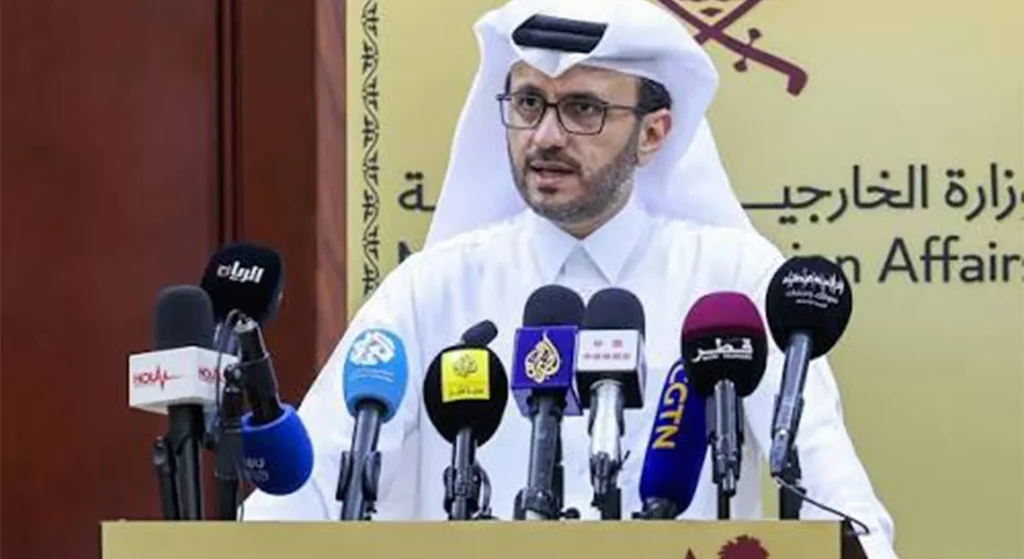
Qatar Rejects Allegations Linking Doha to Financial Support for Hamas, Dismissing Israeli Media Reports as Misleading and Unfounded. Officials say the Gulf state is being unfairly singled out and portrayed as responsible for developments in the region.
Qatar Denies Israeli Claims of Funding Hamas, Says Doha Is Being Made a ‘Scapegoat’.

Qatar emphasized that it had no intention of interfering in Israel’s internal political affairs. However, it said it would continue to respond publicly when inaccurate or misleading allegations were made against it, particularly when such statements appeared to be motivated by political considerations.
Qatar Rejects Allegations Over Gaza Aid and Hamas Funding
Qatar has strongly rejected allegations circulating in Israeli media that humanitarian assistance it provided to the Gaza Strip was ultimately channelled to Hamas. Doha’s International Media Office described the reports as completely untrue, arguing that the claims misrepresented the nature of Qatar’s humanitarian role in Gaza and ignored the arrangements through which its assistance was delivered.
The dispute centres on accusations made by Israeli media outlets and echoed by figures from Israel’s far-right and political circles. According to the Qatari statement, these allegations attempt to associate Qatar directly with financial support for Hamas despite Doha’s assertion that it did not transfer money to the organisation through the mechanisms used for its humanitarian assistance.
In a statement released on September 18, Qatar said its support for civilians in Gaza had been provided for humanitarian purposes and had been distributed through arrangements involving international organisations and coordination with Israeli authorities. The assistance, according to Doha, included financial support as well as essential supplies such as food, medicine and fuel.
Qatar’s media office described the allegations as “categorically false” and said they appeared to serve a political purpose rather than accurately reflect the way humanitarian assistance had been organised and delivered. Doha also rejected suggestions that its aid programme constituted a direct financial relationship with Hamas.
The Qatari government has maintained that humanitarian assistance destined for Gaza was handled through established channels involving international and United Nations organisations. While Qatar provided the resources, the actual delivery of much of the assistance into Gaza was carried out by UN agencies and other relevant organisations in coordination with Israeli authorities.
This distinction is central to Qatar’s response. Doha argues that providing humanitarian resources for civilians should not be equated with directly financing Hamas. The Qatari statement said that any funds that might have reached Hamas outside the established humanitarian mechanisms were unrelated to Qatar.
The statement therefore sought to separate Qatar’s humanitarian activities from allegations concerning Hamas financing. Qatar said that its assistance had been provided through procedures involving multiple parties and that Israeli authorities, including security agencies, had been involved in the arrangements over a period spanning several years.
Doha further pointed out that its humanitarian assistance to Gaza had not been a recent initiative. According to the statement, the programme continued under successive Israeli governments and had previously received public support from Israeli political leaders. Qatar cited this history in rejecting the suggestion that its assistance was secretly designed to benefit Hamas.
The Qatari position is that its humanitarian engagement with Gaza was conducted within a framework known to relevant authorities. The statement said Israeli security agencies had been involved in the process, while international organisations played a role in delivering aid once it entered Gaza.
Qatar also criticised what it characterised as a growing political campaign against Doha. The International Media Office said Israeli far-right figures and other political actors were using accusations against Qatar to shift public attention away from domestic political difficulties.
According to Doha, the allegations should therefore be viewed in the context of Israeli domestic politics. The statement argued that criticism of Qatar had intensified as Israel moved closer to elections and suggested that some political figures were attempting to use Qatar as a target for criticism rather than focusing on internal political disputes.
The Qatari statement referred to the country as a “convenient scapegoat” for political purposes. Doha said it had no desire to become involved in Israel’s internal political debate and had no interest in influencing Israeli domestic politics.
At the same time, Qatar made clear that it would respond to allegations it considered inaccurate. The government said it would not remain silent when claims about its activities were presented publicly in ways it believed were misleading or politically motivated.
The disagreement highlights the complicated political and humanitarian environment surrounding Gaza. Qatar has played a role in humanitarian assistance and diplomatic mediation concerning the conflict, while Israel and other governments have also been engaged in efforts relating to aid distribution, security and negotiations.
Qatar’s statement sought to emphasise that these different roles should not be conflated. Doha said its humanitarian assistance was intended to address the needs of Palestinian civilians and that the distribution process involved international organisations and coordination with Israeli authorities.
The aid described by Qatar covered several basic necessities. Financial assistance was among the forms of support provided, while food, medical supplies and fuel were also part of the humanitarian response. Such assistance has been particularly significant because of the severe humanitarian needs faced by civilians in Gaza.
Qatar argued that the existence of humanitarian support should not, by itself, be interpreted as evidence of direct financial assistance to Hamas. Its statement specifically denied having provided money directly to the organisation and maintained that its assistance was delivered through agreed mechanisms.
The distinction between donor, distributor and recipient is important in Qatar’s account. Doha said it supplied humanitarian resources, while UN organisations were responsible for carrying out delivery into Gaza. The process, it said, was coordinated with Israeli authorities.
Qatar also referred to the involvement of Israeli security institutions in the arrangements. By pointing to that involvement, Doha sought to challenge claims that its humanitarian activities had taken place without Israeli knowledge or oversight.
The statement additionally stressed that Qatar’s assistance had continued through different Israeli administrations. Doha said Israeli leaders had previously supported the provision of its humanitarian assistance, suggesting that the policy had not been limited to cooperation with one particular Israeli government or political faction.
This historical argument forms another major part of Qatar’s response. Rather than presenting its Gaza assistance as an isolated or recent policy, Qatar described it as a longstanding humanitarian programme conducted over several years. The country said that the arrangements had involved successive Israeli governments and relevant Israeli security agencies.
Qatar rejected the implication that the existence of humanitarian channels could be used to establish a direct connection between Doha and Hamas financing. The statement said that if money had reached Hamas outside those mechanisms, such transfers were not connected to Qatar.
The wording was intended to draw a clear line between Qatar’s humanitarian programme and any separate financial activity involving Hamas. Doha said that the mechanisms it used for humanitarian assistance were distinct from any funding that might have been transferred to Hamas through other channels.
The dispute comes against the wider backdrop of continuing political controversy surrounding Gaza, Hamas and the international humanitarian response. Questions about how aid enters the territory, who controls its distribution and whether assistance can be diverted have remained sensitive issues throughout the conflict.
Qatar’s response focused specifically on the allegations concerning its own role. Rather than addressing every claim surrounding aid and Hamas, the International Media Office concentrated on denying that Qatar had directly financed Hamas through its humanitarian assistance programme.
Doha also objected to what it regarded as the political use of those allegations. The statement said that certain Israeli political figures were raising the issue in a manner that diverted attention from problems within Israel.
The Qatari government linked the increase in criticism to Israel’s approaching elections. It argued that political circumstances were contributing to the renewed focus on Qatar and that allegations concerning Doha were being used as part of an internal political debate.
Qatar nevertheless reiterated that it did not intend to participate in that debate. The statement said the country was not seeking to interfere in Israel’s domestic affairs and had no interest in becoming an actor in Israeli electoral politics.
However, Doha also indicated that neutrality toward Israel’s internal political affairs did not mean remaining silent in the face of accusations. It said that when statements concerning Qatar were false or misleading, the country would respond and clarify its position.
The government’s response therefore combined two messages. First, Qatar said it would not involve itself in Israel’s domestic political contest. Second, it said it would defend its record when claims were made that it considered factually incorrect or politically motivated.
The statement also connected the controversy to Qatar’s wider diplomatic role. Doha reaffirmed that criticism surrounding its humanitarian activities would not change its approach toward Palestinians requiring assistance.
Qatar said it would continue supporting humanitarian efforts aimed at helping Palestinians in need. It also reiterated its commitment to mediation and diplomatic engagement as tools for resolving conflicts and reducing tensions in the region.
Mediation has been an important part of Qatar’s regional diplomatic activity, particularly in situations involving parties that do not maintain direct or straightforward diplomatic relations. In its latest statement, Doha presented humanitarian assistance and mediation as part of a broader approach focused on addressing humanitarian needs and encouraging political solutions.
The country said the allegations would not alter that approach. Qatar reaffirmed its intention to continue providing humanitarian support while pursuing diplomatic efforts aimed at ending conflicts and contributing to long-term peace and security.
The statement consequently placed the dispute within a wider framework. Qatar’s response was not limited to a denial of individual media reports; it also sought to explain the principles underlying its involvement in Gaza and the procedures through which its assistance was delivered.
According to Doha, humanitarian assistance should be assessed according to the mechanisms through which it was provided rather than assumptions about where resources might eventually have gone. The country maintained that its aid was channelled through arrangements involving international organisations and Israeli coordination.
Qatar’s account also highlights the involvement of the United Nations in aid delivery. Doha said that while Qatar supplied humanitarian assistance, UN organisations were responsible for delivering the aid into Gaza in coordination with Israeli authorities.
This arrangement, according to the Qatari government, provided a degree of oversight and separation between the provision of humanitarian resources and their delivery on the ground. Qatar cited these procedures in response to allegations that its assistance was directly transferred to Hamas.
The government further stressed that Israeli authorities were aware of and involved in the humanitarian arrangements. The reference to Israeli security agencies was particularly significant because it challenged the portrayal of Qatar’s aid programme as an activity conducted without Israeli involvement.
Qatar said the humanitarian programme had operated across multiple Israeli governments. It argued that public statements from Israeli leaders in previous years had supported the assistance, providing additional context to the current allegations.
The disagreement therefore involves competing interpretations of Qatar’s role. Israeli political and media figures have raised allegations linking Qatari assistance with Hamas, while Qatar has rejected those allegations and maintained that its humanitarian programme operated through internationally coordinated channels.
Rather than accepting the allegations, Doha has presented its own account of how the aid system functioned. It has emphasised the involvement of UN organisations and Israeli authorities and has denied making direct payments to Hamas.
The Qatari statement also disputed the political narrative surrounding the accusations. Doha said that some of the individuals promoting the allegations were seeking to redirect public attention toward Qatar rather than addressing domestic political challenges.
The government did not present its response as an attempt to influence Israeli voters or participate in the country’s political process. Instead, it said its objective was to correct what it regarded as inaccurate claims about Qatar.
This distinction is important to Doha’s stated position. Qatar said it had no interest in Israeli domestic politics but considered it necessary to defend its reputation and clarify the record when allegations were publicly circulated.
The statement concluded by reaffirming Qatar’s continued commitment to humanitarian assistance for Palestinians. Doha said political criticism would not discourage it from supporting civilians affected by the conflict.
It also repeated its support for diplomatic efforts intended to bring conflicts to an end. Qatar said it remained committed to mediation as a means of encouraging dialogue, reducing tensions and working toward durable regional peace and security.
The latest exchange illustrates how humanitarian assistance can become entangled with wider political disputes during periods of conflict. For Qatar, the issue is not simply about the delivery of aid but also about how its regional diplomatic role is portrayed by political actors and media organisations.
Doha’s response sought to establish that its humanitarian support for Gaza was conducted through specific channels involving international organisations and coordination with Israel. The country denied that it had directly funded Hamas and said any money reaching Hamas outside those arrangements was unrelated to Qatar.
At the same time, Qatar challenged the political context in which the allegations were being made. It said that far-right and political figures in Israel were using accusations against Doha to divert attention from domestic political matters, particularly as elections approach.
Qatar maintained that it would not enter Israel’s domestic political arena. Nevertheless, the country said it would continue answering claims that it regarded as false, especially when those claims concerned its humanitarian policies or diplomatic activities.
The government also made clear that the controversy would not change its humanitarian priorities. Qatar said it would continue assisting Palestinians in need and maintaining its involvement in international diplomatic initiatives.
In reaffirming its commitment to mediation, Doha presented diplomacy as a central part of its broader regional policy. The country said its objective remained to contribute to efforts aimed at ending conflicts and establishing conditions for longer-term peace and security.
Overall, Qatar’s statement represents a firm rejection of allegations that its humanitarian assistance to Gaza was intended as direct financial support for Hamas. Doha insists that its aid was delivered through established mechanisms involving UN organisations and Israeli authorities and that it did not directly provide money to Hamas.
Qatar has also rejected the political interpretation attached to the allegations, arguing that some Israeli political figures are using the issue for domestic purposes. While declining to participate in Israel’s internal political affairs, Doha said it would continue to respond to claims it considers inaccurate.
The government has therefore sought to distinguish between humanitarian assistance to Palestinian civilians, the independent activities of international organisations, and allegations concerning Hamas financing. It has also reaffirmed that neither the current political controversy nor criticism from Israeli political figures will change its stated commitment to humanitarian support, mediation and diplomatic efforts aimed at achieving a more lasting resolution to conflicts in the region.