A cargo aircraft operated by Amazon was involved in a serious accident at Miami airport after reportedly running beyond the runway. The incident resulted in at least five fatalities, while another five people suffered injuries and were taken for medical treatment.
Amazon Cargo Plane Crashes After Overshooting Miami Runway, Leaving Five Dead and Five Injured.
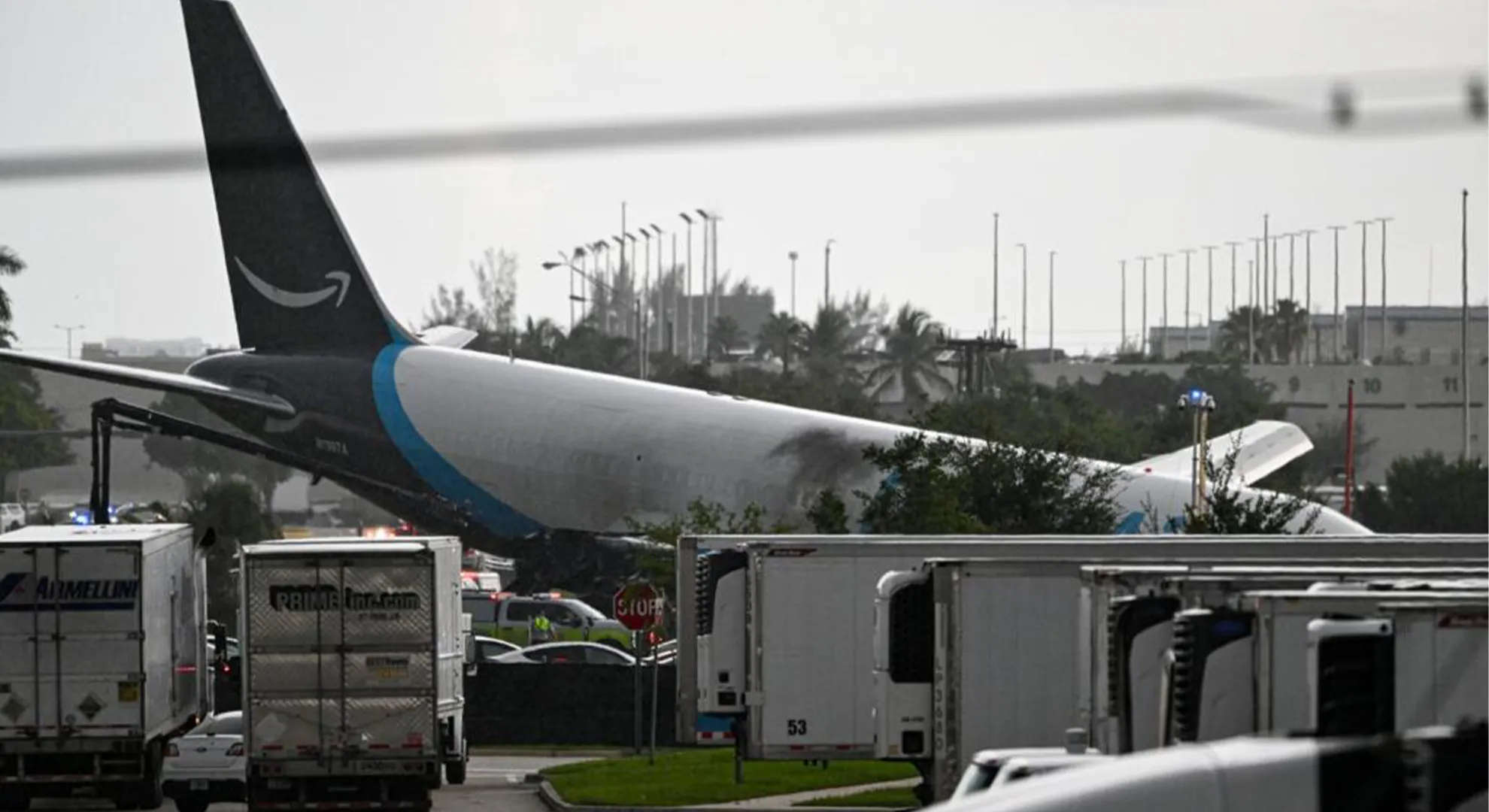
Following the accident, airport authorities temporarily shut down every runway and taxiway. Travellers were also urged to contact their respective airlines on Sunday evening to confirm flight information and operational updates before leaving for the airport, helping them avoid unnecessary delays.
Five Dead After Amazon Cargo Aircraft Runs Off Miami Airport Runway
At least five people have died following a serious aviation accident at Miami International Airport, where an Amazon-operated cargo aircraft reportedly went beyond the runway after landing on Sunday and collided with vehicles before bursting into flames.
Emergency crews were dispatched to the airport after the Boeing 767 cargo aircraft became involved in the crash shortly after arriving from Puerto Rico. The incident triggered a major emergency response involving firefighters, rescue personnel and hazardous-material specialists.
Authorities said several people were trapped as a result of the collision, requiring specialized rescue teams to work at the scene.
Miami-Dade County Fire Rescue Chief Ray Jadallah said five people were confirmed dead following the incident. Three additional victims were taken to trauma centres in critical condition, while two others received treatment at a nearby hospital.
The accident involved not only the aircraft but also vehicles near the runway area. According to Jadallah, the plane struck several vehicles during the incident, leaving some people trapped inside or underneath them.
Rescue workers were required to carry out a complicated extraction operation as they searched the aircraft and surrounding area for survivors.
Major Emergency Operation Underway
The scale of the response reflected the seriousness of the crash.
Miami-Dade Fire Rescue deployed approximately 60 emergency vehicles to the airport, with nearly 200 firefighters and other personnel participating in the operation.
Crews were tasked with several responsibilities at the same time, including fighting the aircraft fire, searching for victims, rescuing people trapped in vehicles and securing the crash site.
Specialized technical rescue personnel were brought in because of the difficult conditions created by the collision.
Fire Chief Jadallah said emergency responders had to conduct a complex extrication operation after people became trapped in vehicles involved in the crash.
Rescuers also carried out a search of the aircraft for the pilot and co-pilot, who were reported to have been trapped inside the plane.
Officials did not immediately provide details about the condition of the flight crew.
During the initial briefing, Jadallah did not confirm whether either the pilot or co-pilot survived the accident. Authorities also declined to take additional questions after providing brief statements about the incident.
The lack of immediate information left several important details about the circumstances surrounding the crash unclear.
Aircraft Arrived From Puerto Rico
The aircraft involved was a Boeing 767 cargo plane operating under Amazon’s Prime Air service.
Flight-tracking information and officials indicated that the aircraft had arrived from San Juan, Puerto Rico.
The cargo flight, identified as Prime Air Flight 7598, reached Miami International Airport at approximately 1:58 p.m. local time.
Shortly after landing, however, the aircraft reportedly failed to remain within the runway area and continued beyond it.
The plane then struck vehicles in the vicinity before the aircraft caught fire.
Videos recorded at the airport showed a large cloud of dark smoke rising from the blue-and-white Boeing 767 as emergency vehicles moved toward the crash site.
Firefighters immediately began working to contain the flames and secure the area.
The dramatic images showed the scale of the response as fire trucks and rescue vehicles converged on the location where the aircraft had come to rest.
Firefighters Battle Aircraft Blaze
The collision was followed by a significant fire involving the aircraft.
Fire officials said the plane caught fire as a result of the crash, prompting firefighters to launch an intensive operation to bring the flames under control.
Crews eventually used firefighting foam to suppress a blaze in the aircraft’s engine compartment.
Because the aircraft was carrying fuel and was damaged during the accident, emergency responders also had to consider the risk of additional fire and hazardous-material exposure.
Specialized HazMat teams were called to the scene to manage those risks.
According to a statement released by Miami-Dade Fire Rescue, hazardous-material personnel helped secure the aircraft’s engine and took steps to control a fuel leak.
The operation was necessary to prevent the damaged aircraft from creating additional dangers for emergency crews and people in the surrounding area.
Firefighters and rescue workers remained focused on both the immediate emergency and the broader safety of the crash site.
Victims Found Around the Crash Site
The collision with vehicles complicated the rescue effort.
Fire officials said one person was discovered trapped beneath one of the vehicles involved in the accident.
Specialized technical rescue personnel were required to free the individual.
The incident therefore involved multiple rescue challenges rather than a straightforward aircraft response.
Emergency workers had to examine the aircraft, search nearby vehicles and navigate the damaged area while simultaneously dealing with fire and leaking fuel.
The rescue effort involved teams with different areas of expertise, including firefighters, technical rescue specialists and hazardous-material crews.
The coordinated response continued as authorities worked to determine the full number of people affected and establish what had happened during the aircraft’s landing.
Investigators Begin Examining the Accident
The cause of the runway excursion had not immediately been established.
Federal aviation authorities and investigators from the National Transportation Safety Board are expected to examine the circumstances surrounding the accident.
The NTSB announced that it had launched a specialized investigative team, commonly referred to as a “go team,” to travel to the site and begin examining the incident.
The investigation is expected to focus on the aircraft’s approach and landing, what happened as it moved along the runway and why it ultimately left the designated runway area.
Investigators will also examine the condition of the aircraft, the runway environment, weather conditions, flight data and other available evidence.
The NTSB and the Federal Aviation Administration will determine the official cause after reviewing the evidence.
Officials have not indicated that a specific cause has been established.
At this stage, authorities are expected to avoid drawing conclusions until investigators have completed their examination.
Amazon Expresses Sympathy
Amazon confirmed that it would cooperate with the investigation.
Company spokesperson Kelly Nantel issued a statement following the crash, expressing sorrow over the loss of life.
The company said it was deeply saddened by the incident and extended its condolences to the families and loved ones of those who died.
Amazon also said it would work with authorities investigating the accident.
The company operates Prime Air as part of its air-cargo network, using aircraft to transport packages between distribution and logistics facilities.
The accident involving one of its cargo aircraft is therefore expected to receive close attention from aviation authorities as investigators work to determine exactly what went wrong.
For those affected, however, the immediate concern remained the victims and their families.
Airport Response
The accident also prompted operational disruption at Miami International Airport.
Following the crash, airport authorities closed runways and taxiways as emergency personnel responded to the scene and began securing the area.
The closures were necessary to allow rescue teams and emergency vehicles to operate safely while investigators and airport officials assessed the situation.
Travellers were advised to check directly with their airlines before making their way to the airport, as the incident could affect flight schedules and airport operations.
The disruption came as authorities dealt with the consequences of the crash and worked to determine when affected areas could safely return to normal use.
Passengers travelling through Miami were therefore encouraged to obtain the latest information from their airlines rather than relying on previously scheduled departure or arrival times.
Questions Surrounding the Landing
The circumstances leading up to the runway excursion remain a central part of the investigation.
The aircraft had completed its journey from San Juan and was attempting to land at Miami International Airport when the incident occurred.
Investigators will now need to establish why the aircraft was unable to stop or remain within the designated runway area.
A runway excursion can occur for a variety of reasons, and officials have not yet said what factors contributed to this particular accident.
Possible areas of examination could include aircraft performance, runway conditions, weather, braking, operational procedures and other circumstances surrounding the landing.
However, investigators will be responsible for determining which factors, if any, played a role.
Authorities have stressed that the official cause will be established through the investigation rather than through early speculation.
Rescue Teams Faced Difficult Conditions
The response at Miami International Airport involved numerous emergency agencies and specialized teams.
Firefighters had to contend with the aircraft fire while technical rescue personnel worked to reach people trapped in vehicles.
At the same time, HazMat specialists addressed the fuel leak and other potential hazards created by the damaged aircraft.
The presence of a large cargo aircraft, damaged vehicles and fire made the scene particularly complex.
Rescue operations had to be conducted carefully to protect emergency personnel while giving them access to victims.
The deployment of dozens of emergency vehicles and hundreds of responders demonstrates the scale of the operation.
Officials said around 60 fire apparatuses were involved, with nearly 200 members of Miami-Dade Fire Rescue responding.
The emergency response continued as crews worked through the wreckage and secured the affected area.
Investigation Expected to Take Time
The NTSB investigation is likely to involve several stages.
Investigators typically examine physical evidence at the crash site, collect information from the aircraft and review available records as part of determining how an accident occurred.
They may also examine flight data, communications, maintenance records and other information relevant to the aircraft’s operation.
Witness accounts and video recordings could provide additional information about the moments immediately before and after the aircraft left the runway.
Authorities may also examine the vehicles that were struck to establish how the collision unfolded and determine the sequence of events.
Because the accident resulted in multiple fatalities and serious injuries, investigators will be expected to conduct a comprehensive review.
The initial investigation may provide information about what happened, while a final report could take significantly longer as officials analyze all available evidence.
Families Face Devastating Loss
The five confirmed deaths have turned what began as a routine cargo flight into a devastating tragedy.
Families and loved ones of those who died are now facing the consequences of the accident, while several other people remain hospitalized with serious injuries.
Three victims were reported to have been transported to trauma centres in critical condition.
Two additional people were treated at a local hospital.
Authorities have not immediately released complete details about the identities of those killed or injured.
Officials are also expected to provide further information as families are notified and investigators establish the full circumstances surrounding the incident.
Focus Turns to Determining What Happened
The immediate emergency response has now been followed by an investigation aimed at answering fundamental questions about the accident.
Authorities need to establish what occurred during the aircraft’s landing, why the plane continued beyond the runway and how it came into contact with nearby vehicles.
The condition of the aircraft and the circumstances surrounding its operation will be examined closely.
Investigators will also look at the response of the flight crew, although officials have not yet provided details about the condition of the pilot and co-pilot.
Until investigators complete their work, authorities have not attributed the crash to any particular factor.
The FAA and NTSB will ultimately be responsible for determining the official cause.
A Tragedy at a Major US Airport
The accident has highlighted the risks involved in aviation operations and the importance of coordinated emergency response at major airports.
Miami International Airport is a major transportation hub, and the incident required airport officials and emergency services to respond rapidly to a complex situation involving an aircraft, vehicles, fire and injured people.
The coordinated deployment of firefighters, technical rescue specialists and HazMat teams allowed emergency personnel to address the various dangers at the site.
As the investigation moves forward, officials will work to establish a detailed timeline of the aircraft’s final approach, landing and subsequent runway excursion.
For now, the focus remains on those who lost their lives, the people who were injured and the families affected by the tragedy.
Amazon has expressed its condolences and pledged to cooperate with investigators, while federal authorities have begun the process of determining exactly what led to the crash.
The coming investigation is expected to provide more answers about the circumstances surrounding Prime Air Flight 7598 and the events that unfolded after the Boeing 767 arrived in Miami from Puerto Rico.
Until those findings are available, officials are urging the public to rely on information released by the relevant authorities and avoid speculation about the cause of the accident.
The crash has left five people dead, several others seriously injured and a major airport temporarily disrupted, with investigators now working to understand how a routine cargo flight ended in a fatal runway accident.
Authorities Respond to Deadly Incident at Miami Airport
Miami authorities described the scene at the international airport as deeply distressing following the serious cargo aircraft accident that left several people dead and others injured.
Miami-Dade County Sheriff Rosie Cordero-Stutz said emergency personnel arriving at the airport were confronted with what she characterized as an extremely tragic situation.
Despite the seriousness of the incident and the scale of the emergency response, the sheriff said there was no indication of an ongoing danger to the wider public.
Her comments came as law enforcement officers, firefighters and other emergency responders worked to secure the area and assist those affected by the crash.
Authorities maintained a significant presence around the airport while rescue and recovery operations continued.
The sheriff’s statement was intended to reassure residents, passengers and members of the public that the accident did not appear to represent a continuing security threat outside the immediate crash area.
Airport Runways and Taxiways Shut Down
The crash caused major disruption to operations at Miami International Airport.
Airport officials temporarily closed all runways and taxiways following the incident as emergency crews responded and authorities assessed the situation.
The closures were necessary to provide emergency responders with sufficient room to work and to prevent regular aircraft and ground traffic from interfering with rescue and safety operations.
The airport later issued guidance to passengers through its website, advising travellers to contact their airlines directly before travelling to the airport.
Passengers were encouraged to confirm the status of their individual flights because the accident had affected normal airport operations.
The advice was particularly important for travellers whose flights were scheduled for Sunday evening, as the airport was dealing with significant operational restrictions.
Rather than assuming that their previously scheduled flight would operate normally, passengers were urged to obtain the latest information from their airlines.
Widespread Flight Disruptions
The airport shutdown resulted in significant disruption for commercial airline passengers.
Flights were held for an extended period while authorities dealt with the aftermath of the accident.
Numerous flights experienced delays, while others were cancelled as airport operations were affected by the emergency response.
The disruption created difficulties for passengers attempting to depart from or arrive at Miami International Airport.
Airlines were required to adjust their schedules as access to runways remained restricted.
For passengers, the situation meant that planned journeys could be delayed or cancelled with little notice.
Travellers were therefore advised to remain in contact with their airlines for updates regarding departures, arrivals, connections and possible changes to their travel plans.
The airport’s recommendation reflected the rapidly changing nature of operations following a major aviation emergency.
Partial Restoration of Airport Operations
After several hours of restricted activity, some airport operations began returning to normal.
The Miami Herald reported on Sunday that two of the airport’s four runways had reopened.
The reopening represented an important step toward restoring normal flight activity, although restrictions remained in place while authorities continued dealing with the aftermath of the crash.
With only part of the airport’s runway capacity available, airlines were still likely to experience delays as aircraft movements were gradually brought back under control.
The reopening of two runways also indicated that authorities had determined that certain parts of the airport could safely resume operations while work continued in other affected areas.
Passengers were still advised to check with their airlines before travelling because the reopening of some runways did not necessarily mean that all scheduled flights would operate without changes.
Emergency Crews Praised for Rapid Response
Local officials praised the first responders who arrived at the airport shortly after the accident.
Miami-Dade Mayor Daniella Levine Cava expressed gratitude to firefighters and other emergency personnel for their immediate actions.
In a statement shared on X, the mayor highlighted the speed with which Miami-Dade Fire Rescue teams reached the crash site.
She said the emergency crews arrived within seconds of the incident, emphasizing how quickly first responders moved into action.
The rapid response was particularly important given the circumstances at the scene, which involved an aircraft accident, fire, injured people and vehicles affected by the collision.
Firefighters and rescue workers had to address multiple challenges simultaneously.
Their responsibilities included dealing with the aircraft fire, searching for people who may have been trapped, providing assistance to injured individuals and securing the surrounding area.
The mayor’s comments recognized the difficult work undertaken by emergency personnel during the initial stages of the incident.
Coordinated Emergency Effort
The response required cooperation among several agencies.
Firefighters, law enforcement officers, technical rescue teams and airport personnel worked together to manage the emergency.
The presence of an aircraft accident on an active airport property created additional complications because responders had to secure the crash area while ensuring that other parts of the airport remained safe.
The initial priority was to protect lives and prevent the situation from becoming more dangerous.
Emergency teams were required to work around damaged vehicles and the aircraft while also dealing with the consequences of the fire.
Law enforcement personnel helped maintain security around the affected area and supported the broader emergency response.
Airport officials, meanwhile, had to make decisions about runway and taxiway closures and communicate operational changes to passengers and airlines.
No Wider Threat Identified
Although the crash resulted in a major emergency, Sheriff Cordero-Stutz said there was no apparent continuing threat to public safety.
That assessment was significant because the airport is a busy transportation hub with large numbers of passengers, employees and visitors.
Authorities were able to distinguish between the serious dangers created by the crash itself and any potential threat to the wider public.
The sheriff’s comments indicated that officials had no immediate reason to believe the incident represented an intentional attack or another ongoing public-security emergency.
The focus therefore remained on rescue, firefighting, recovery and the investigation into what caused the aircraft to leave the runway.
Officials continued to maintain control of the affected area while emergency operations proceeded.
Passengers Asked to Monitor Flight Information
The airport’s guidance to passengers reflected the uncertainty created by the temporary closures.
Travellers were advised not to rely solely on regular schedules and instead contact their airlines directly.
This was particularly important because reopening individual runways does not automatically restore all airport operations.
Airlines may need time to reorganize aircraft, crews and gates following extended periods of disruption.
Passengers whose flights were delayed or cancelled could therefore face further schedule changes even after portions of the airport reopened.
By checking directly with airlines, travellers could obtain more specific information about their individual flights.
The airport also used its website to communicate operational updates as the situation developed.
Gradual Return Toward Normal Operations
The reopening of two runways suggested that Miami International Airport was beginning a gradual return toward normal activity.
However, the recovery process was expected to take time.
Major airport disruptions can have effects beyond the immediate location of an accident.
When flights are delayed or cancelled, aircraft and crews can become displaced from their planned locations, creating additional delays throughout the airline network.
Passengers connecting through Miami could also be affected even if their own flights were not directly connected to the crash.
As a result, the airport and airlines needed to coordinate carefully while restoring operations.
The reopening of part of the runway system allowed some flights to resume, but the airport still faced the challenge of clearing remaining restrictions and managing accumulated traffic.
Officials Thank First Responders
Mayor Levine Cava’s public statement placed particular emphasis on the speed and dedication of emergency workers.
Her appreciation reflected the demanding circumstances faced by the first responders.
Arriving at the scene of an aircraft accident requires emergency crews to act quickly while dealing with potentially dangerous conditions.
Fire, fuel, damaged vehicles and unstable aircraft structures can create serious risks for both victims and rescuers.
In this case, responders also had to determine whether people were trapped and identify the safest way to reach them.
The mayor’s acknowledgement underscored the importance of their immediate intervention.
Their rapid arrival allowed firefighting and rescue operations to begin almost immediately after the accident.
Airport Safety Remained a Priority
Even as authorities worked to restore flight operations, safety remained the primary consideration.
Closing runways and taxiways gave emergency teams the necessary space to operate without interference from regular airport traffic.
It also allowed authorities to examine the affected areas and determine which portions of the airport could safely reopen.
The decision to restore two runways while maintaining restrictions elsewhere demonstrated a gradual approach to reopening.
Rather than returning the entire airport to normal operations at once, authorities could evaluate each area and determine whether it was ready for aircraft movements.
This approach helped balance the need to reduce disruption with the requirement to maintain safety.
Investigation Continues
While airport officials concentrated on restoring operations, investigators were beginning the process of determining what led to the accident.
The cause of the runway excursion had not immediately been established.
Federal aviation investigators are expected to examine the aircraft, flight data and conditions surrounding the landing.
Information from airport systems, witnesses and video recordings may also assist investigators in reconstructing the events.
Authorities are expected to examine the aircraft’s movements before the crash and determine why it continued beyond the runway.
The investigation will ultimately seek to establish the sequence of events and identify any factors that contributed to the accident.
Until that work is completed, officials have not assigned a definitive cause.
Impact on Miami
The incident had an immediate impact on one of the region’s most important transportation hubs.
Miami International Airport handles large numbers of domestic and international travellers, meaning that a major operational interruption can quickly affect thousands of people.
The closure of all runways and taxiways created a significant challenge for airlines and passengers.
The subsequent reopening of two runways provided some relief, but delays and cancellations remained part of the situation as airport operations were gradually restored.
For passengers, the most important advice remained to check directly with their airlines.
The situation demonstrated how quickly an emergency at a major airport can affect a much wider network of travellers.
Community Response
The statements from local officials also reflected the community’s response to the tragedy.
While authorities focused on managing the emergency and ensuring public safety, officials expressed appreciation for the people who responded to the scene.
The speed of the emergency response was particularly significant given the seriousness of the accident.
Firefighters and rescue workers were among the first people to confront the consequences of the crash, working under difficult and potentially hazardous conditions.
Their efforts were essential in dealing with the fire, reaching trapped victims and securing the site.
What Happens Next
As emergency operations transition into investigation and recovery, authorities will continue assessing the airport and the circumstances surrounding the crash.
Investigators will work to determine what happened during the aircraft’s landing and why the plane left the runway.
Airport officials will focus on restoring normal operations as safely and efficiently as possible.
Airlines will also need to manage the effects of the earlier closures, including delays, cancellations and possible aircraft scheduling changes.
Passengers are expected to continue monitoring airline communications while the airport works through the disruption.
The reopening of two runways was an important step, but authorities must still ensure that the remaining affected areas are safe before completely restoring normal operations.
A Rapid Response Amid a Tragic Incident
The deadly accident created a complex emergency at Miami International Airport, bringing together law enforcement, firefighters, rescue specialists and airport officials.
Sheriff Rosie Cordero-Stutz described the scene as tragic but said authorities had found no apparent threat to the broader public.
At the same time, the airport took immediate measures to protect passengers and responders by closing its runways and taxiways.
The resulting flight disruptions affected commercial travellers, with delays and cancellations reported during the day.
Later, the reopening of two of the airport’s four runways offered a sign that operations were beginning to recover.
Throughout the response, local officials highlighted the performance of first responders.
Mayor Daniella Levine Cava specifically praised Miami-Dade Fire Rescue crews for reaching the crash site within seconds.
Their quick arrival allowed emergency operations to begin without delay and played an important role in the effort to manage the consequences of the accident.
As investigators work to establish what caused the aircraft to leave the runway, airport authorities and airlines will continue working to restore regular service.
For passengers, however, the immediate priority remains staying informed and checking directly with their airlines before travelling to Miami International Airport.
The incident has left a significant mark on the airport and the wider Miami community, but the coordinated response from emergency services has helped authorities manage the immediate crisis while the investigation into the accident moves forward.