Dubai’s Beloved Toyota Landmark Faces Demolition, While Its Famous Sign Is Set to Remain as a Special Final Moment Is Planned Before the Iconic Building Disappears
Dubai’s Famous Toyota Building Set for Change, but Its Iconic Sign Will Remain and a Final Surprise Awaits.
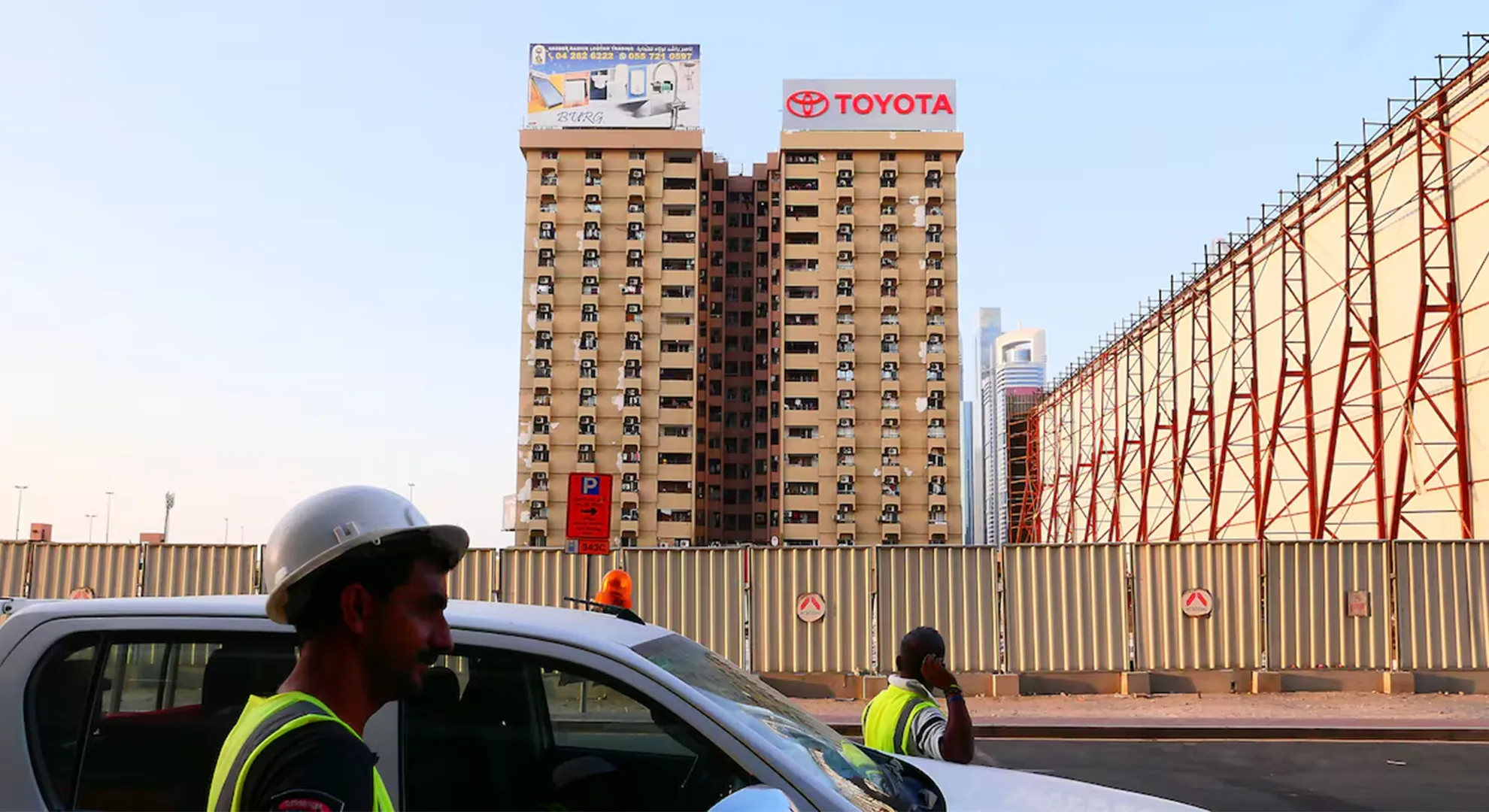
The well-known 15-floor building along Sheikh Zayed Road will soon be demolished, while residents and tenants are gradually vacating the property as preparations for its removal continue.
The story of one of Dubai’s most recognisable roadside landmarks is approaching a major turning point. The Toyota Building on Sheikh Zayed Road is expected to disappear from the city’s skyline, but the feature that made the structure famous may have a future beyond the building itself.
The 15-storey property, officially known as the Nasser Rashid Lootah Building, has been a familiar part of Dubai for decades. Although the building dates back to 1974, its identity became closely connected with the huge Toyota sign positioned on its rooftop. Over the years, the sign became so recognisable that many residents knew the property simply as the “Toyota Building”.
Now, as preparations continue for the building’s eventual demolition, Al Futtaim Toyota has indicated that the famous sign will not simply vanish with the structure.
The company plans to preserve the legacy of the Toyota branding associated with the landmark and is expected to reveal more about its plans in the coming months. The announcement offers a sense of continuity for residents who have watched the building remain a familiar reference point through several decades of Dubai’s extraordinary development.
A familiar sight on Sheikh Zayed Road
For longtime residents, the Toyota Building represents an earlier chapter in Dubai’s history.
When the structure was completed in 1974, the landscape along Sheikh Zayed Road looked dramatically different from the modern skyline that surrounds it today. The road would eventually become one of the most recognisable urban corridors in the region, lined with high-rise towers, hotels, offices and major developments.
The Toyota Building predates much of that transformation.
Its relatively modest height became increasingly noticeable as taller buildings began appearing around it. As Dubai expanded upwards, the older structure remained in place, creating a visual link between the city’s earlier years and its modern era.
The large Toyota sign on the roof added another layer to its identity. Rather than being remembered primarily by its official name, the building became known to residents and motorists by the company name displayed above it.
For generations, the sign became an easy reference point for people navigating Sheikh Zayed Road. It was not simply an advertisement; over time, it became part of the visual vocabulary of Dubai.
The building’s official identity
Despite its popular nickname, the property’s official name is the Nasser Rashid Lootah Building.
Constructed in 1974, the 15-storey building has stood through decades of rapid urban expansion. During that time, Dubai changed from a developing city into a global destination known for its distinctive skyline and ambitious infrastructure.
The building witnessed many of those changes from its position along Sheikh Zayed Road.
New towers appeared around it, roads became busier, and the city’s skyline grew increasingly dense. Yet the Toyota sign remained a constant visual feature.
That continuity helped turn the building into a nostalgic symbol for residents who remember an earlier version of Dubai.
Tenants begin moving out
The building’s next chapter is now coming to an end, with tenants gradually leaving the property.
The move-out process is taking place in phases as preparations continue for the eventual demolition of the structure. However, there is currently no specific date for when the demolition will take place.
A representative from the building’s real estate department previously indicated that no fixed timeline had been established.
This means the building may remain standing for some time, even as its tenants leave and preparations for its eventual removal continue.
For residents and motorists familiar with the landmark, that period creates an unusual situation. The building is still visible, but its future has already been decided.
Its disappearance will mark another significant change to a road corridor that has undergone enormous redevelopment over the years.
The Toyota sign will have a future
While the building itself is heading towards demolition, the Toyota sign is expected to have a very different fate.
Al Futtaim Toyota has confirmed that it intends to continue the legacy of the famous sign after the Nasser Rashid Lootah Building is removed.
The company’s Managing Director, Jacques Brent, described the news as bittersweet. The end of the building represents the closing of an important chapter, but the company also sees an opportunity to create something new at the prominent location.
According to Brent, Dubai’s constantly changing nature means that landmarks cannot remain unchanged forever. The city is continually replacing older structures with new developments, and the Toyota Building is now becoming part of that cycle.
However, the company does not view the demolition as the end of the Toyota sign’s story.
Instead, plans are being developed to carry its legacy forward, with further details expected to be announced in the coming months.
More than just a commercial sign
The continued interest in the Toyota sign reflects how certain commercial symbols can become closely connected with the identity of a city.
For many Dubai residents, the giant Toyota logo was not simply an advertisement placed on top of a building. It became part of the cityscape and a reference point that people recognised almost instinctively.
Over several decades, thousands of motorists travelled along Sheikh Zayed Road beneath the sign. People used the building to describe locations, give directions or identify their surroundings.
Its importance grew as Dubai’s skyline changed around it.
New skyscrapers may have been taller and more architecturally striking, but the Toyota Building retained a different kind of significance. It represented familiarity.
In a rapidly changing city, familiar landmarks can become especially valuable because they provide a connection to places and memories from earlier periods.
A changing Sheikh Zayed Road
The future of the Toyota Building also reflects the broader transformation of Sheikh Zayed Road.
The road is now synonymous with Dubai’s modern skyline. Towering structures dominate the horizon, and the corridor has become a major route connecting different parts of the city.
But the landscape was once much less developed.
The Toyota Building was constructed during an era when Dubai’s urban environment was still taking shape. Over the following decades, the city expanded at a remarkable pace, and Sheikh Zayed Road became one of the central areas of that transformation.
The contrast between the old building and the skyscrapers surrounding it became increasingly striking.
For longtime residents, seeing the Toyota Building remain among the newer towers was itself a reminder of how much the city had changed.
Its eventual demolition will remove one of the remaining physical links to that earlier landscape.
A final surprise before the farewell
Although the building’s future may already be known, residents have been given another reason to keep watching the landmark.
Brent has hinted that Al Futtaim Toyota has something special planned before the building disappears.
The company has described it as a final surprise and suggested that people will recognise it when it happens.
No further details have been disclosed, leaving residents to wait and see what will happen during the building’s final days.
The tease adds another element to the story of a landmark that has already attracted considerable public attention.
Rather than allowing the building to quietly disappear, the company appears to be planning a final moment that acknowledges its importance and the memories associated with it.
A farewell to an old Dubai
The demolition of the Toyota Building is likely to generate nostalgia among residents who remember Dubai before the skyline became dominated by modern skyscrapers.
For some, the building may be associated with daily journeys along Sheikh Zayed Road. For others, it could bring back memories of a period when the city had fewer high-rise developments and familiar roadside landmarks played a bigger role in navigation.
Its significance is not necessarily connected to architectural grandeur. Instead, it comes from familiarity and longevity.
The structure has been present for more than five decades, meaning several generations have grown up seeing the Toyota sign above it.
That long association has transformed an ordinary commercial building into a recognisable piece of Dubai’s visual history.
The city continues to evolve
Dubai’s rapid development has meant that many older buildings and landmarks have eventually made way for new projects.
Roads have been redesigned, neighbourhoods have been redeveloped and older structures have been replaced by larger or more modern developments.
The Toyota Building is now part of that continuing process.
Its demolition does not mean the memories attached to it will disappear. Photographs, stories and personal recollections will continue to preserve its place in the city’s history.
The decision to continue the Toyota sign’s legacy also offers a connection between Dubai’s past and its future.
While the original building may no longer exist, the symbol that made it famous could continue to remind residents of the landmark that once stood beneath it.
What happens next?
For now, the focus remains on the gradual departure of tenants and the eventual removal of the building.
There is no confirmed demolition date, so the landmark remains visible along Sheikh Zayed Road.
Meanwhile, anticipation is growing over what Al Futtaim Toyota has planned for the famous sign and the promised final surprise.
The company is expected to reveal more information in the months ahead.
Until then, residents who have a special connection with the building still have an opportunity to see it in its familiar form.
Its future may be uncertain in terms of timing, but its place in Dubai’s history is firmly established.
An iconic sign lives on
The Toyota Building may soon become another vanished landmark from Dubai’s rapidly changing landscape, but its most recognisable feature is not expected to disappear with it.
The famous Toyota sign has become part of the memories of countless residents and motorists, and plans to carry its legacy forward mean that its story will continue in some form.
For a city known for constantly reinventing itself, the transition is fitting. An old landmark is making way for what comes next, while an instantly recognisable symbol is being given the opportunity to continue into the future.
As the final chapter approaches, the Toyota Building stands as a reminder of how dramatically Dubai has evolved since the 1970s. Its presence has survived the arrival of countless skyscrapers and major infrastructure projects, but the city’s next phase of development will eventually bring the building down.
What remains, however, may be just as meaningful: the memories of the landmark, the famous Toyota sign and one final surprise before the farewell.
For longtime residents, that final moment could provide a fitting tribute to a building that became far more than its official name suggested. It became a piece of Dubai’s identity, recognised by a nickname that eventually became more famous than the name on its official records.
Al Futtaim Toyota has confirmed that the future of the famous Toyota sign is still being worked out. The company has not yet revealed whether the giant red-and-white display will be moved to another location, installed somewhere else in Dubai or retained as a piece of the city’s heritage.
For now, those details remain undecided. What is clear, however, is that the sign has become much more than a conventional advertisement. Over the decades, it developed a strong connection with Dubai residents and became one of the visual features people associated with an earlier version of the city.
From advertising display to iconic Dubai landmark
The story of the Toyota sign began in 1981, when it was installed on the roof of the Nasser Rashid Lootah Building along Sheikh Zayed Road.
Dubai at the time bore little resemblance to the city people know today. Sheikh Zayed Road had not yet developed into the spectacular corridor of skyscrapers, hotels and commercial towers that now defines much of the city’s skyline.
The area was considerably less built-up, and only a relatively small number of tall buildings stood out along the road. The surroundings were associated with Defence Roundabout, which served as an important reference point for people travelling through the area.
Against this developing urban backdrop, the bright Toyota sign immediately stood out.
Its large red-and-white design made it easy to spot from a considerable distance. As Dubai expanded and the number of buildings around it increased, the sign continued to attract attention.
Over time, its visibility gave the building a new identity in the minds of residents.
Although the property was officially known as the Nasser Rashid Lootah Building, many people stopped using its formal name. Instead, they simply referred to it as the “Toyota Building”.
The nickname became so widespread that the advertising sign effectively gave the entire property its most recognisable identity.
A landmark without a Toyota showroom
One of the more interesting aspects of the building’s history is that there was no Toyota showroom or service centre inside the property.
The building became associated with the automotive brand because of the enormous sign displayed above it rather than because the building itself housed a Toyota dealership.
That distinction did little to weaken the connection.
For people travelling along Sheikh Zayed Road, the Toyota branding became a convenient visual marker. The sign was easy to recognise, and its location helped residents identify where they were in relation to other parts of the city.
As Dubai continued to develop, that practical function gradually became part of the building’s cultural significance.
The Toyota sign was not designed to become a historic landmark. It began life as advertising, but decades of familiarity transformed it into something much more personal for many residents.
People associated it with daily commutes, road trips, family journeys and the changing appearance of Dubai.
A symbol of Dubai’s rapid transformation
The Toyota Building witnessed an extraordinary period of urban growth.
When the sign was first installed in 1981, Dubai’s skyline was still relatively modest. In the years that followed, new roads were constructed, neighbourhoods expanded and increasingly ambitious towers began appearing across the city.
Sheikh Zayed Road became one of the clearest examples of that transformation.
The road evolved into a major artery connecting different parts of Dubai, while the skyline around it became increasingly dominated by high-rise architecture.
The Toyota Building remained in place through these changes.
Its height and appearance may not have matched the spectacular skyscrapers that eventually surrounded it, but its continued presence gave residents a familiar point of reference.
In a city where the physical environment was changing at remarkable speed, the Toyota sign remained remarkably constant.
That consistency helped strengthen its status as a landmark.
The sign disappears, but the memory remains
The Toyota billboard remained on the building for almost four decades.
Then, in 2018, it was taken down after the advertising agreement came to an end.
The removal marked a noticeable change for people accustomed to seeing the sign along Sheikh Zayed Road.
However, removing the physical sign did not remove the association between Toyota and the building.
The nickname “Toyota Building” had already become firmly established in Dubai’s popular vocabulary.
Even without the billboard, residents continued to recognise the property by the name that had become part of its identity.
The building therefore demonstrated how a landmark can become embedded in public memory even after its most recognisable feature has disappeared.
A return prompted by nostalgia
Four years after the sign was removed, it returned.
In 2022, Al Futtaim Toyota reinstated the familiar billboard, saying the decision was influenced by strong public demand.
Its return generated considerable nostalgia among Dubai residents.
For people who remembered the sign from earlier decades, seeing it once again above the building recreated a familiar part of the city’s skyline.
The decision was presented not simply as a commercial move but as a gesture towards the community and the memories associated with the landmark.
Jacques Brent, Managing Director of Al Futtaim Toyota, said the company recognised the emotional connection many residents had with the billboard.
Bringing it back allowed people to see a familiar feature once again after several years of absence.
The reinstatement also demonstrated how deeply the sign had become connected with Dubai’s identity.
A piece of advertising that had originally been installed in 1981 had eventually become something residents actively wanted to see return.
A reminder of old Dubai
The reappearance of the billboard in 2022 was particularly significant because the landscape surrounding the building had changed so dramatically.
The Toyota Building was no longer standing in a relatively open environment.
Instead, it was surrounded by the modern towers and infrastructure that had emerged during Dubai’s rapid expansion.
This contrast made the building even more noticeable.
For some residents, the structure represented a surviving piece of the city they remembered from earlier decades. It offered a visual connection to a period before Dubai’s skyline became internationally famous.
As towers continued to rise around it, the Toyota Building remained a familiar reminder of what had come before.
The sign therefore became associated not only with Toyota but also with the memories of an older Dubai.
More than a roadside advertisement
The significance of the Toyota sign can be understood through the memories of people who lived in Dubai before smartphones and digital navigation became part of everyday life.
Today, residents can use GPS applications, digital maps and location-sharing tools to find almost any address.
That was not always the case.
Before these technologies became widespread, people relied heavily on prominent buildings, roundabouts, roads and other visual landmarks when navigating the city.
The Toyota Building was one of those landmarks.
Its distinctive sign made it easy to identify, allowing residents to use it when describing locations or providing directions.
For someone unfamiliar with a particular street, being told to look for the Toyota Building could provide a simple and practical way to orient themselves.
‘Before GPS and Google Maps’
According to Al Futtaim Toyota, conversations with longtime Dubai residents revealed how important landmarks such as the Toyota Building once were for navigation.
The company found that older landmarks had become closely linked with people’s personal memories of the city.
Before digital maps, location pins and navigation applications became commonplace, prominent structures effectively acted as informal addresses.
The Toyota Building was one such reference point.
The World Trade Centre served a similar purpose, providing residents with an easily recognised feature that could be used when giving directions.
These landmarks were particularly useful in a city undergoing rapid development, where roads and neighbourhoods were continually changing.
A large and recognisable building could provide a sense of stability even as the surrounding landscape evolved.
A personal connection for longtime residents
The importance of the Toyota Building extends beyond its physical appearance.
For people who have lived in Dubai for decades, seeing the sign may immediately bring back memories of earlier stages of their lives.
It could remind someone of a first job in the city, a family journey, a former home or a familiar daily commute.
That emotional connection is one reason why the building’s possible demolition has generated nostalgia.
The landmark became part of people’s personal maps of Dubai.
Its significance was not necessarily the same for everyone, but its familiarity created a shared connection among generations of residents.
From an older skyline to a modern one
Today, the Toyota Building is surrounded by some of Dubai’s most recognisable modern landmarks.
The Burj Khalifa, Emirates Towers and Museum of the Future represent very different eras of the city’s architectural development.
The Toyota Building belongs to an earlier chapter.
Its continued presence among these newer structures creates a striking visual comparison between Dubai’s past and present.
The contrast also highlights the speed at which the city has developed.
A building that was once among the taller structures in its surroundings eventually became one of the older and smaller landmarks beside much larger developments.
Yet it retained its recognisability because of the Toyota sign.
Preserving a piece of visual heritage
With the building now approaching demolition, the question of what happens to the sign has become increasingly important.
Al Futtaim Toyota has made it clear that it wants the legacy of the billboard to continue, although the exact form that continuation will take has not yet been announced.
Whether the sign eventually appears at another location, becomes part of a heritage display or is preserved in another way remains to be seen.
The company has not disclosed a final plan.
Whatever happens, the decision reflects the recognition that the sign has acquired historical value beyond its original advertising purpose.
Its story is now connected with Dubai’s development, changing skyline and the memories of the people who have lived through those changes.
A landmark that survived decades of change
The Toyota Building has remained standing through some of the most dramatic periods of Dubai’s transformation.
It witnessed the expansion of Sheikh Zayed Road, the construction of countless towers and the emergence of a skyline that became famous around the world.
Throughout those changes, the Toyota sign provided a familiar constant.
Even when the billboard disappeared in 2018, the building retained its popular identity.
When the sign returned in 2022, it was welcomed by residents who remembered what it represented.
Now the building itself is expected to disappear, bringing another chapter to a close.
The legacy continues
Although the physical future of the Toyota Building is uncertain, its historical importance is unlikely to disappear.
The structure has become part of the story of Dubai’s transformation from a developing city into a global metropolis.
The Toyota sign played a surprisingly important role in that story.
It began as a large commercial display but gradually became a navigation point, a visual reference and ultimately a nostalgic symbol for many residents.
Its association with Dubai has lasted for more than four decades.
As the city continues to develop, new landmarks will inevitably emerge and older ones will disappear. Yet places that become part of people’s memories can remain meaningful long after the physical structures are gone.
The Toyota Building is a clear example of that process.
Looking ahead
For now, Al Futtaim Toyota has not confirmed exactly where the famous sign will go or how it will be preserved.
The company has indicated that plans are still being finalised, leaving residents waiting for the next announcement.
Whatever form the future takes, the Toyota sign has already secured its place in Dubai’s visual history.
From its installation in 1981 to its removal in 2018, its return in 2022 and the expected demolition of the building, the landmark has followed the city through several generations of change.
Its story is ultimately a story about more than a logo on a rooftop. It is about familiarity, memory and the way ordinary features of a city can become meaningful through time.
For longtime residents, the Toyota Building was a point on the road, a way to give directions and a familiar sight on the journey home.
For the city itself, it became a visual reminder of an earlier Dubai.
And even when the building eventually disappears, the memories attached to the famous Toyota sign are likely to remain.