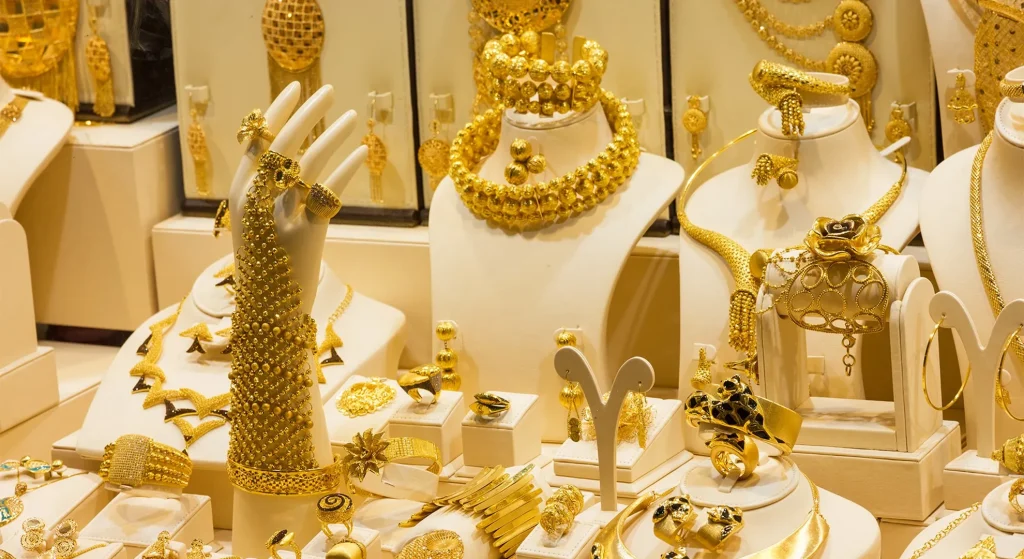
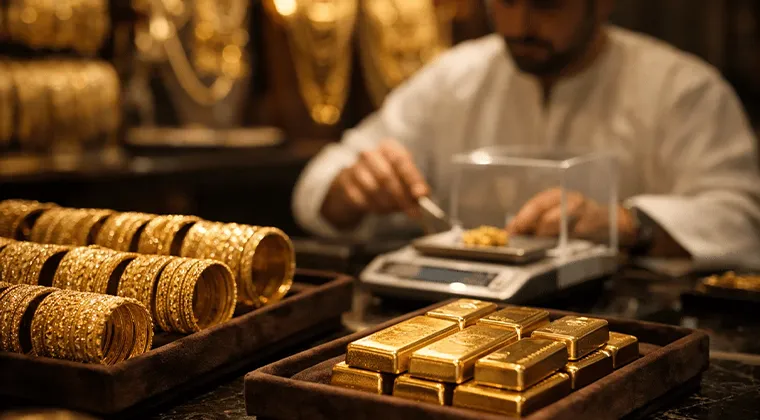
Gold prices are still under downward pressure, and in Dubai the 22-karat gold rate remains below Dh500, showing limited upward movement despite ongoing market fluctuations and global economic influences.
Gold prices continue to face pressure, with 22K gold still trading below Dh500 in Dubai..
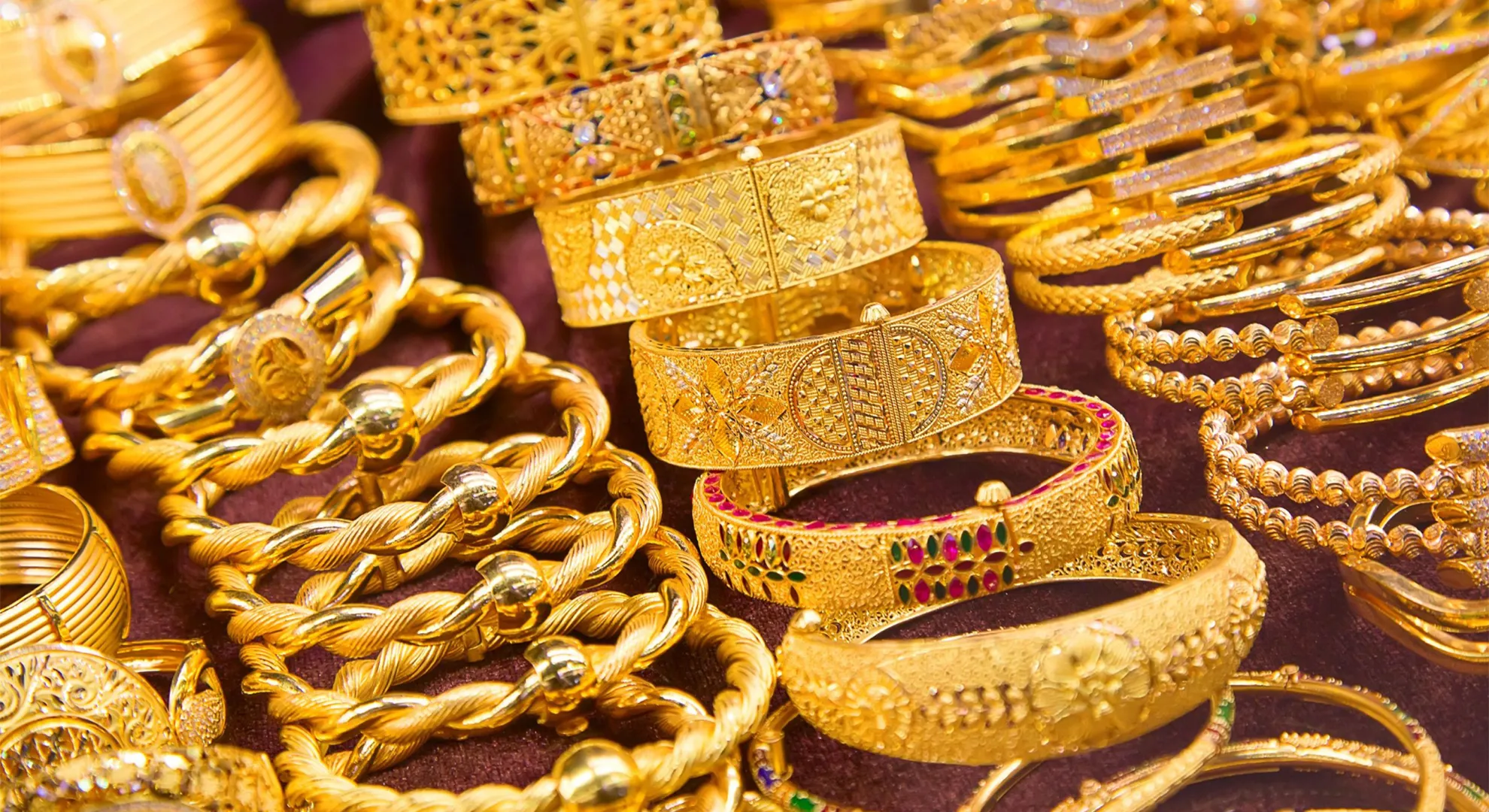
Gold markets in Dubai started Friday on a softer note, with prices continuing to face downward pressure amid global uncertainty. The 22-karat gold rate, closely watched by local buyers and traders, remained below the Dh500 mark per gram, reflecting cautious sentiment in the regional bullion market.
In broader trading, the 24-karat gold segment also recorded a decline, slipping to Dh534.75 per gram compared with the previous day’s closing level of Dh538.5. This represents a drop of Dh3.75, indicating that the metal has struggled to maintain momentum after recent fluctuations in international markets. Traders noted that despite occasional rebounds, selling pressure has largely dominated short-term movement.
Other commonly traded gold categories in the Dubai market followed a similar downward trajectory. The 22K variant was priced at Dh495.25 per gram, while 21K gold stood at Dh474.75. Meanwhile, 18K gold was recorded at Dh407 per gram, and 14K gold declined to Dh317.5 per gram. The consistent easing across all purities suggests that the weakness is not isolated to a single segment but rather reflects a broader trend affecting the precious metal complex.
On the international front, spot gold was trading at $4,448 per ounce, marking a 0.6 percent decline. This movement puts the metal on track for a weekly loss, driven by a combination of geopolitical concerns in the Middle East and growing speculation around future US monetary policy decisions. Investors appear to be balancing safe-haven demand against expectations of tighter financial conditions in the United States.
Market sentiment has been shaped heavily by global risk factors. Escalating tensions in parts of the Middle East have traditionally supported gold as a safe-haven asset. However, in the current environment, that support has been partially offset by concerns that the US Federal Reserve may maintain higher interest rates for longer than previously expected. Higher rates typically reduce the appeal of non-yielding assets like gold, leading to subdued investor demand.
Silver also mirrored gold’s weakness, falling by 1.35 percent to $72.78 per ounce. The decline in silver reflects similar macroeconomic pressures, including uncertainty in global growth prospects and shifting expectations around interest rate movements. Industrial demand concerns have also added to the softness in silver prices, given its dual role as both a precious and industrial metal.
Commenting on recent market behavior, Tony Sage, Chief Executive Officer of Critical Metals, observed that gold had experienced a modest rise on Thursday. He attributed this brief upward movement to a slight easing in the US dollar and a minor dip in government bond yields. According to him, these short-term shifts provided temporary support to bullion, as a weaker dollar generally makes gold more attractive to investors holding other currencies.
However, analysts suggest that this support has not been strong enough to reverse the broader trend. The overall direction of the market continues to be influenced by a complex mix of geopolitical developments, macroeconomic indicators, and investor expectations regarding central bank policy. As a result, price movements remain volatile, with frequent fluctuations rather than a clear upward or downward trend.
Looking ahead, market participants are expected to closely monitor developments in the Middle East, where geopolitical tensions continue to influence global risk sentiment. Any escalation or easing in the region could have a direct impact on safe-haven demand for gold. At the same time, attention is turning toward upcoming US employment data, which is likely to provide fresh clues about the strength of the American economy and the future direction of interest rates.
Stronger-than-expected job numbers could reinforce the case for maintaining higher interest rates, which may weigh further on gold prices. On the other hand, weaker employment data could revive expectations of policy easing, potentially offering some support to the precious metal.
In Dubai’s retail market, jewellers and traders are also keeping a close watch on these global cues, as local prices tend to adjust quickly in response to international movements. Demand from consumers, particularly in the jewellery segment, is also expected to remain sensitive to price levels, especially with gold still trading near elevated historical ranges despite recent corrections.
Overall, the current environment reflects a delicate balance between supportive geopolitical risks and restrictive monetary policy expectations. While gold continues to serve as a hedge against uncertainty, its upside appears limited in the near term unless there is a significant shift in global economic or political conditions.
The metal continued to trade near its recent lows as market participants weighed the uncertainty surrounding global monetary policy against fast-changing geopolitical developments in the Middle East. While tensions across the region remain elevated, there have been tentative signs of diplomatic movement that some investors interpret as a potential step toward longer-term stability.
Recent discussions and easing diplomatic signals, including a reported ceasefire arrangement between Israel and Lebanon, have added a layer of cautious optimism to an otherwise fragile situation. In addition, increasing political pressure within the United States to avoid deeper military engagement in the region has also contributed to expectations that the geopolitical risk premium could gradually ease if such trends persist.
According to Tony Sage, Chief Executive Officer of Critical Metals, these developments may eventually reduce some of the upward pressure typically seen in safe-haven assets like gold. However, he noted that markets are still far from pricing in any lasting resolution, meaning uncertainty continues to play a central role in shaping investor behavior.
At the same time, Sage pointed out that as long as regional tensions remain unresolved, investors are likely to stay highly attentive to how these developments feed into broader economic variables, particularly energy prices, inflation expectations, and central bank policy decisions. In his view, the interaction between geopolitical risk and macroeconomic indicators remains one of the most important drivers of sentiment in the current environment.
One of the key concerns highlighted is the effect of elevated oil prices. Higher energy costs tend to filter through the global economy, increasing inflationary pressures and complicating the decision-making process for central banks. If inflation remains sticky due to sustained energy price strength, major monetary authorities such as the US Federal Reserve may be compelled to maintain a more restrictive policy stance for a longer period than previously anticipated.
Sage explained that this scenario can create headwinds for gold, as higher interest rates generally reduce the attractiveness of non-yielding assets. When returns on bonds and other fixed-income instruments remain elevated, investors often shift capital away from precious metals, leading to increased selling pressure in the gold market.
Despite these short-term challenges, market observers continue to emphasize that the outlook for gold is shaped by multiple competing forces rather than a single dominant factor. On one hand, restrictive monetary policy and stronger energy-driven inflation concerns weigh on prices. On the other hand, geopolitical uncertainty and central bank buying activity continue to provide important structural support.
Looking ahead, analysts believe that attention in the coming weeks will remain firmly focused on two major drivers: ongoing geopolitical developments and upcoming economic data releases from the United States, particularly employment figures. These indicators are expected to play a crucial role in shaping expectations around interest rate direction and the broader policy outlook.
Stronger labour market data would likely reinforce the case for keeping interest rates higher for longer, which could further limit upside potential for gold. Conversely, weaker employment figures could revive expectations of policy easing in the medium term, potentially offering renewed support for bullion prices.
In addition to macroeconomic data, traders are also closely monitoring central bank activity around the world. Continued gold purchases by central banks, particularly from emerging markets, remain an important pillar of demand. This steady accumulation is seen as a long-term stabilizing factor, helping to cushion the market during periods of volatility and offset some of the pressure created by speculative trading flows.
Overall, while short-term headwinds remain firmly in place due to monetary policy uncertainty and fluctuating geopolitical risks, the broader outlook for gold continues to be shaped by a complex balance between demand drivers and macroeconomic constraints.