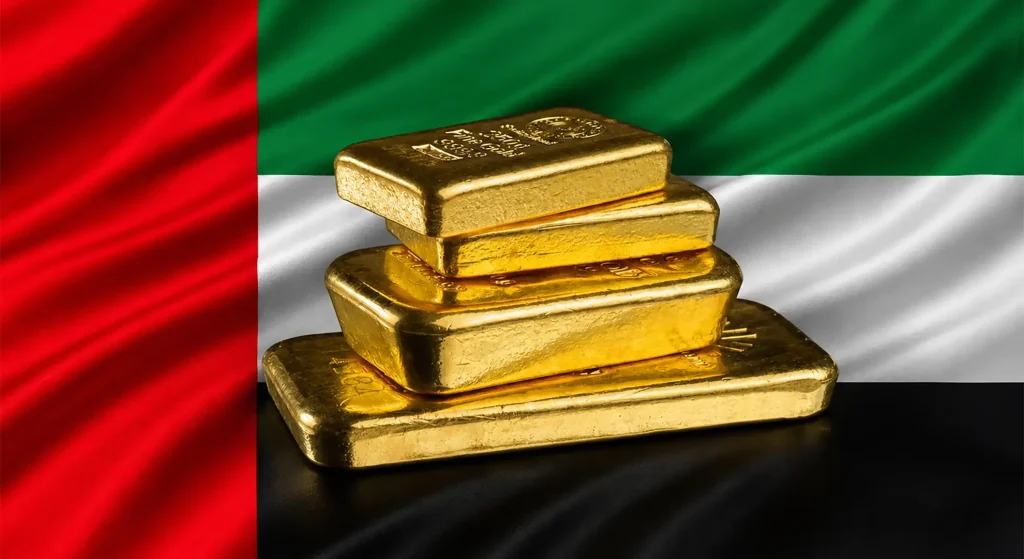
Gold prices climbed by more than Dh6 per gram as renewed optimism over a possible US–Iran peace agreement improved investor sentiment and influenced movements in the global bullion market.
Gold rates rise above Dh6 per gram on renewed US–Iran peace hopes.
Investors across global markets are currently exercising heightened caution as they closely monitor political developments in the Middle East, a region that continues to play a crucial role in shaping global risk sentiment and influencing commodity prices. Uncertainty surrounding diplomatic relations, particularly involving the United States and Iran, has recently become a key factor driving movements in precious metals markets.
On Monday morning, gold prices in Dubai recorded a notable upward movement, rising by approximately Dh6.5 per gram during early trading hours. This increase came as bullion markets reacted positively to growing expectations that progress could be made toward a potential peace agreement between the United States and Iran. Such geopolitical developments often lead investors to turn toward safe-haven assets like gold, contributing to price gains.
At the opening of the trading session, the price of 24-karat gold in Dubai was reported at Dh549.75 per gram. This marked an increase from the previous closing level of Dh543.25 per gram recorded at the end of the last trading week. The rise reflects a broader upward trend in the precious metals market, driven by international cues and investor sentiment influenced by geopolitical optimism.
Other categories of gold also experienced similar upward adjustments. The price of 22-karat gold increased by around Dh6 per gram, reaching Dh609.25 per gram. Meanwhile, additional purities of gold followed the same positive trajectory, with 18-karat gold opening at approximately Dh418.5 per gram and 14-karat gold trading at about Dh326.5 per gram. These consistent increases across various purity levels highlight a uniform market response to global developments affecting demand for the metal.
In the international commodities market, spot gold also showed strength, trading around 0.5 percent higher at $4,565.24 per ounce. This rise aligns with investor expectations that geopolitical tensions, even when accompanied by peace negotiations, can create volatility that benefits safe-haven assets. Gold, traditionally viewed as a store of value during uncertain times, tends to attract increased buying interest when global political risks are in focus.
Silver, another key precious metal often influenced by similar market forces, also recorded gains during the same period. It increased by approximately 1.5 percent, reaching $285.86 per ounce. The movement in silver prices further reflects broader strength in the precious metals sector, as both industrial demand and investment sentiment contribute to its valuation.
Market analysts suggest that the current price movements are largely driven by speculation surrounding diplomatic discussions between Washington and Tehran. Any indication of easing tensions in the Middle East can have a ripple effect on financial markets, particularly commodities like gold and silver, which are highly sensitive to geopolitical risk.
In addition, traders are carefully assessing how potential changes in international relations might affect global inflation expectations, interest rate outlooks, and currency fluctuations. These macroeconomic factors often intersect with geopolitical developments, amplifying price volatility in precious metals markets.
Overall, the recent rise in gold and silver prices reflects a combination of geopolitical optimism, investor caution, and global market sensitivity to developments in the Middle East. While the situation remains fluid, market participants continue to closely watch further updates that could influence the direction of bullion prices in the coming days.
Simon-Peter Massabni, who serves as head of business development at XS.com, highlighted that gold is currently going through a particularly delicate phase, one that stands out as one of the most complex periods seen so far this year. According to his assessment, the movement in gold prices is no longer being driven only by traditional market forces such as inflation expectations or interest rate outlooks, but increasingly by broader global anxieties that are rooted in geopolitics and macroeconomic uncertainty.
He emphasized that the behaviour of gold in recent weeks reflects a deeper transformation in how investors perceive the metal. Rather than viewing it purely as a commodity or an inflation hedge, market participants are now treating gold as a kind of real-time indicator of global tension. In other words, its price fluctuations are increasingly seen as a mirror of investor fear, uncertainty, and shifting confidence in international stability.
In this context, he pointed out that the recent upward movement in gold at the start of the trading week is particularly significant. The metal opened with a noticeable price gap above the $4,550 mark, which he interprets as a clear signal that investors remain highly sensitive to ongoing political developments, especially those unfolding in the Middle East. This kind of price gap, in his view, is not just a technical market event but also a reflection of strong underlying sentiment that is being shaped by global news flow.
He further explained that market participants are approaching these developments with a high degree of caution. The geopolitical situation, particularly discussions and negotiations between the United States and Iran, has become one of the central themes influencing investor decision-making. Even small signals related to diplomatic progress or setbacks tend to have an immediate impact on risk appetite across global financial markets.
According to his analysis, these negotiations are not isolated events, but rather part of a wider geopolitical framework that affects multiple asset classes simultaneously. Gold, in particular, reacts quickly because it is widely considered a safe-haven asset. Whenever uncertainty rises, investors tend to move capital away from higher-risk investments and into assets perceived as more stable, and gold has historically played that role.
He also noted that the influence of these political developments extends beyond the precious metals market alone. Energy markets, foreign exchange movements, and broader commodity trends are all being affected at the same time. This interconnectedness means that a single geopolitical headline can ripple across multiple sectors, amplifying volatility and making short-term price movements more unpredictable.
Massabni stressed that what makes the current environment especially unique is the way different types of risks are overlapping. It is not just geopolitical tension on its own, but also the presence of economic uncertainty globally, including concerns about growth, monetary policy direction, and inflation persistence. When these factors combine, they tend to reinforce each other, leading to stronger reactions in assets like gold.
He suggested that investors are essentially pricing in multiple layers of uncertainty at once. On one level, there is concern about political stability in key regions such as the Middle East. On another level, there are broader questions about global economic direction, including how central banks will respond to changing conditions. Together, these elements are creating an environment where caution dominates market behaviour.
The XS.com executive also pointed out that gold’s recent upward gap is a reflection of positioning in the market. Traders and institutional investors appear to be adjusting their portfolios in anticipation of possible developments in the US–Iran dialogue. Even without a concrete outcome, the expectation of movement in either direction is enough to influence trading strategies and risk management decisions.
He explained that in such environments, gold tends to respond not only to actual events but also to expectations and speculation. This makes the market particularly sensitive, as sentiment alone can drive price changes even before any formal policy or diplomatic shift occurs. As a result, gold becomes a forward-looking indicator of global stress levels.
Furthermore, he described the current phase as one in which emotional factors in trading are playing a larger-than-usual role. Fear of escalation, hope for diplomatic resolution, and uncertainty about the timing and outcome of negotiations are all contributing to rapid shifts in sentiment. These emotional drivers, when combined with algorithmic trading systems and high-frequency responses, can intensify price swings in both directions.
He added that the reaction in gold also reflects broader concerns about energy markets. Since geopolitical developments in the Middle East are often closely linked to oil supply expectations, any potential disruption or easing of tensions can affect crude oil pricing. These changes then feed back into inflation expectations, which in turn influence gold demand, creating a complex chain reaction across markets.
Currency markets are also part of this dynamic. Fluctuations in the US dollar, which often move inversely to gold prices, are being closely watched by investors. Any indication of policy shifts or geopolitical stress can lead to rapid changes in currency valuation, further influencing the attractiveness of gold as an alternative store of value.
Massabni’s overall view suggests that gold is currently functioning less as a passive investment asset and more as an active barometer of global uncertainty. Each movement in price is being interpreted in relation to broader developments, rather than isolated supply and demand factors alone. This gives the market a more reactive and sensitive character than usual.
He concluded that the coming period is likely to remain highly responsive to news flow, particularly anything related to diplomatic negotiations or geopolitical developments involving major global powers. Until there is greater clarity on the direction of US–Iran relations and broader regional stability, he expects gold to continue reflecting this cautious and uncertain investor mindset.
In summary, his commentary portrays a market environment where gold is deeply intertwined with geopolitical sentiment. The metal’s recent price behaviour, including its upward gap above key levels, is seen as evidence that investors are actively hedging against uncertainty while closely monitoring developments that could reshape global risk dynamics in the near future.
Massabni interprets the recent bullish price gap in gold as something far more meaningful than a routine technical fluctuation or a brief reaction to breaking geopolitical news. In his view, the movement reflects a deeper shift in how global financial markets are reassessing and re-pricing future risks, particularly those connected to critical geopolitical chokepoints such as the Strait of Hormuz.
Rather than viewing the price action as an isolated or short-lived response, he believes investors are increasingly incorporating longer-term scenarios into their decision-making. This includes the possibility of disruptions to one of the world’s most strategically important maritime passages, which plays a vital role in the transportation of global energy supplies. According to this perspective, the market is not simply reacting to current headlines but is instead anticipating potential future instability and adjusting asset valuations accordingly.
He emphasizes that the Strait of Hormuz holds exceptional importance in the global energy system, as a significant portion of the world’s oil and liquefied natural gas shipments pass through this narrow waterway. Because of this concentration of supply, even the slightest risk of disruption—whether due to geopolitical tensions, military escalation, or diplomatic breakdowns—can have immediate and far-reaching consequences for global energy pricing.
From his standpoint, investors are fully aware of this structural vulnerability. They understand that any sustained interruption or even the credible threat of restricted navigation through this route would likely trigger a sharp increase in global energy costs. Such an outcome would not remain limited to the energy sector alone; instead, it would ripple across the entire global economy.
Higher energy prices tend to feed directly into inflationary pressures, raising the cost of production, transportation, and consumption across multiple industries. At the same time, rising inflation can weaken consumer purchasing power and place additional strain on economic growth. This dual impact—both inflationary and growth-restrictive—creates a challenging macroeconomic environment that financial markets tend to price cautiously.
In this context, Massabni explains that investors typically respond by seeking protection in assets that are perceived as stable stores of value. Gold has historically played this role, especially during periods of heightened geopolitical tension and macroeconomic uncertainty. Its appeal lies in its independence from any single government or currency system, making it a preferred hedge when confidence in global stability begins to weaken.
He suggests that this is precisely the dynamic currently being observed in the markets. The upward movement in gold is not simply the result of speculative trading or short-term momentum, but rather a reflection of deeper structural concerns about global risk exposure. Investors are increasingly positioning themselves defensively, preparing for scenarios in which geopolitical tensions could escalate and affect energy supply chains.
Massabni also points out that markets are highly forward-looking in nature. Prices often adjust based not only on what is happening in the present, but also on what participants believe could happen in the future. As a result, even the anticipation of potential disruption in a key maritime route like the Strait of Hormuz is enough to influence asset allocation decisions across global portfolios.
He adds that this forward-looking behaviour is particularly evident in periods of geopolitical uncertainty involving major international players. When diplomatic relations are strained or negotiations appear fragile, markets tend to assign a higher probability to worst-case scenarios, even if those outcomes have not yet materialised. This risk-adjusted thinking leads to increased demand for safe-haven assets.
In addition, he highlights the interconnected nature of global markets. Energy prices, inflation expectations, currency movements, and precious metals are all closely linked. A perceived threat to energy supply routes does not remain confined to oil markets alone; instead, it quickly spreads across financial systems, influencing everything from interest rate expectations to equity valuations.
Within this interconnected framework, gold often acts as a central point of response. It absorbs uncertainty from multiple directions and reflects the combined effect of geopolitical, economic, and financial risks. This makes its price behaviour especially sensitive during periods when several risk factors converge at the same time.
Massabni’s analysis suggests that investors are now increasingly conscious of these linkages and are adjusting their strategies accordingly. Portfolio allocations are being shaped not just by current market data, but also by scenario-based thinking that accounts for possible disruptions in global supply chains and energy infrastructure.
He reiterates that the Strait of Hormuz represents one of the most critical points in this global system, and any perceived instability in the region naturally elevates risk premiums across multiple asset classes. In such environments, gold tends to benefit from increased demand as investors seek to protect capital against potential shocks.
Ultimately, his view is that the recent gold price gap should be understood as part of a broader reassessment of global risk conditions. It reflects a market environment in which uncertainty surrounding geopolitical flashpoints is being actively translated into pricing behaviour, with investors positioning themselves defensively in anticipation of potential volatility ahead.