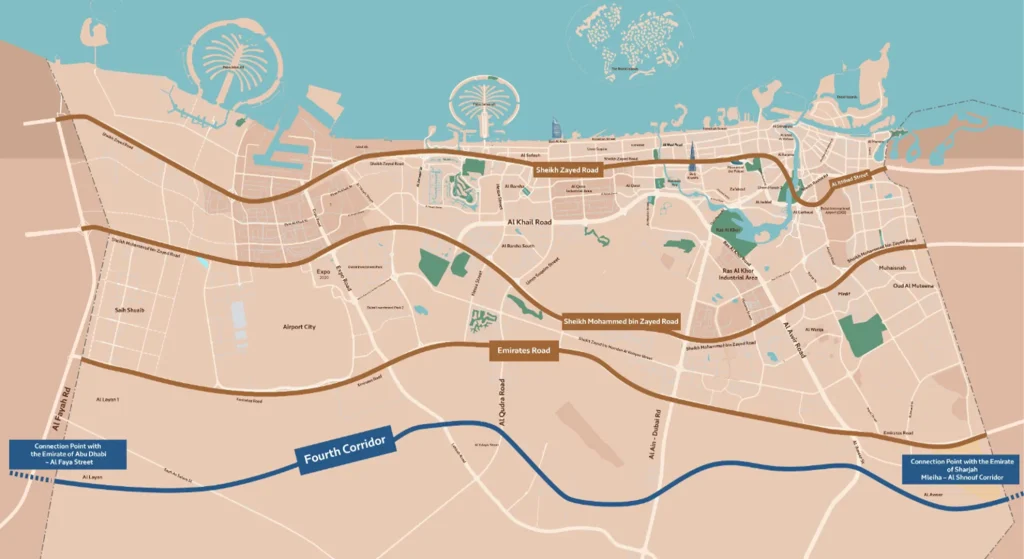
Dubai’s planned fourth transport corridor is expected to strengthen connectivity for residents in newly developed and less central communities, making daily travel more convenient while improving access to key destinations, major roads, public transport links and essential services across the emirate.
Dubai’s Fourth Transport Corridor Set to Improve Access for Residents in Emerging Outlying Communities.
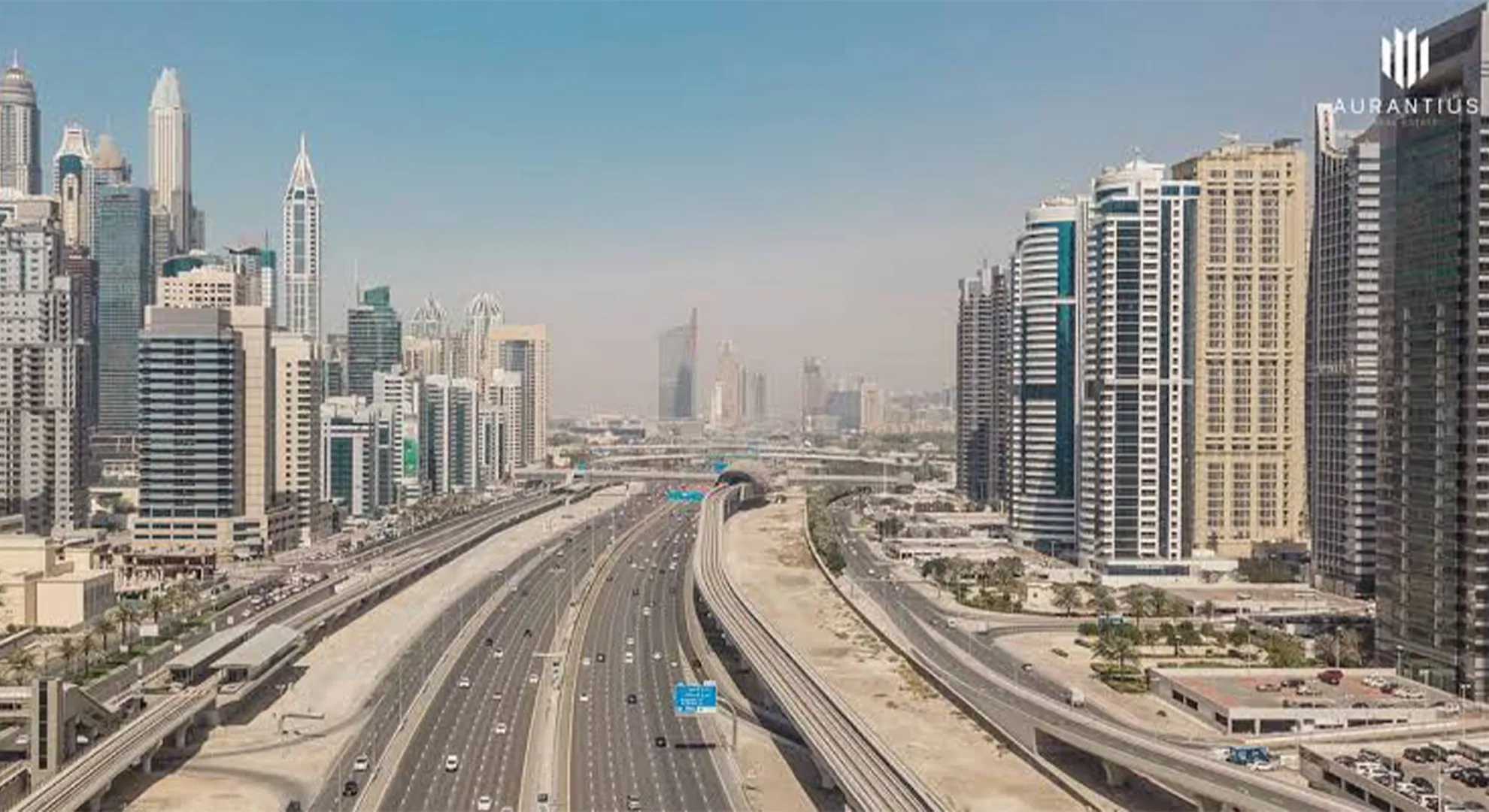
The new route will become Dubai’s fourth key highway linking different parts of the emirates, adding to the existing network formed by Sheikh Zayed Road, Sheikh Mohammed bin Zayed Road and Emirates Road, which already serve as major regional transport corridors.
New road project expected to improve connectivity for Dubai’s outer communities
Residents living in some of Dubai’s newer and more distant neighbourhoods have long faced lengthy journeys when travelling around the emirate. Everyday trips, including school drop-offs, office commutes and visits to central Dubai, can often take a significant amount of time because of limited direct road connections.
The planned Fourth Corridor is expected to address some of these connectivity challenges by creating a new major route through several developing areas.
For residents of communities such as Damac Hills 2, the project could make a noticeable difference to their daily travel. Damien Dexter Goveas, a 17-year-old student who has lived in the area for nearly five years, said travelling to central Dubai and other parts of the UAE can currently be difficult.
He said most journeys from his home take at least 45 minutes, making regular travel more time-consuming. Goveas expects the new corridor to make trips to the city and his school in Al Twar considerably easier and faster.
The project gained further momentum last week after Dubai Crown Prince Sheikh Hamdan bin Mohammed bin Rashid Al Maktoum approved plans to implement the 80-kilometre corridor.
Once completed, the route will become the fourth major road connection between the emirates, joining Sheikh Zayed Road, Sheikh Mohammed bin Zayed Road and Emirates Road as part of Dubai’s wider highway network.
Potential impact on property values
Improved road access is also attracting attention from homeowners and property investors in Dubai’s expanding communities.
Muhammad, a resident who purchased an off-plan home in The Valley, said he initially had concerns about the development’s location and its distance from central Dubai. However, the existing Dubai–Al Ain Road and the objectives outlined in the Dubai 2040 Urban Master Plan helped strengthen his confidence in the area.
With the Fourth Corridor now approved, he believes the improved infrastructure could enhance the appeal of his investment.
The Dubai 2040 Urban Master Plan focuses on developing the emirate’s urban areas while supporting more sustainable, flexible and efficient mobility options for residents.
Muhammad also highlighted plans for an additional lane between Emirates Road and Lehbab Road, saying the improvement could make journeys through the area more efficient.
The new corridor is expected to provide more direct access to several important destinations, including Al Maktoum International Airport, Abu Dhabi, Sharjah and the northern emirates. According to Muhammad, residents may be able to reach neighbouring emirates without first having to join some of Dubai’s existing major highways.
Residents anticipate stronger demand
The planned infrastructure has also raised expectations about the future value and attractiveness of properties in developing communities along the route.
When asked whether he expects his property to become more valuable after the corridor is completed, Muhammad said he believes the project could provide a significant boost to upcoming developments in the surrounding areas.
Better connectivity, he suggested, could become one of the features used to attract potential buyers rather than being viewed as a drawback associated with living farther from central Dubai.
The road could also benefit families with children studying or planning to attend universities outside their immediate communities.
Muhammad said his daughter, who is currently completing her A levels, is considering universities in Academic City, Sharjah and Abu Dhabi. Travel time and transport connections had been among the family’s concerns when considering those options.
He expects the new road network to provide faster and more convenient journeys regardless of which institution she ultimately chooses.
Project to be delivered in two phases
The 80-kilometre Fourth Corridor will be developed in two stages.
The first phase will cover approximately 30 kilometres, running from Al Shanouf Road in Sharjah towards Dubai–Al Ain Road. The estimated cost of this stage is around Dh3.5 billion.
A second phase will extend the route by another 50 kilometres towards Al Faya Road in Abu Dhabi, creating a longer transport link between the emirates.
The planned highway will feature 12 lanes and include 72 bridges, 17 tunnels and 45 drainage culverts. Once operational, the road is expected to accommodate as many as 24,000 vehicles per hour.
The corridor will also provide direct connections to Al Maktoum International Airport and Etihad Rail, linking the road network with major aviation and rail infrastructure.
For residents of Dubai’s outer communities, the project is expected to provide another route for travelling across the emirate and beyond. Its planned connections to major roads, neighbouring emirates, the airport and rail network could also support the continued development of communities located away from central Dubai.
Looking ahead: A more connected transport network
Joseph Salem, Partner and Head of the Travel, Transportation & Hospitality Practice at Arthur D. Little Middle East, described the project as an example of the kind of long-term infrastructure planning needed to support the region’s continued growth.
He said the corridor’s ability to bring road, aviation and rail connections together reflects a broader approach to transport planning, where different modes are designed to work alongside one another rather than being developed as separate solutions.
According to Salem, the project also demonstrates Dubai’s focus on preparing its transport infrastructure for future demand. He pointed to the expected reduction in travel times, alongside the integration of multiple transport modes, as an indication that the corridor is being planned with the emirate’s longer-term population and economic expansion in mind.
For residents such as Damien, however, the success of the project will not only depend on the new road itself. Better public transport connections are also a key concern for people living in communities farther from central Dubai.
Damien said affordable public transport options are currently limited for residents who need to travel between these outer communities and the city.
He hopes the completion of the corridor will encourage the Roads and Transport Authority (RTA) to introduce more direct and frequent bus services connecting the developing areas with central Dubai.
He also suggested that dedicated feeder bus routes could improve access to the wider public transport network by linking residential communities with nearby Metro stations and the Etihad Rail station.
Such connections, he believes, would give residents more affordable alternatives to driving and make it easier to combine different forms of public transport when travelling across Dubai.
The combination of improved highways, public transport services, Metro connections and Etihad Rail could therefore play a role in making Dubai’s newer communities more accessible as the city continues to expand.