The United Arab Emirates is considering the establishment of new seawater desalination projects outside the Arabian Gulf to strengthen its water security. The initiative aims to ensure a reliable and uninterrupted supply of fresh water amid growing demand and regional challenges, according to a government minister.
UAE to Develop Desalination Facilities Beyond the Gulf to Secure Long-Term Water Supply, Minister Says
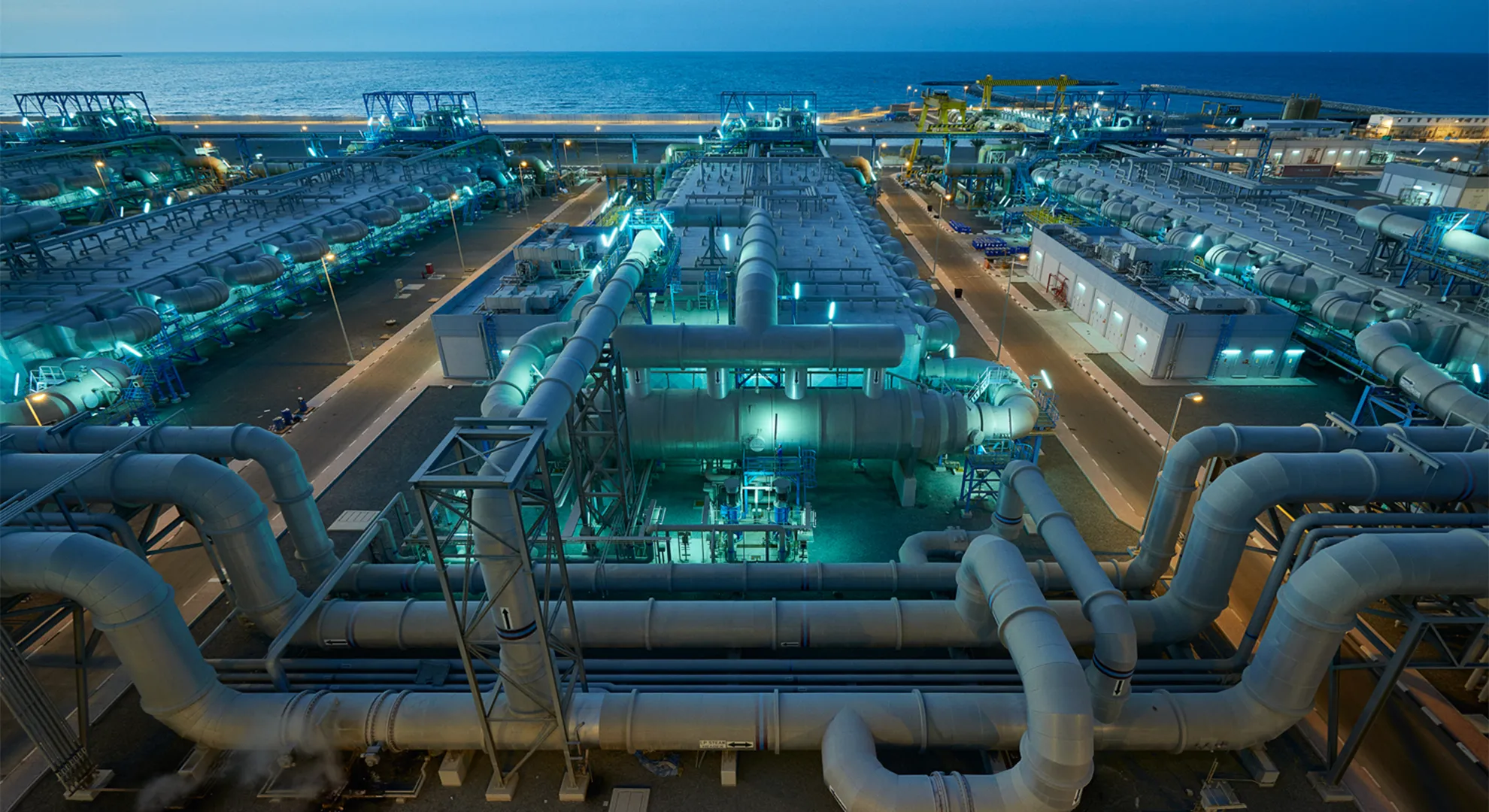
UAE Plans New Desalination Projects Outside the Gulf to Strengthen Water Security
The United Arab Emirates is exploring plans to establish additional seawater desalination facilities along its eastern coastline as part of a broader strategy to protect the country’s drinking water supply and improve its long-term water security.
The proposed projects will be developed beyond the Arabian Gulf, allowing the UAE to reduce its dependence on desalination facilities concentrated in one geographical area. The initiative is also expected to improve the country’s ability to maintain freshwater production during environmental emergencies, pollution incidents and other unexpected disruptions.
Suhail Al Mazrouei, the UAE’s Minister of Energy and Infrastructure, said the government is working on several initiatives to diversify its sources of clean water. Alongside efforts to identify alternative trade and transportation routes, the country is also examining ways to make its water infrastructure more secure and geographically diverse.
Speaking at the RAK Energy Summit on Wednesday, Al Mazrouei explained that the government intends to introduce several desalination projects on the country’s eastern coast. These facilities will operate outside the Gulf and will incorporate advanced technologies to improve water production and operational efficiency.
According to the minister, concentrating a large number of desalination facilities within the same maritime region creates significant challenges. Such dependence could expose the country’s water production infrastructure to common environmental threats, particularly when pollution affects the surrounding seawater.
He highlighted increasing seawater salinity as another concern that needs attention. Changes in water quality, contamination and other environmental factors can affect desalination operations and create difficulties for facilities that depend on seawater as their primary source.
Al Mazrouei stressed that the UAE needs to prepare for different types of environmental risks rather than relying heavily on infrastructure located in a single region. Establishing additional facilities outside the Gulf would help distribute these risks and provide greater flexibility in maintaining drinking water production.
UAE Looks to Expand Desalination Infrastructure
The government is reviewing its long-term water strategy with a particular focus on increasing desalination capacity beyond the Arabian Gulf. The proposed facilities are expected to become part of a wider network connected through major water transmission pipelines.
These transmission systems would allow freshwater produced at different locations to be transported across the country. By linking facilities through an extensive distribution network, authorities aim to ensure that water remains available even if individual plants experience operational difficulties.
The approach is intended to strengthen the reliability of the national water supply system while providing additional production capacity to meet future requirements.
Desalination has become an important part of the UAE’s water management strategy because of the country’s limited natural freshwater resources and challenging climatic conditions. With relatively low rainfall and high temperatures, the country depends significantly on advanced technologies to convert seawater into drinking water.
Expanding facilities outside the Gulf could therefore play an important role in reducing geographical concentration risks. It would also give authorities additional options for maintaining production if an incident affects existing desalination infrastructure.
The planned projects are expected to make use of modern desalination technologies. However, the minister’s remarks did not specify the total investment, construction schedule or exact number of facilities that will be developed.
Environmental Pollution Raises Concerns Over Water Production
The UAE’s plans come amid growing attention to the vulnerability of desalination facilities to marine pollution. Since these plants draw seawater directly from the surrounding environment, oil spills and other contamination incidents can create operational challenges.
An oil spill reported in late October, primarily affecting waters around Umm Al Quwain, raised concerns about the condition of coastal areas in the northern emirates. Several beaches were temporarily closed as a precautionary measure while authorities monitored the situation.
The country’s environmental authorities subsequently reported a noticeable reduction in the intensity of the pollution observed in the affected areas by the end of October.
Although the incident did not establish a wider disruption to the country’s drinking water supply, it highlighted the importance of protecting coastal infrastructure and maintaining effective monitoring systems.
Oil contamination can complicate the operation of seawater desalination facilities because the quality of the incoming water is essential to the treatment process. If polluted seawater reaches an intake system, operators may need to take precautionary measures to prevent damage to equipment and maintain water quality standards.
For this reason, early detection and effective emergency response arrangements are becoming increasingly important for the UAE’s water infrastructure.
Early Warning System Introduced to Protect Desalination Plants
Etihad Water and Electricity (EtihadWE) has developed a monitoring system designed to identify approaching oil spills before they reach important desalination facilities.
The system can reportedly provide warnings up to three days before an oil spill is expected to approach a vulnerable location. This advance notice gives authorities and plant operators additional time to prepare protective measures and reduce the possibility of contamination affecting water production.
The development reflects the growing importance of combining technological monitoring with infrastructure protection.
Early identification of marine pollution can help operators assess potential risks, monitor seawater conditions and take appropriate precautionary action. Such measures are particularly important for facilities that depend on uninterrupted access to suitable seawater.
The system also demonstrates how technological solutions can support the wider objective of strengthening the UAE’s water security.
Along with establishing desalination facilities in different geographical locations, improving pollution monitoring and emergency preparedness could help reduce the risks associated with environmental incidents.
Regional Security Concerns Highlight the Importance of Water Infrastructure
The UAE’s decision to diversify desalination facilities also comes against the backdrop of wider security concerns affecting critical infrastructure across the Gulf region.
Desalination plants are strategically important because they provide a substantial share of the freshwater required by several Gulf countries. Any disruption to these facilities could create difficulties for households, businesses and essential public services.
Earlier in the summer, desalination infrastructure in other parts of the region was affected by military incidents linked to tensions involving Iran, the United States and Israel.
In Kuwait, a power generation and water desalination facility was struck in mid-July, resulting in a fire. The incident demonstrated the potential vulnerability of essential water and energy infrastructure during periods of regional conflict.
Bahrain also reported an incident involving one of its desalination facilities earlier in the Iran-US-Israel conflict. However, the country’s National Communication Office stated that the incident had not affected drinking water supplies or the capacity of the distribution network.
These developments have brought greater attention to the need for stronger protection of essential infrastructure throughout the region.
For countries that rely heavily on seawater desalination, maintaining the safety and operational continuity of these facilities is an important national priority.
Building a More Resilient Water Supply Network
The UAE’s proposed expansion of desalination capacity outside the Gulf represents an effort to make its water supply system more flexible and resilient.
Instead of depending predominantly on facilities located within one maritime environment, the government wants to establish additional production centres along the eastern coastline and connect them through large-scale water transmission infrastructure.
This geographical diversification could provide an additional layer of protection against pollution, environmental changes and other unexpected events.
A more distributed system would also give authorities greater flexibility when managing water production. If one facility faces operational problems, other plants connected to the national network could potentially help support overall supply requirements.
The strategy is particularly important as demand for freshwater continues to grow alongside population expansion, economic development and industrial activity.
For the UAE, ensuring a dependable supply of drinking water is closely connected to its broader development and infrastructure objectives.
The government’s focus on modern desalination technologies, alternative production locations and improved water transportation networks indicates an effort to address both present and future challenges.
While the proposed projects are still part of the country’s broader planning strategy, their development could represent an important step towards reducing the risks associated with concentrated desalination infrastructure.
Through geographical diversification, technological improvements and stronger environmental monitoring, the UAE aims to build a water supply system capable of withstanding a wider range of potential disruptions.