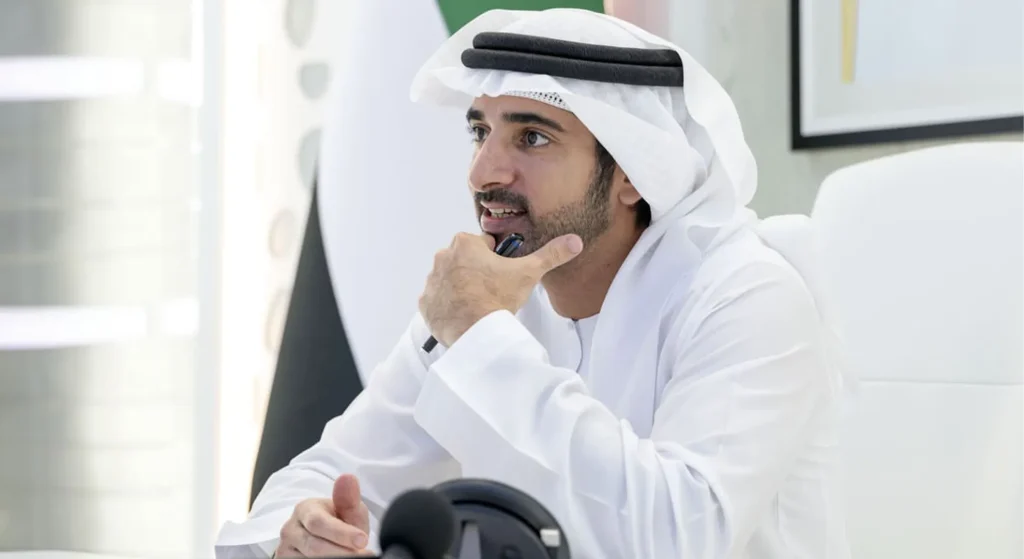
Sheikh Hamdan has introduced a major global competition aimed at encouraging innovators, developers and AI enthusiasts to create advanced artificial intelligence agents, with a total prize pool of Dh2.5 million available to participants from around the world.
Dh2.5 Million Up for Grabs as Sheikh Hamdan Announces Worldwide AI Agents Contest.

Dubai Launches Dh2.5 Million Global AI Agents Competition for Innovators
Artificial intelligence developers, entrepreneurs, students and creative problem-solvers from around the world have been invited to take part in a new international competition focused on building practical AI agents.
The Create AI Agents Championship, launched under the initiative of Dubai Crown Prince Sheikh Hamdan, offers a combined prize pool of more than Dh2.5 million. The global challenge is designed to encourage participants to move beyond conventional digital applications and develop AI-powered systems capable of assisting people, organisations and communities in solving real-world problems.
The competition is open to both individuals and teams, giving participants the opportunity to enter with an original concept, a working prototype or an early-stage product. Participants do not need to be established technology professionals to apply, as the championship welcomes people with technical and non-technical backgrounds.
At the heart of the competition is the idea of turning artificial intelligence into practical, independent assistance that can be used in everyday situations. Rather than simply creating another digital tool or application, participants are encouraged to identify a genuine challenge, develop an AI-based solution, test how effectively it addresses that challenge and assess whether the concept could eventually become a commercially viable product or service.
A new approach to AI innovation
The championship represents a shift in the way technology competitions approach innovation. Instead of concentrating solely on conventional software and digital applications, the initiative places greater emphasis on AI agents and assistive systems that can perform useful functions and support users in practical environments.
Participants are expected to start by identifying a specific problem or unmet need. They can then design an AI agent capable of helping address that issue, develop and test their concept, and measure the results.
The organisers are also encouraging participants to think beyond the prototype stage. Successful ideas could potentially be developed into scalable businesses, services, products or other projects capable of reaching a wider audience.
This approach puts the focus on the usefulness and real-world impact of AI rather than technology for its own sake. It also gives innovators an opportunity to explore how emerging artificial intelligence capabilities can be applied to challenges affecting communities, individuals, businesses and young people.
Who can enter the championship?
The competition has been designed to accommodate a broad range of participants from different backgrounds and experience levels.
Innovators from anywhere in the world can participate, and there is no minimum age requirement for most categories. Participants do not have to be professional programmers, engineers or artificial intelligence specialists.
Individuals can submit their own concepts, while teams can work together to develop and present a solution. Entries may be based on a completely new idea, an existing prototype or an early-stage product that is still being developed.
The initiative is therefore intended to attract a diverse pool of applicants, including technology enthusiasts, entrepreneurs, students, developers and people who may have limited technical experience but have identified a problem that could potentially be addressed using AI.
Existing companies are also eligible to participate, provided they are presenting a new AI-based solution or capability. However, businesses cannot enter solutions that have already been fully launched and commercially marketed.
This requirement is intended to ensure that the competition remains focused on innovation and emerging concepts rather than products that are already established in the market.
Four areas of competition
Participants will compete across four principal categories, each addressing a different area in which AI agents could make a meaningful contribution.
The categories are:
- Best Societal AI Agent
- Best Personal AI Agent
- Best Business AI Agent
- Best Youth AI Agent
Each category has its own focus, allowing participants to develop solutions based on different types of users and challenges.
Best Societal AI Agent
The societal category is aimed at AI solutions that can contribute to positive changes within communities and society.
Participants in this section can focus on issues such as social inclusion, education, sustainability, community development and resilience.
The objective is to demonstrate how an AI agent can help bring people together, improve access to opportunities or services, support learning and contribute to solutions for wider social and environmental challenges.
Projects may therefore address problems that extend beyond individual users and have the potential to benefit groups, communities or society more broadly.
Best Personal AI Agent
The personal category concentrates on solutions designed to make everyday life easier or more productive.
Participants can explore how AI agents could assist individuals with areas such as personal organisation, productivity, health, wellbeing and decision-making.
The emphasis is on creating technology that provides useful assistance in people’s daily lives. A successful entry could, for example, help a user manage tasks, make informed choices, organise information or improve aspects of their personal routine.
The category provides an opportunity for innovators to demonstrate how AI can function as a practical assistant rather than simply as a conventional software feature.
Best Business AI Agent
The business category is intended for AI solutions that can support organisations in the public or private sectors.
Participants are encouraged to identify opportunities where AI agents could improve operational processes, workflows, customer interactions or decision-making.
Solutions may target challenges faced by companies, government entities or other organisations, with a focus on demonstrating measurable improvements and practical value.
The category also highlights the potential for AI agents to change how organisations deliver services and interact with their customers.
Best Youth AI Agent
The youth category is specifically reserved for young innovators.
To qualify, the participant must be 21 years old or younger. Teams are also permitted, but the group must be led by a young participant who meets the age requirement.
The principal applicant must be under 21 when the registration takes place.
This category is intended to provide younger innovators with a dedicated platform to demonstrate their ideas and explore the possibilities offered by artificial intelligence.
By giving young participants a distinct competition category, the championship creates an opportunity for students and emerging technology enthusiasts to experiment with AI and develop solutions around issues that matter to their generation.
More than Dh2.5 million in prizes
The championship offers substantial financial support for the winning projects.
Each of the four category winners will receive Dh550,000. The funding is intended to help winners continue developing their AI agent, strengthen their project and potentially expand it beyond the competition.
In addition to the four category awards, one winner will receive the overall title of AI Agent of the Year.
The recipient of this top honour will receive an additional Dh1 million prize.
Together, the category awards and the overall recognition take the total value of the competition’s prizes to more than Dh2.5 million.
The financial awards are designed not only to recognise innovative ideas but also to give successful participants resources that can support the next stage of development.
For innovators working on early-stage concepts, such support could help turn a promising prototype into a more mature solution.
Focus on real-world applications
A central element of the competition is the emphasis on solving actual problems.
Rather than asking participants to develop AI technology simply as a demonstration, the championship encourages them to begin with a problem that needs to be addressed.
Once the problem has been identified, participants are expected to consider how an AI agent could provide assistance, develop a solution and test whether the approach works effectively.
This process encourages innovators to consider the needs of real users from the beginning.
Participants are also expected to think about the potential impact of their solutions. An idea may have technological potential, but the competition places importance on demonstrating how it can create practical value.
The longer-term commercial potential of projects is another important consideration. Participants can explore whether their AI agents could eventually be developed into sustainable products, services or businesses.
As a result, the competition connects technological experimentation with entrepreneurship and practical implementation.
Registration now open
The championship has officially begun with registration opening to participants from around the world.
Entrepreneurs, students, developers, innovators and other individuals interested in artificial intelligence can submit their ideas and take part in the programme.
The broad eligibility requirements mean that participants do not necessarily need to have an advanced technical background. What matters is the ability to identify a meaningful challenge and develop an AI-assisted approach to addressing it.
Teams can also combine different skills and areas of expertise. For example, participants with business, design, research or industry knowledge can work alongside people with technical capabilities to develop a more complete solution.
Training and development opportunities
The championship is not limited to the competition itself. Participants will also have access to a range of learning and development opportunities designed to strengthen their understanding of AI agents and help them improve their projects.
Three introductory workshops focusing on AI assistance are scheduled as part of the programme.
These sessions are intended to provide participants with foundational knowledge and help them better understand the principles behind AI-powered assistance.
Further training will follow in November, when the Digital Academy is scheduled to open.
The academy will feature four advanced training courses as well as four practical workshops.
Participants will also have access to mentoring sessions, allowing them to receive guidance while developing their ideas and preparing their competition entries.
Support for participants
The organisers are providing participants with educational resources and specialist support throughout the challenge.
Those taking part will have access to self-learning materials that can help them expand their knowledge of assistive artificial intelligence.
Workshops and specialist sessions will provide additional opportunities to explore different aspects of AI development, while mentoring programmes will give participants a chance to receive more focused guidance.
The support is designed to help entrants at different stages of development.
Someone starting with an initial idea can use the learning resources and workshops to develop the concept further, while participants with an existing prototype can use mentoring and specialist sessions to improve their solution and prepare it for presentation.
The programme therefore combines competition with education, experimentation and project development.
From concept to prototype
Participants are ultimately expected to demonstrate the progress of their AI agent and show how their proposed solution works.
The competition allows early-stage ideas to participate, but entrants will need to develop their concepts as they move through the programme.
By the conclusion of the challenge, participants are expected to complete the required elements, including a prototype, presentation and demonstration video.
These components will allow participants to explain the problem they are addressing, show how their AI agent operates and demonstrate the potential impact of their solution.
The requirement for a prototype and demonstration also encourages participants to move beyond theoretical concepts and produce something that can be evaluated in a practical context.
December deadline
The participation period will continue through December 2026.
By the end of the competition period, participants must have completed the required submission materials, including their prototype, presentation and demonstration video.
This gives innovators several months to develop their ideas, participate in training opportunities, receive guidance and refine their solutions.
The programme’s timeline is structured to provide participants with opportunities to improve their projects rather than requiring them to submit a finished concept immediately after registration.
Encouraging a global community of innovators
By opening the championship to participants worldwide, the initiative aims to bring together people with different experiences, skills and perspectives.
The organisers’ broad approach to eligibility also means that participation is not restricted to established AI professionals.
Students, entrepreneurs, developers, technology enthusiasts and innovators from other fields can explore how AI agents might be used to address challenges in their respective areas.
The involvement of both individuals and teams could also encourage collaboration between people with different skill sets.
For example, a technically skilled participant could work with someone who understands a particular industry or community problem. Combining those perspectives may help produce AI solutions that are more closely aligned with users’ actual needs.
Building AI for practical needs
The championship reflects the growing focus on AI systems that can perform useful tasks and provide assistance rather than simply generate information.
AI agents can potentially be designed to help users navigate complex processes, automate repetitive activities, support decision-making or provide specialised assistance.
The competition gives participants an opportunity to explore these possibilities across several areas, including society, personal life, business and youth innovation.
Its structure also encourages participants to consider the complete journey of an AI idea — from identifying a problem and developing a prototype to testing its effectiveness and examining its potential for wider adoption.
A platform for emerging ideas
For early-stage innovators, the championship provides an opportunity to put new concepts in front of a global platform.
Because fully launched and commercially marketed products are excluded, the competition remains focused on solutions that are still at an early or developmental stage.
This gives participants an opportunity to develop ideas that may otherwise still be in the experimental phase.
The financial awards, training programme and mentoring opportunities could also help successful participants move their projects closer to real-world implementation.
What participants need to prepare
Those interested in entering should be prepared to clearly explain the problem their AI agent is designed to solve.
They will also need to demonstrate how their solution works and why it could be useful to its intended users.
As the competition progresses, participants will be expected to develop the necessary prototype and supporting materials.
The final requirements include a presentation and a demonstration video, giving entrants an opportunity to communicate both the technical concept and its practical value.
Participants can use the available workshops, educational materials and mentoring sessions to strengthen these elements before the final submission period.
Four categories, one overall title
The four category awards give participants several pathways to recognition depending on the type of AI solution they develop.
A project focused on community impact can compete in the societal category, while an AI assistant designed for individual users can enter the personal category.
Solutions created to support organisations can compete under the business category, while young innovators can pursue the youth award if they meet the age requirements.
From these four category winners, one will ultimately receive the AI Agent of the Year title and the additional Dh1 million prize.
This structure provides both specialised recognition and an overall award for the project judged to stand out across the competition.
Opportunity for innovators worldwide
The Create AI Agents Championship offers a global platform for people interested in exploring the next stage of artificial intelligence.
With participation open to individuals and teams, and with no minimum age requirement for most categories, the initiative is designed to attract a wide range of ideas.
Participants can enter with an early concept, prototype or developing product, while established companies can also take part if they are presenting a new AI capability that has not already been fully commercialised.
Through financial prizes, specialised training, workshops, educational resources and mentoring, the championship aims to help participants develop their ideas into practical AI-agent solutions.
Registration is now open, with the competition scheduled to continue until December 2026. Participants will have the coming months to develop their projects, test their concepts and prepare the materials required for the final stage.
The initiative ultimately places the focus on one central question: how can AI agents be designed to provide meaningful assistance and solve problems faced by real people, communities and organisations?
By bringing together innovators from different backgrounds and giving them resources to develop their ideas, the championship seeks to turn early-stage AI concepts into solutions with the potential for broader practical and commercial use. :::
This version is intentionally restructured rather than simply replacing individual words, so it should read as an independently written news feature while retaining the information from your source.