Dubai is testing fresh approaches to education, with several new school concepts being piloted as authorities consider alternative learning formats designed to give families greater choice while preparing students for changing academic and future workplace demands.
Dubai Explores Innovative Education Options as Alternative Schooling Models Enter Pilot Phase.
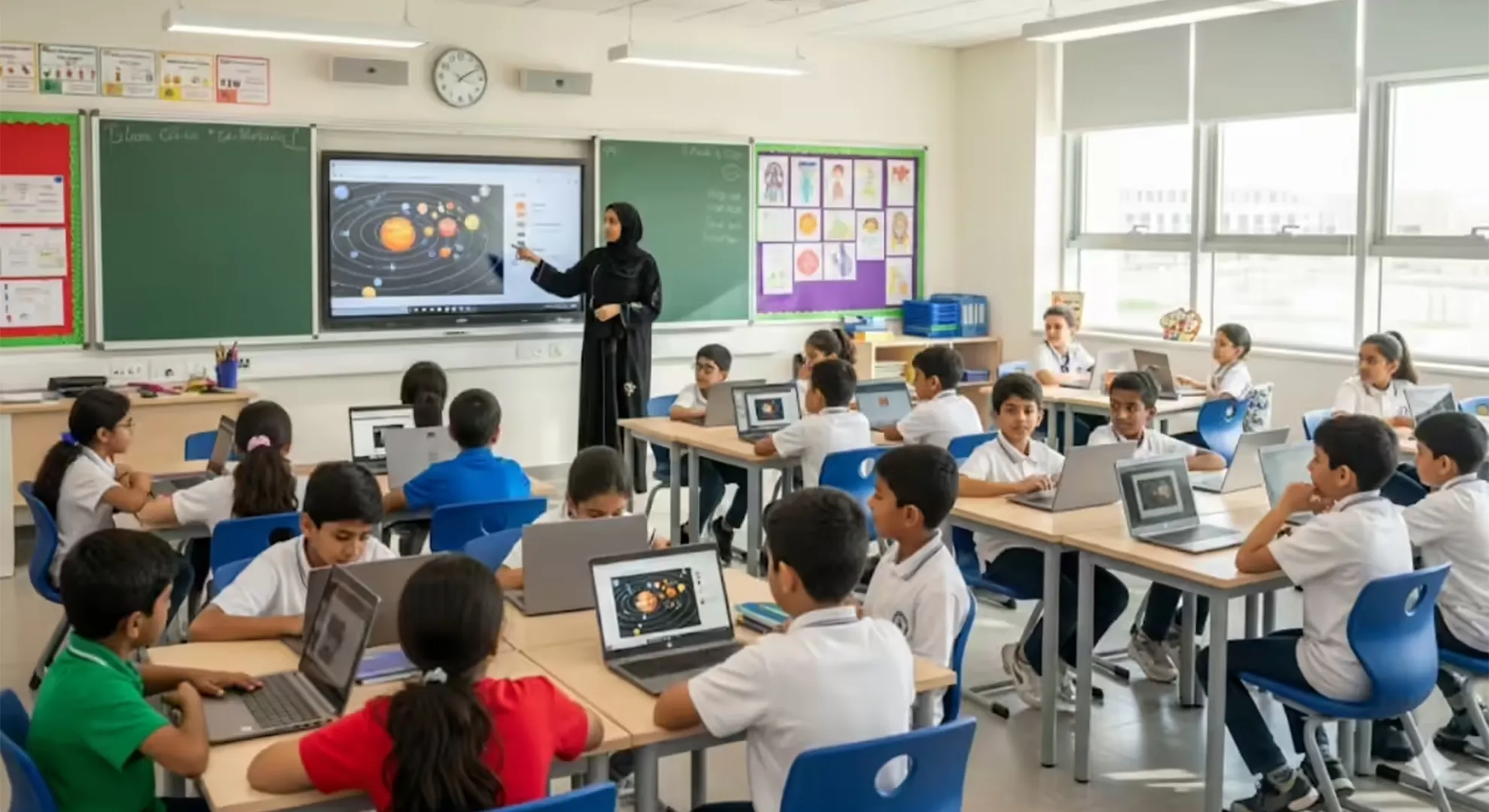
Dubai Rethinks Schooling as Authorities Explore New Education Models
Dubai is moving towards a more flexible and forward-looking approach to education, with authorities examining new ways of delivering schooling while also addressing teacher retention, educator well-being and the distribution of schools across communities.
The emirate’s education authorities are considering whether traditional school structures remain the best fit for future generations, with innovation emerging as a central theme in the development of Dubai’s education strategy.
Aisha Miran, director general of the Knowledge and Human Development Authority (KHDA), said Dubai Crown Prince Sheikh Hamdan bin Mohammed bin Rashid Al Maktoum has repeatedly emphasised the importance of changing the way children are educated.
According to Miran, Sheikh Hamdan believes future generations should not simply experience the same type of schooling that previous generations received.
His position has become an important part of conversations about the future direction of Dubai’s education sector, particularly as the emirate considers new school concepts and alternative methods of learning.
The objective is not simply to introduce change for its own sake, but to create an education system that can respond to the needs of children growing up in a rapidly changing world.
A New Approach to Education
Miran said Dubai’s leadership wants schools to evolve rather than continue operating according to models that were designed for earlier generations.
The emphasis on innovation reflects the changing expectations placed on education systems worldwide.
Students today are growing up in an environment shaped by digital technology, artificial intelligence, changing employment patterns and new approaches to learning.
As a result, schools may need to provide more personalised and flexible experiences than traditional education models have typically offered.
Dubai is now examining how different approaches could be introduced while ensuring that students continue to receive a high-quality education.
The KHDA has already taken steps towards making it possible for alternative education providers to operate in the emirate.
An innovative licensing framework has been approved, and officials are continuing to examine the practical requirements needed for different types of school models.
The intention is to create room for experimentation without weakening the standards expected from educational institutions.
Dubai as a Testing Ground for Innovation
Miran described Dubai as an environment where new ideas can be tested and developed.
She said the emirate remains open to different approaches to education, including models that differ considerably from conventional schools.
One example mentioned is the Alpha model, which uses personalised learning supported by artificial intelligence and mastery-based education.
Under such an approach, students can receive more individualised instruction, while core academic learning is concentrated into a particular portion of the school day.
The model represents a different way of organising learning and could offer an alternative to the conventional structure followed by many schools.
However, the Alpha model is only one example.
The KHDA is also aware of other education concepts being developed or tested in Dubai.
Officials have not released full details about every initiative because some of the models remain in the pilot stage.
Miran indicated that several programmes are already being tested before they are introduced more widely.
This approach allows authorities to assess whether new concepts work effectively before they become available to larger numbers of students.
Pilot Programmes Underway
The use of pilot projects gives Dubai an opportunity to evaluate new ideas in real educational settings.
Instead of immediately introducing a new system across multiple schools, authorities can observe how individual models perform and identify areas that may need improvement.
This could include examining student outcomes, teacher experiences, parental feedback and the practical operation of the model.
The results of such trials can then inform decisions about whether an approach should be expanded.
Several pilot programmes are currently being implemented, although their details have not yet been publicly disclosed.
The confidentiality surrounding some of these projects allows education providers and authorities to experiment before making formal announcements.
For Dubai, the pilot approach is part of a broader effort to make the education system more adaptable.
It also reflects the emirate’s willingness to consider different ideas rather than relying exclusively on established models.
Innovation Must Be Balanced With Standards
While the KHDA is encouraging experimentation, Miran made clear that innovation will not come at the expense of basic educational requirements.
New models will still be expected to meet strict standards concerning student safety, academic achievement and overall development.
Safeguarding children remains a fundamental requirement for any education provider.
Schools must also demonstrate that their approach can support students academically and contribute to their personal and social development.
This means that simply offering a different educational format will not be enough to secure approval.
Alternative models will need to demonstrate that they can provide a safe, effective and meaningful learning environment.
The KHDA’s approach therefore attempts to strike a balance between flexibility and regulation.
Education providers are being given greater space to experiment, but they must continue to meet the standards established to protect students and maintain educational quality.
Growing Demand for School Places
The discussion around alternative school models comes at a time when Dubai continues to experience strong demand for education.
Seven new schools have opened in the emirate during the current academic year.
At the same time, 11 additional applications are under consideration for the following two years.
The expansion reflects the continued growth of Dubai’s population and the increasing need for additional educational capacity.
As more families move to the emirate, demand for school places is likely to remain an important issue for education planners.
The challenge is not simply to increase the number of schools.
Authorities also need to ensure that the schools being developed provide the curricula, fee levels and educational approaches that families in different communities actually want.
That is where Dubai’s wider school-planning strategy becomes important.
Supporting Teachers Is Another Priority
Alongside the development of new school models, the KHDA is focusing on the people responsible for delivering education: teachers.
Teacher retention has become an important part of the authority’s strategy.
Keeping experienced educators within schools can provide greater stability for students and reduce the disruption caused by frequent staff changes.
The KHDA is therefore working on an educator well-being strategy designed to improve the overall experience of teachers.
The strategy will cover different stages of an educator’s professional journey, beginning with recruitment and continuing through retention.
The aim is to make Dubai an attractive destination for highly qualified teachers while also encouraging existing educators to remain in the profession.
Miran said several factors would need to be considered if Dubai is to attract and retain top teaching talent.
Professional Development for Educators
Continuing professional development is expected to form an important part of the strategy.
Teachers need opportunities to strengthen their skills, learn about new educational approaches and keep pace with developments in their subjects.
Professional development can also help educators adapt to changing classroom environments.
As schools introduce new technologies and teaching methods, teachers need appropriate training and support.
The KHDA’s focus on continuing professional development reflects the idea that teacher development should not stop once an educator enters the profession.
Instead, teachers should have opportunities to continue learning throughout their careers.
This can benefit educators while also improving the quality of instruction received by students.
Recognition and Career Development
Recognition is another area being examined by the KHDA.
Teachers who feel that their work is valued may be more likely to remain motivated and committed to their schools.
Recognition can take different forms, including professional opportunities, exposure to new experiences and acknowledgement of strong performance.
Providing educators with opportunities to grow professionally can also contribute to retention.
Teachers may be more likely to remain in a school system when they can see a clear path for development and advancement.
The KHDA’s strategy is therefore looking beyond salaries and recruitment numbers to consider the broader professional environment in which teachers work.
Work-Life Balance
Another issue highlighted by the KHDA is the balance between professional responsibilities and personal life.
Teaching can involve considerable preparation, assessment, communication and administrative work outside normal classroom hours.
Maintaining a healthy balance can influence an educator’s motivation, well-being and willingness to remain in the profession.
The authority is therefore examining how working conditions can be improved to make teaching more sustainable.
A stronger focus on educator well-being could also benefit students.
Teachers who are supported and motivated are better positioned to maintain high levels of engagement in the classroom.
This means teacher well-being is not simply an employment issue but can also have a direct connection to educational quality.
Reducing Disruption When Teachers Leave
The KHDA is also considering whether teachers should be discouraged from leaving their positions during the academic term.
The proposed approach is linked directly to the interests of students.
When a teacher leaves in the middle of a semester, a school may need to find a replacement quickly.
Although another teacher can take over the role, the new educator may not necessarily have the same subject expertise, familiarity with the students or understanding of the curriculum.
This can interrupt the continuity of learning.
Miran said the authority is collecting data as it considers how such a policy might work.
The intention is not simply to control teacher movement but to understand the effect that mid-year departures can have on students.
Students Remain the Main Priority
The KHDA’s position is based on a learning-centred approach.
From the authority’s perspective, decisions affecting teachers should ultimately consider their impact on students.
A stable classroom environment can help students build relationships with teachers and maintain consistency in their learning.
Frequent changes in teaching staff can make that more difficult.
By examining teacher retention and potential restrictions around resignations during the academic year, the KHDA is attempting to reduce unnecessary disruption.
At the same time, any policy would need to take into account the legitimate needs and circumstances of educators.
The collection of data will help authorities understand the scale of the issue and determine the most appropriate approach.
Making Schools More Accessible
School planning is another major component of Dubai’s education strategy.
The KHDA wants families to have access to appropriate schools within or close to the communities where they live.
For many parents, choosing a school involves more than simply selecting an institution.
Families often have specific preferences concerning curriculum, fees, teaching approaches and school facilities.
If the preferred school is located far away, parents may have little choice but to spend significant amounts of time travelling.
Dubai’s education master plan is intended to address this issue by examining where schools are located and whether the distribution of places reflects the needs of individual communities.
Matching Schools With Local Demand
The master plan will assess whether particular communities have enough schools to meet demand.
It will also consider whether some areas have more capacity than required.
This could help authorities identify gaps and avoid unnecessary duplication.
For example, a community may have strong demand for a British curriculum school within a particular fee range.
If no suitable school is available nearby, families may have to travel a considerable distance to find one.
The KHDA wants school planning to respond more directly to these local requirements.
The goal is to ensure that the supply of educational places is not only sufficient in terms of numbers but also appropriate in terms of curriculum and affordability.
Working With Developers and Government Agencies
Achieving this objective will require coordination between several organisations.
The KHDA is working with property developers, zoning authorities, Dubai Municipality and the Roads and Transport Authority.
This collaboration is important because schools are closely connected to urban development.
When new residential communities are created, education needs to be considered alongside housing, transport, healthcare, retail and other essential services.
If schools are planned too late, families may have to travel outside their communities to access education.
By working with developers and planning authorities, the KHDA can identify where new schools may be required as communities expand.
This could help ensure that educational infrastructure develops alongside population growth.
Reducing Long School Journeys
One of the main objectives of the planning strategy is to reduce unnecessary travel for families.
Parents should ideally be able to find a suitable school within a reasonable distance of their homes.
Long school journeys can place pressure on families and increase traffic on Dubai’s roads, particularly during peak morning and afternoon periods.
Providing appropriate schools closer to residential communities could therefore have benefits beyond education.
It could also contribute to more efficient transport patterns and reduce the daily burden on parents and students.
The KHDA’s approach recognises that access to education is not only about the number of available school places.
Location matters as well.
Curriculum Choice Close to Home
Dubai has a diverse population, and families have different educational preferences.
Some parents may seek British curricula, while others may prefer American, Indian, International Baccalaureate or other educational systems.
Fee expectations also vary significantly between households.
A community may therefore require several different types of school provision rather than simply more places.
The education master plan is intended to take these differences into account.
Instead of treating every school place as interchangeable, authorities are looking at whether the right types of schools are available in the right locations.
This could give families greater choice without requiring lengthy daily commutes.
Education and Dubai’s Population Growth
The need for careful school planning is closely connected to Dubai’s continuing population growth.
As new residential developments attract families, demand for education can rise rapidly.
School capacity needs to keep pace with that expansion.
At the same time, education planning needs to anticipate future demand rather than responding only after schools become overcrowded.
The collaboration between the KHDA, developers and other government entities is intended to support this longer-term planning process.
By understanding where populations are expected to grow, authorities can work towards ensuring that schools are available when communities become established.
Technology and the Future Classroom
The push for innovation also reflects the growing influence of technology on education.
Artificial intelligence and personalised learning systems are already being incorporated into some educational models.
These technologies could allow students to learn at different speeds and receive more targeted support.
However, technology alone cannot replace the broader responsibilities of a school.
Students also need opportunities to develop communication skills, social abilities, creativity, independence and emotional resilience.
Any new model introduced in Dubai will therefore need to consider the full development of the child.
The KHDA’s emphasis on academic performance, well-being and self-development reflects this broader view of education.
Preparing Students for a Changing World
The education system children enter today may look very different from the system they experience as adults.
Many future careers are likely to involve technologies and skills that are still subjects remain important, but students may also need stronger abilities gives education providers an opportunity to experiment with how learning developing.
Schools therefore face the challenge of preparing students for uncertainty.
Traditional subjects remain important, but students may also need stronger abilities in problem-solving, collaboration, critical thinking and adaptation.
Innovative education models could provide new ways of developing these skills.
Dubai’s willingness to test alternative approaches gives education providers an opportunity to experiment with how learning can be organised for future generations.
The Role of Parents
Any major change in schooling will also affect parents.
Families need clear information about what new education models offer, how they operate and whether they meet recognised academic standards.
Greater choice can be beneficial, but it can also make decisions more complicated.
Parents may need to compare different approaches to determine which model is most appropriate for their children.
The KHDA’s regulatory role will therefore remain important as new concepts are introduced.
Ensuring transparency and maintaining quality standards can help families make informed choices.
Balancing Choice and Regulation
The challenge for Dubai will be to encourage innovation without creating an education system in which standards vary significantly between providers.
The KHDA’s licensing framework provides a mechanism for managing that balance.
Alternative schools can be given greater flexibility in how they deliver education while still being required to meet fundamental expectations.
Child protection, academic standards and student development will remain essential requirements.
This allows innovation to take place within a controlled framework.
A Broader Vision for Dubai’s Schools
Taken together, the initiatives being considered by the KHDA point towards a broader transformation of Dubai’s education system.
The authority is looking simultaneously at what happens inside classrooms, who teaches students and where schools are located.
New learning models address the first issue.
Teacher well-being and retention address the second.
The education master plan addresses the third.
These areas are interconnected.
Innovative schools need capable teachers.
Teachers need supportive working environments.
And families need schools that are accessible and appropriate for their communities.
More Schools, but Better Distribution
The opening of seven new schools demonstrates that Dubai is continuing to expand its education capacity.
However, simply increasing the number of schools may not resolve every challenge.
If new schools are concentrated in areas that already have substantial capacity, other communities could continue to face shortages.
Likewise, increasing the number of schools without considering curriculum preferences or affordability may not provide families with meaningful choice.
This is why the master-planning approach is significant.
The objective is to understand where demand exists and what type of education families are seeking.
The Next Stage of Dubai’s Education Strategy
The education sector is now entering a period in which experimentation is likely to play a larger role.
Several pilot models are already being tested, while other concepts remain under development.
The results of these trials could influence how education evolves across the emirate.
At the same time, work on teacher retention and well-being could help strengthen the workforce needed to support those changes.
The master plan could further connect educational supply with the development of Dubai’s residential communities.
Together, these initiatives represent an attempt to approach education as a complete ecosystem rather than as a collection of individual schools.
Looking Beyond the Traditional School
The central message behind Dubai’s education reforms is that the conventional school model should not necessarily be treated as the only option.
As technology, society and employment change, education may need to change as well.
Alternative models could provide students with different ways of learning, while personalised approaches could allow education to respond more closely to individual needs.
However, innovation will need to remain grounded in educational quality and student welfare.
Dubai’s approach appears to be one of experimentation combined with regulation.
New concepts can be tested, but they must demonstrate that they serve students effectively.
Building an Education System for Future Generations
The long-term objective is to create an education environment that prepares children for the world they will enter as adults rather than simply reproducing the systems used by previous generations.
That means encouraging innovation while maintaining academic standards.
It means supporting teachers so they can perform at their best.
It also means planning schools in a way that reflects the changing needs of Dubai’s communities.
These priorities are likely to remain central as the emirate’s population grows and its economy continues to evolve.
Conclusion
Dubai is taking a broad look at the future of education, with authorities examining new school models, teacher support measures and a long-term strategy for planning educational facilities across the emirate.
The push for innovation has been strongly encouraged by Crown Prince Sheikh Hamdan bin Mohammed bin Rashid Al Maktoum, according to KHDA chief Aisha Miran, who said the aim is to ensure future generations are not simply placed into the same type of schools attended by previous generations.
The KHDA has already approved an innovative licensing framework and is allowing different concepts to be tested.
The Alpha model, which combines personalised learning, artificial intelligence and mastery-based education, is one example, while several other pilot programmes are also being developed.
At the same time, authorities are making clear that innovation must operate within firm boundaries.
Student safety, academic achievement, well-being and personal development will remain essential requirements for any new educational model.
The expansion of Dubai’s school network is also continuing, with seven new schools opening this academic year and 11 applications being assessed for the next two years.
Beyond the number of schools, however, the KHDA is looking at how to make the education system more responsive to individual communities.
The authority’s master-planning work will examine school locations, capacity, curriculum availability and fee levels to determine whether the existing supply matches what families need.
Cooperation with developers, zoning authorities, Dubai Municipality and the RTA will be important in achieving that goal.
Teacher welfare represents another major part of the strategy.
The KHDA is developing an educator well-being programme covering the journey from recruitment through retention, with professional development, recognition and work-life balance among the areas being considered.
The authority is also studying whether teachers should be discouraged from leaving schools during the academic term to minimise disruption to students.
Ultimately, the various initiatives share a common objective: creating an education system that is better aligned with the needs of children, teachers and communities.
Dubai’s approach suggests that the future of schooling may involve more choice, greater experimentation and more personalised forms of learning, while continuing to operate under strong standards for safety and educational quality.
As new models move through their pilot stages and the education master plan develops, the emirate will have an opportunity to assess which approaches can deliver meaningful improvements for students.
The broader vision is clear: schools should evolve alongside the society they serve, and Dubai is seeking to ensure its education system is prepared not only for today’s students but also for the generations that will follow.