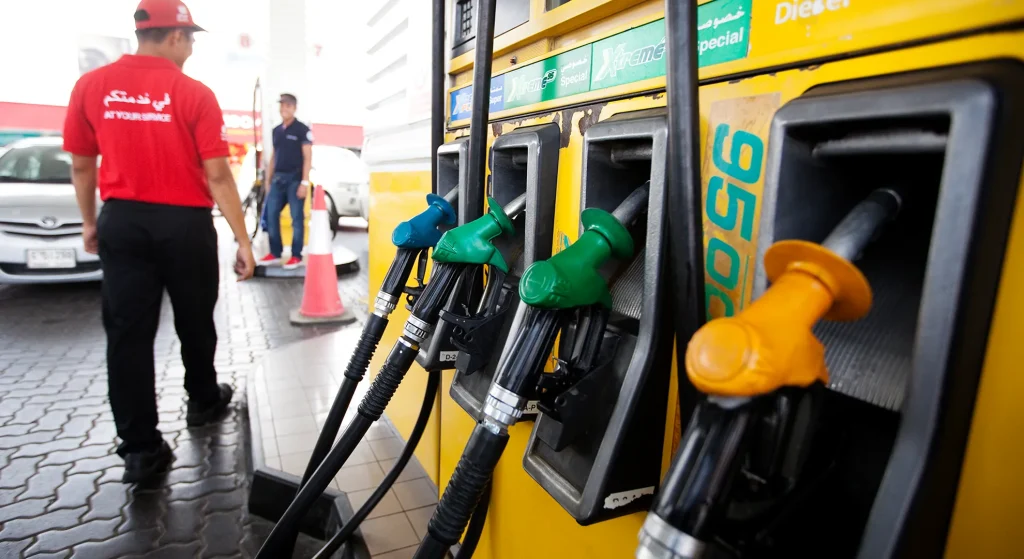
The recent rise in fuel prices could lead to higher charges for household relocation, food delivery and vehicle recovery services, as businesses may pass increased transportation and operating expenses on to customers through revised service fees.
Fuel Price Increase May Add to the Cost of Moving, Food Delivery and Car Recovery.
Fuel Price Rise Puts Fresh Pressure on Movers, Recovery Firms and Food Delivery Businesses
The latest increase in fuel prices in the UAE is prompting businesses that depend heavily on transportation to take a closer look at their operating costs.
Moving companies, vehicle recovery operators and restaurants that provide delivery services are reviewing how much more they are spending on fuel and whether those additional expenses could eventually affect customers. For many businesses, the increase is not simply about the fuel consumed while completing a job. Empty return journeys, repeated trips and the distance covered between different locations can significantly increase the total cost of each service.
For moving companies in particular, the cost of travelling back after completing a job is becoming an important part of the calculation.
A truck may leave Sharjah carrying a household’s furniture to Dubai, complete the delivery and then have to make the return journey without another customer’s belongings on board. Although the vehicle is no longer generating revenue on the way back, it continues to consume diesel.
That means the higher price of fuel is being felt on both the outbound and return portions of a trip.
The issue is also being considered by vehicle recovery operators, whose trucks may have to cover considerable distances before reaching a customer, transporting a damaged or stranded vehicle to a garage and eventually returning to their operating base.
Restaurants, meanwhile, say the impact is generally smaller because many of their deliveries are made over relatively short distances. Motorcycles used for food delivery also tend to consume less fuel than larger commercial vehicles.
Nevertheless, operators are keeping track of the additional expense because even a small increase in the cost of an individual delivery can become significant when multiplied across dozens or hundreds of orders.
Diesel and petrol prices increase
From October 1, diesel became more expensive by 50 fils per litre, reaching Dh4.80 a litre. Special 95 petrol also increased, rising by 59 fils to Dh4.28 per litre.
The changes have led transport-dependent businesses to examine their fuel consumption more closely and consider whether their existing pricing structures can absorb the higher costs.
For businesses operating vehicles throughout the day, the effect of the increase depends on several factors, including the type of vehicle, its fuel efficiency, the distance travelled and whether the vehicle is carrying a load.
A trip that appears relatively straightforward can therefore become more expensive when the complete journey is taken into account.
This is particularly relevant to movers, who often have to travel between emirates and may not be able to find another customer for the return leg.
Empty return trips add to moving costs
Zeeshan Khan, a freelance mover based in Sharjah, said a typical assignment to Dubai could involve travelling approximately 40 kilometres in one direction.
Once the furniture has been delivered, however, the truck may have to return to Sharjah without carrying another load.
For the operator, that return journey represents an expense without corresponding income.
“When we have to go a long distance, around 40 to 50 kilometres, we have to return empty-handed. For example, if we move households and furniture from Sharjah to Dubai, we cannot load another customer’s furniture in Dubai. So, the extra fuel cost of the return journey becomes a loss for us,” Khan said.
A journey of 40 to 50 kilometres each way means the vehicle can cover between approximately 80 and 100 kilometres before returning to its starting point.
The amount of fuel consumed over that distance depends on the truck being used. According to the figures provided by the mover, fuel efficiency can range from around four to seven kilometres per litre.
Using those figures, the latest diesel increase could add roughly Dh7 to Dh17 to the fuel cost of a complete round trip.
Although that may not appear to be a substantial amount for a single assignment, the additional expense can accumulate over the course of a month when a moving vehicle completes numerous long-distance jobs.
For independent movers and smaller operators, controlling these costs can therefore become important to maintaining their margins.
Movers are not immediately passing the increase to customers
Despite the higher diesel price, Khan said his business has not yet increased the amount charged to customers.
Instead, he said the company is monitoring its fuel expenses and calculating the additional amount spent over the course of each month before deciding whether any change to customer prices will be necessary.
“We have not started charging extra. We will first see how much more we have to pay. We are calculating the cost every month. If it goes above Dh200, we may have to share part of the cost with customers. But for this month, we are not planning to add anything,” he said.
This approach means customers booking moving services are not immediately facing a separate fuel surcharge.
For the time being, the additional expense is being absorbed by the business while operators gather more information about the overall effect of the fuel price increase.
The decision to delay a price increase also gives movers an opportunity to assess whether they can reduce the amount of fuel used through better planning.
Combining loads could reduce unnecessary journeys
One option being considered by movers is to combine consignments belonging to different customers when their destinations are located in the same direction.
Rather than sending a truck back empty after completing one delivery, operators could temporarily store a customer’s belongings and wait until another suitable moving job becomes available.
Khan said this could allow several customers’ goods to be transported in a single journey, reducing the number of separate trips required.
“What we are thinking of doing is loading one customer’s furniture and keeping it safely for a day or two. Then we can look for another customer moving in the same direction. If we can take two or three customers’ items in one trip, they save money and we save fuel,” he said.
Such an arrangement could benefit both the operator and customers, provided the timing and destinations are suitable.
For customers, sharing a trip could potentially reduce transportation expenses. For movers, carrying more than one consignment in a single journey could make better use of the vehicle and reduce the number of kilometres travelled without a paying load.
However, the approach may require additional coordination, temporary storage arrangements and flexibility from customers whose moving dates may not always coincide.
Recovery companies face a different fuel challenge
Vehicle recovery operators are also assessing the impact of the higher diesel price.
Unlike a conventional delivery vehicle, a recovery truck can be required to travel considerable distances before the actual service begins.
A typical assignment may involve travelling from the company’s base to a stranded vehicle, transporting that vehicle to a garage or another destination and then returning to the company’s base.
Depending on the location of the breakdown and the destination of the vehicle being recovered, the total distance can become substantial.
Rafiq, a recovery operator based in Sharjah, said the additional diesel expense for a recovery assignment covering between 100 and 150 kilometres could range from approximately Dh8 to Dh25, depending on the fuel efficiency of the truck.
The figure varies because recovery vehicles differ in size, engine specifications, load and fuel consumption.
A truck travelling a longer distance or operating with a heavier load can consume considerably more fuel than a smaller or more efficient vehicle.
Recovery charges remain unchanged for now
Rafiq said his business has not yet increased its recovery charges following the fuel price adjustment.
Instead, the company is monitoring its monthly fuel consumption to determine the actual effect of the increase.
“We have not added anything to the customer’s bill. We are still checking how much extra fuel we are using every month. For this month, we are not planning any change,” he said.
As with the moving sector, the immediate approach is to absorb the additional cost while collecting more information.
Operators are likely to have a clearer picture after completing a full month under the new fuel prices because the total expense will depend on the number and length of recovery jobs handled.
A few individual assignments may not significantly change the monthly accounts, but repeated long-distance calls could make the additional fuel expense more noticeable.
Winter could bring additional pressure
Rafiq also pointed to the approaching winter season as a potential factor that could increase fuel consumption.
The cooler months traditionally encourage more people to travel outdoors, including trips to desert and mountainous areas. Such locations can be considerably farther from urban centres and may result in longer recovery assignments.
“Now that winter is coming, more people will be going to the desert and the hills. We may have more long-distance jobs, so it may become difficult to manage the additional fuel cost,” he said.
If the number of long-distance recovery calls increases, operators could face a higher fuel bill even if the price charged for each recovery remains unchanged.
For companies that have already been operating on relatively narrow margins, managing these additional expenses could become more challenging if the trend continues.
Food delivery businesses see a smaller impact
The situation is somewhat different for restaurants that operate their own food delivery services.
Restaurants contacted by Khaleej Times said the effect of the latest fuel increase is relatively limited because most orders are delivered within nearby neighbourhoods.
Shorter delivery routes mean motorcycles generally travel fewer kilometres per order, while their fuel efficiency is also considerably better than that of larger commercial vehicles.
Nazir, who operates a restaurant in Al Nahda, said most of his deliveries are made within the surrounding area.
“Our deliveries are within the vicinity and not long distances. The bikes give better fuel economy, and we usually refill once a week,” he said.
Because the delivery vehicles cover shorter distances and use comparatively little fuel, the increase in fuel prices does not immediately translate into a major additional expense for each order.
However, the cumulative impact can still be noticeable when the number of deliveries increases.
Small increases can accumulate over many orders
Using an estimated fuel efficiency of 40 kilometres per litre, the additional fuel expense caused by the latest increase would be around 15 fils for a delivery covering 10 kilometres.
On a single order, that is a relatively small amount.
The calculation changes when the number of deliveries is considered over an entire day or week.
A restaurant handling a large number of orders may have delivery riders travelling continuously between the kitchen and customers’ homes. Even if the additional fuel expense on each trip is only a few fils, the combined amount can become more significant as the number of deliveries rises.
Nazir said the restaurant’s weekly fuel requirement is generally between 12 and 14 litres. At the new fuel price, that amount would cost approximately Dh7 to Dh8 more than it did previously.
The exact additional expense will naturally vary according to how frequently the motorcycles are used and how far riders travel.
Distance and order volume remain key factors
Nazir said the cost associated with the fuel increase ultimately depends on the number of orders being handled and the distance travelled for each one.
“For one delivery, the extra fuel cost may be small. But if there are many deliveries in a day, or if the distances are longer, the total extra cost can reach up to Dh1 in some cases. We are not adding a separate delivery charge at the moment,” he said.
This means customers ordering food are not currently being charged an additional amount specifically because of the higher fuel price.
Restaurants appear to be absorbing the difference for now, while keeping track of how much their delivery operations are costing.
The effect is likely to be more noticeable for restaurants that serve customers across a wider area, particularly when delivery vehicles make repeated longer journeys during busy periods.
By comparison, businesses operating within a compact neighbourhood may be able to limit the impact through shorter delivery routes and more efficient motorcycles.
Businesses focus on reducing unnecessary travel
Across all three sectors, one common response to the higher fuel price is closer monitoring of vehicle usage.
Movers are considering whether several consignments can be transported during the same journey. Recovery companies are assessing the distance covered on each call. Restaurants are paying attention to delivery routes and the number of kilometres travelled by their riders.
The aim is to reduce kilometres that do not directly contribute to revenue.
For a moving company, this could mean avoiding an empty return journey wherever possible.
For a recovery operator, it could involve planning assignments and routes more efficiently.
For restaurants, it could mean keeping delivery areas manageable and ensuring riders do not make unnecessary trips.
The strategies differ between businesses, but the underlying objective is similar: use less fuel without reducing the number of services provided.
Monthly calculations will determine the next step
The immediate response from the businesses contacted is that customer prices will remain unchanged.
However, operators are continuing to monitor their expenses before deciding whether the current pricing structure will remain sustainable.
Monthly calculations will provide a clearer indication of how much the fuel increase is affecting individual businesses.
A mover completing several long-distance assignments could experience a much greater increase in fuel expenses than an operator whose work is concentrated within one neighbourhood.
Similarly, a recovery company handling frequent calls outside urban areas could see a different impact from a business whose jobs are mainly short-distance.
Restaurants will also experience different effects depending on their order volumes and delivery radius.
As a result, there is no single additional cost that applies to every business.
Customers are not seeing immediate increases
For now, customers using moving, vehicle recovery and food delivery services are not facing an immediate increase in prices from the businesses quoted.
The operators said they are currently absorbing the additional fuel expense while they assess their monthly costs.
This means the full impact of the fuel price increase may not be visible in service charges straight away.
Businesses may first look for internal savings, improve route planning, combine trips or find other ways of reducing fuel consumption.
Only if those measures fail to offset the additional expense could companies consider passing some of the cost on to customers.
For smaller operators, the decision may depend on how much the additional fuel expense adds up over a month.
Khan, for example, said that if the extra monthly expense rises beyond about Dh200, his business may consider passing part of the increase on to customers.
For now, however, he does not plan to make such a change.
The longer-term effect will depend on fuel prices and travel patterns
The eventual effect of the fuel increase on consumers will depend on how long the higher costs remain in place and how businesses respond.
If fuel prices remain at elevated levels, companies that depend heavily on vehicles may eventually have to reconsider their operating costs.
The pressure could be greater for businesses that routinely travel between emirates or serve customers located far from their base.
Long-distance moving assignments and vehicle recovery calls are particularly sensitive because a significant portion of their operating expenses comes from travelling from one location to another.
Food delivery businesses, meanwhile, may have more flexibility because many deliveries are short and motorcycles consume comparatively little fuel.
Nevertheless, restaurants with larger delivery areas or high order volumes could still experience a measurable increase in operating expenses.
Businesses look for ways to absorb the increase
Rather than immediately raising prices, the businesses contacted are focusing on ways to improve efficiency.
For movers, combining consignments could reduce the number of empty journeys.
For recovery operators, monitoring the distance travelled on each assignment could help identify where fuel is being consumed unnecessarily.
For restaurants, maintaining short delivery routes and using fuel-efficient motorcycles can limit the effect of the higher petrol price.
These measures could allow businesses to absorb at least part of the additional expense without immediately changing what customers pay.
However, the ability to absorb higher costs varies from one business to another.
Companies with high vehicle usage may have less room to absorb an increase than businesses whose transportation requirements are limited.
No immediate change, but future reviews remain possible
At present, the businesses contacted are taking a wait-and-see approach.
They are calculating their new fuel expenses, examining how many kilometres their vehicles cover and considering whether changes to their operations could reduce the additional cost.
For customers, this means there is no immediate indication of a separate fuel surcharge from the movers, recovery operators and restaurant interviewed.
That situation could change if the higher fuel cost begins to have a larger effect on monthly operating expenses.
If fuel prices remain high, or if businesses are required to travel longer distances, operators may eventually review their service charges.
For now, however, the focus remains on controlling expenses rather than passing the increase directly to consumers.
The coming months will provide a clearer picture of whether businesses can continue absorbing the additional fuel expense or whether higher transportation costs eventually become reflected in moving fees, vehicle recovery charges and food delivery prices.