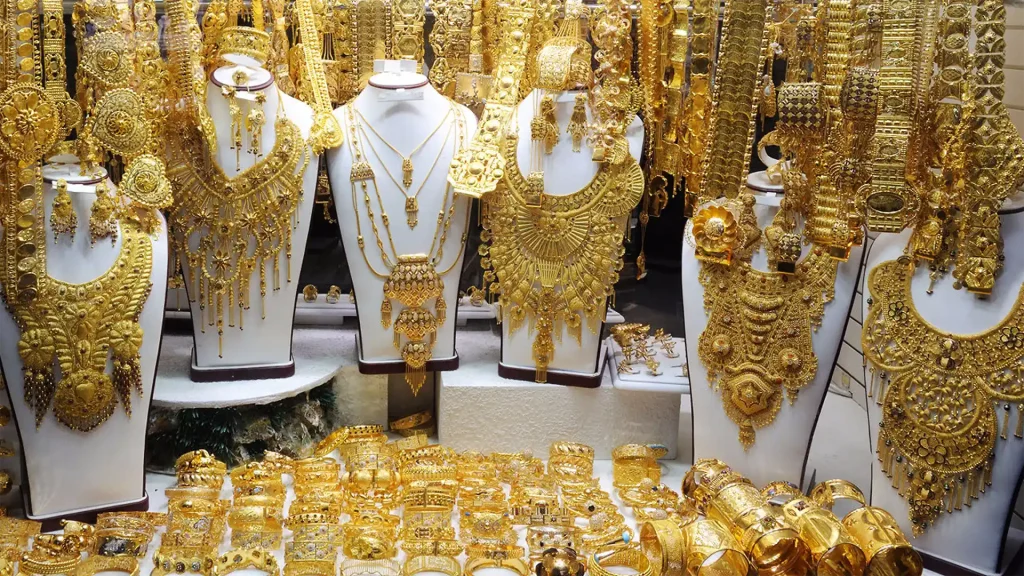
Gold rates in Dubai have declined, with the price of 24-carat gold falling by Dh11 to reach Dh505.50 per gram, marking a noticeable drop in the precious metal’s latest retail rate across the emirate.
Dubai Gold Prices Fall by Dh11 as 24K Rate Drops to Dh505.50 per Gram.
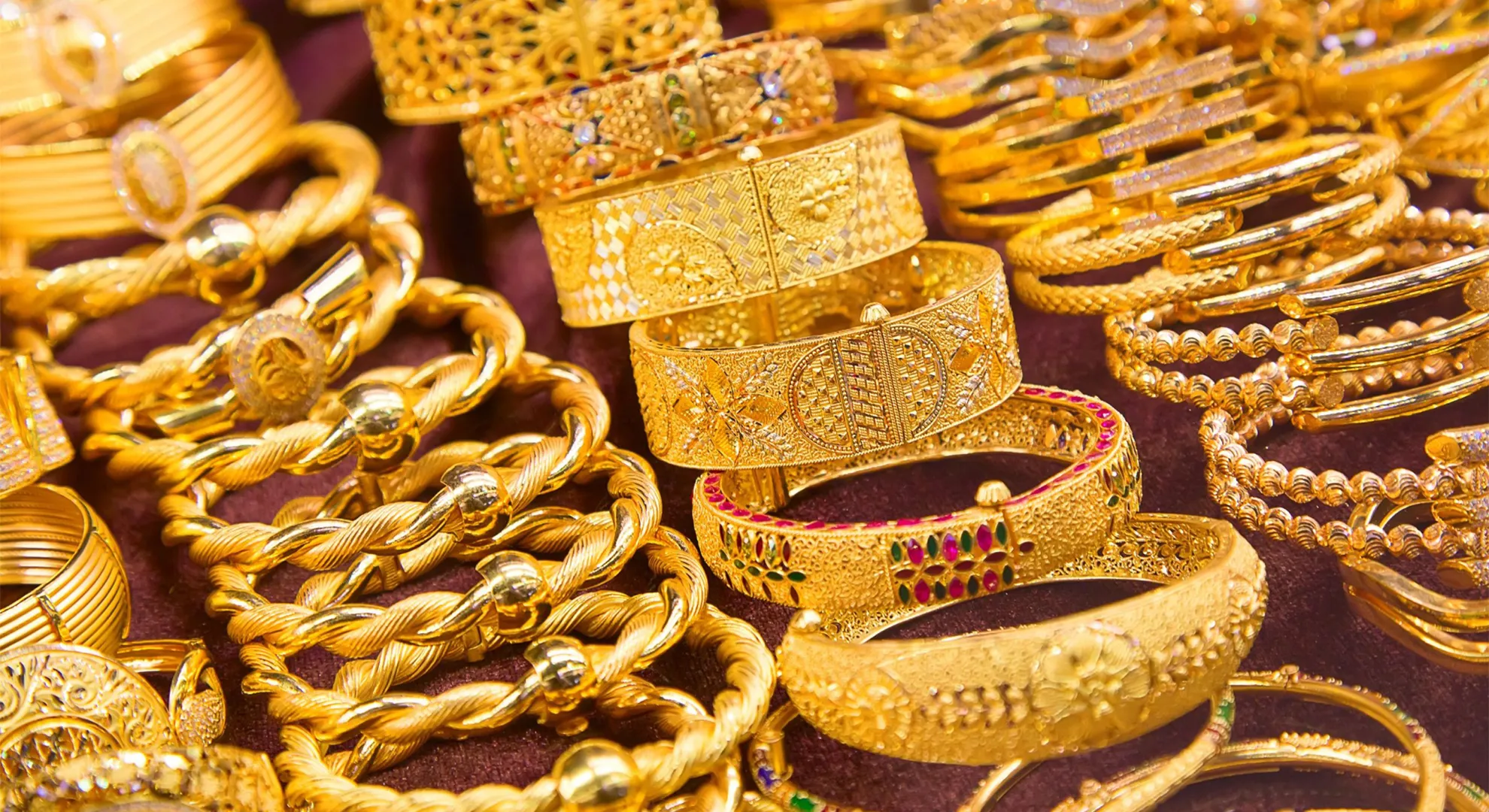
Gold prices continue to face downward pressure as the US dollar strengthens to levels not seen in three months, supported by expectations of a firm Federal Reserve stance and renewed selling across global government bond markets.
Dubai gold prices slide as stronger dollar puts pressure on bullion
Gold prices in Dubai moved lower at the beginning of Monday’s trading session, with the rate for 24-carat gold declining by Dh11 per gram.
The latest drop brought the 24K gold price to Dh505.50 per gram at the market opening. The decline extends a period of weakness for the precious metal, which has already fallen by Dh18.25 per gram over the previous seven days.
The softer prices in Dubai come as gold faces pressure in international markets, particularly from renewed strength in the US dollar. Expectations surrounding US interest rates and the direction of Federal Reserve policy have also been influencing investor sentiment towards bullion.
24K gold drops to Dh505.50
The 24K category, which represents the highest purity commonly traded in the market, opened at Dh505.50 per gram on Monday.
Other gold purity categories were also quoted at lower levels.
The latest rates were:
24K gold: Dh505.50 per gram
22K gold: Dh468 per gram
21K gold: Dh448.75 per gram
18K gold: Dh384.75 per gram
14K gold: Dh300 per gram
The latest movement means buyers in Dubai are seeing a noticeable change in the retail value of gold compared with the previous week.
For 24K gold, the accumulated decline over the past seven days stands at Dh18.25 per gram.
The movement follows a period in which international investors have been reassessing the outlook for US monetary policy, while the dollar has strengthened against other major currencies.
Dollar recovery weighs on bullion
The US dollar has been one of the key factors affecting gold prices in recent trading sessions.
The currency has recovered strongly and is currently trading around three-month highs. The move has created additional pressure on dollar-denominated commodities, including gold.
A stronger dollar can make gold more expensive for investors holding other currencies, potentially reducing demand.
At the same time, expectations that the US Federal Reserve could maintain a relatively hawkish approach to monetary policy have contributed to the strength of the dollar.
Investors are also responding to movements in global bond markets, where rising yields have affected the attractiveness of various asset classes.
These developments have combined to create a more challenging environment for gold in the short term.
Global gold prices fall
The weakness was also visible in international markets.
Global gold prices declined by 2.01 per cent to Dh4,191.88 per ounce as of 9:10am UAE time.
Silver experienced an even sharper decline during the same period, falling 3.51 per cent to $61.92 per ounce.
The simultaneous weakness in both precious metals reflects the broader pressure affecting the sector.
Gold and silver are influenced by several factors, including movements in the US dollar, interest-rate expectations, bond yields, inflation concerns and investor demand.
In the current environment, currency and monetary-policy expectations have become particularly important as traders attempt to assess where precious metals could move next.
Fed policy remains a major market driver
Vijay Valecha, Chief Investment Officer at Century Financial, said gold continues to be affected by the dollar’s recovery and expectations surrounding US monetary policy.
According to Valecha, energy costs and expectations of further Federal Reserve rate increases have played a significant role in determining the direction of gold prices in recent weeks.
Higher borrowing costs can create pressure on bullion because gold does not generate regular interest income.
When interest rates and bond yields rise, investors may find interest-bearing assets comparatively more attractive.
This can increase the opportunity cost of holding gold and contribute to selling pressure.
Valecha noted that the impact of these expectations can be seen in the way gold has traded within a relatively narrow range.
Market participants have repeatedly adjusted their expectations regarding the future course of Federal Reserve policy, resulting in periods of uncertainty for bullion.
Traders continue to reassess interest-rate expectations
The outlook for US monetary policy remains one of the most closely watched issues in financial markets.
Investors regularly examine economic data, inflation figures and statements from Federal Reserve officials for clues about future interest-rate decisions.
A more hawkish policy outlook can support the dollar and push yields higher, creating headwinds for gold.
Conversely, expectations of lower rates can potentially increase demand for bullion by reducing the relative attractiveness of interest-bearing investments.
This sensitivity means gold can react quickly whenever expectations surrounding the Federal Reserve change.
The recent price action suggests that traders remain cautious and are continuing to adjust their positions as they interpret new signals from the US economy.
Gold still attracts long-term investor interest
Despite the recent decline, Valecha pointed out that some investors continue to expect gold to move higher over the longer term.
The precious metal continues to play an important role in many investment portfolios because it is often viewed as a diversification tool and a potential hedge during periods of market uncertainty.
This longer-term demand can help offset some of the short-term selling pressure caused by a stronger dollar and higher borrowing costs.
Valecha also highlighted continued demand from exchange-traded funds as an indication that investor interest in gold remains significant.
The continued participation of such investors suggests that the recent weakness has not eliminated the broader demand for bullion.
Instead, the market appears to be balancing short-term macroeconomic pressure against longer-term interest in gold as a portfolio asset.
Technical support becomes important
Apart from fundamental factors, traders are also watching technical indicators to determine whether gold could find support after its recent decline.
Valecha identified the $4,261 level as an important technical area for gold.
According to his analysis, the level is supported by an upward-sloping trendline formed by connecting several previous lows recorded on July 17, July 29, August 3 and September 16.
Such trendlines are closely watched by technical traders because they can indicate areas where buying interest may emerge.
Valecha noted that Thursday’s daily candle did not close below this trendline.
The inability of prices to break decisively beneath that support level was seen as a sign that the trendline continued to hold.
This may help limit the downside in the near term, although the market remains vulnerable to further movements in the dollar, interest rates and bond yields.
Silver follows a similar pattern
Silver has also experienced pressure, although its latest decline was larger in percentage terms.
The metal was down 3.51 per cent at $61.92 per ounce as of 9:10am UAE time.
According to Valecha, silver has also been showing signs of technical support.
He pointed to the $63.48 region, where Friday’s price movement found support.
The presence of support levels in both gold and silver suggests that traders are closely monitoring technical signals alongside broader economic developments.
Valecha said the price behaviour of the two metals indicated a market structure that remained tilted towards the upside.
However, the short-term direction remains dependent on whether these support areas continue to hold.
Stronger dollar creates additional pressure
The recent recovery in the US dollar has become one of the most important factors behind the weakness in precious metals.
Gold is generally traded internationally in US dollars. When the dollar becomes stronger, gold can become more expensive for buyers using other currencies.
This can affect international demand and place downward pressure on prices.
The dollar’s movement is closely linked to expectations for US interest rates.
If traders believe the Federal Reserve will keep rates high for longer, the dollar can receive additional support as investors anticipate relatively attractive returns from US assets.
That dynamic can create a challenging environment for gold.
The latest movement in Dubai’s gold market therefore reflects a combination of international currency movements and expectations about US monetary policy rather than an isolated change in local demand.
Treasury yields add to the pressure
Simon-Peter Massabni, head of business development at xs.com, also highlighted the role of the US dollar and Treasury yields in weighing on gold.
According to Massabni, bullion has been facing pressure from the stronger US currency, rising Treasury yields and expectations that the Federal Reserve could continue with a restrictive monetary policy stance.
Treasury yields are particularly relevant for gold investors because they represent the return available from US government debt.
When yields rise, the opportunity cost of holding an asset that does not pay interest can increase.
This can encourage some investors to shift part of their exposure towards fixed-income assets, especially when expectations point towards interest rates staying elevated.
The combination of rising yields and a stronger dollar therefore represents a significant challenge for bullion.
Energy prices remain part of the equation
Energy costs have also influenced expectations in financial markets.
According to Valecha, movements in energy prices have been an important factor in determining the direction of gold in recent weeks.
Energy costs can influence inflation expectations, and inflation expectations can subsequently affect the monetary-policy outlook.
If investors believe inflation could remain persistent, they may expect central banks to keep interest rates elevated for longer.
That can strengthen the dollar and increase bond yields, both of which can weigh on gold.
This creates a chain of interconnected factors that traders must consider when evaluating the precious-metal market.
Gold continues to trade in a relatively tight range
Despite the recent decline, gold’s broader price action has not simply moved in one direction.
Valecha noted that the metal has been trading within a relatively narrow range as traders repeatedly reassess the likely direction of Federal Reserve policy.
This kind of trading environment often occurs when investors are uncertain about the next major market catalyst.
Rather than committing strongly to either side, traders may adjust their positions as new information becomes available.
US economic indicators, inflation data, Federal Reserve comments and movements in Treasury yields can all influence those decisions.
As a result, gold may continue to experience periods of volatility as market expectations shift.
Why interest rates matter for gold
Gold does not provide an interest payment to investors.
Because of this, changes in interest rates can have a significant influence on its attractiveness relative to other assets.
When interest rates are low, the opportunity cost of holding gold may be relatively limited.
However, when rates and bond yields increase, investors can potentially earn higher returns from interest-bearing assets.
This can reduce the relative appeal of holding bullion.
Expectations are just as important as actual rate changes.
If traders believe the Federal Reserve is likely to keep rates elevated, markets can react even before a policy decision is formally announced.
That is one reason gold has remained sensitive to every development affecting expectations for US monetary policy.
Market participants monitor Fed signals
The Federal Reserve’s approach remains a central issue for gold traders.
Investors are watching closely for indications of whether US policymakers intend to maintain restrictive conditions or potentially adjust the pace of monetary tightening.
A hawkish stance generally provides support to the dollar and can push yields higher.
Both developments can create pressure on gold.
However, if expectations change and investors begin anticipating lower rates, the impact on gold could be different.
The uncertainty surrounding the future policy path has therefore contributed to the narrow trading range described by Valecha.
Investment demand provides some support
While macroeconomic factors are creating short-term pressure, continued investor demand is providing another side to the market story.
Gold has historically been regarded as a potential hedge and diversification instrument.
Investors may turn to the metal during periods of financial uncertainty or when they want to reduce dependence on other asset classes.
Exchange-traded fund activity remains one indicator of investment interest.
Valecha said ETF demand continues to be strong, suggesting that some investors remain committed to gold despite the recent price weakness.
This demand could help provide a degree of support if prices approach important technical levels.
Dubai market reflects global developments
The movement in Dubai’s gold rates demonstrates how closely the local market is connected to international bullion prices.
When gold falls in global markets, the change is generally reflected in local prices.
The latest decline in Dubai therefore comes alongside a broader retreat in international gold prices.
For local consumers, this means the current market environment could influence the cost of purchasing jewellery or investment gold.
The decline of Dh18.25 per gram over the past week is particularly notable for buyers purchasing larger quantities, as the difference can add up across multiple grams.
However, consumers should remember that the final price of jewellery can also depend on factors beyond the underlying gold rate.
Different purity levels show corresponding rates
The Dubai market quotes gold according to different purity categories.
The highest rate among the figures provided was for 24K gold at Dh505.50 per gram.
22K gold was priced at Dh468 per gram, while 21K stood at Dh448.75.
The rate for 18K gold was Dh384.75 per gram, and 14K gold was quoted at Dh300.
These differences reflect the varying proportion of pure gold contained in each category.
The rates are particularly relevant to jewellery buyers, many of whom purchase gold in different purities depending on the type of product they want.
Precious metals face a changing market environment
The latest declines in gold and silver come during a period of shifting expectations across financial markets.
Currency movements, bond yields, interest-rate forecasts and energy costs are all influencing investor decisions.
The stronger US dollar has been one of the clearest sources of pressure.
At the same time, the prospect of a restrictive Federal Reserve policy has kept attention focused on borrowing costs and Treasury yields.
These factors have made the short-term environment more challenging for precious metals.
Yet the presence of technical support and continued investment demand indicates that there are also factors working against a deeper decline.
Analysts watch key price levels
Technical levels are particularly important during periods when fundamental market signals are mixed.
For gold, the $4,261 area identified by Valecha is being watched as a significant support point.
The level is connected to an upward trendline based on previous market lows.
The fact that gold’s daily candle remained above the trendline was interpreted as evidence that the support had not been broken.
Silver is being monitored in a similar manner, with the $63.48 region identified as a support area following Friday’s trading activity.
If such levels continue to hold, they could remain important reference points for traders assessing the market’s direction.
Short-term weakness versus longer-term demand
The current gold market can be viewed through two different time frames.
In the short term, the metal is dealing with several negative factors.
The US dollar has strengthened, Treasury yields have risen and expectations for a restrictive Federal Reserve policy have increased.
Together, these developments can make gold less attractive to some investors.
Over a longer horizon, however, gold continues to benefit from its established role as a portfolio-diversification asset.
ETF demand remains firm, according to Valecha, indicating that some investors continue to see value in maintaining exposure to the metal.
This difference between short-term and longer-term factors helps explain why gold can experience pressure while still retaining significant investor interest.
What traders are watching now
Market participants are likely to continue focusing on several key indicators.
The direction of the US dollar will remain important because of its close relationship with dollar-denominated commodities.
Treasury yields will also be closely followed because changes in yields can alter the relative attractiveness of gold.
Federal Reserve communication will provide further clues about the future path of monetary policy.
Energy prices and inflation expectations will also remain relevant because they can influence decisions about interest rates.
At the same time, traders will monitor the technical support levels identified by analysts to determine whether the recent weakness is stabilising.
Dubai gold prices reflect the latest global pressure
The Dh11 per gram decline in Dubai’s 24K gold rate is part of a broader movement in international bullion markets.
At Dh505.50 per gram, the latest Dubai price represents a significant change from the previous week’s level.
The precious metal has now lost Dh18.25 per gram over seven days, with the stronger US dollar and changing expectations around US monetary policy contributing to the pressure.
Internationally, gold was down 2.01 per cent at Dh4,191.88 per ounce, while silver declined 3.51 per cent to $61.92 per ounce at 9:10am UAE time.
Analysts continue to monitor the interaction between the dollar, Treasury yields, Federal Reserve policy and technical support levels.
For now, gold remains caught between short-term macroeconomic headwinds and longer-term investor demand.
The stronger dollar and expectations of higher borrowing costs are limiting the metal’s momentum, while continued ETF demand and technical support could help prevent a more pronounced decline.
With the Federal Reserve outlook still a major source of uncertainty, further changes in interest-rate expectations could have a significant impact on bullion prices.
For Dubai’s gold market, the immediate result has been a lower opening rate, with 24K gold settling at Dh505.50 per gram and the other major purity categories following the broader downward trend.