A sprawling 35-bedroom mansion in Ras Al Khaimah, famously known as the “Haunted Palace,” has been listed for sale, with the striking property now carrying an asking price of Dh23.5 million.
RAK’s 35-Room ‘Haunted Palace’ Hits the Market for Dh23.5 Million.
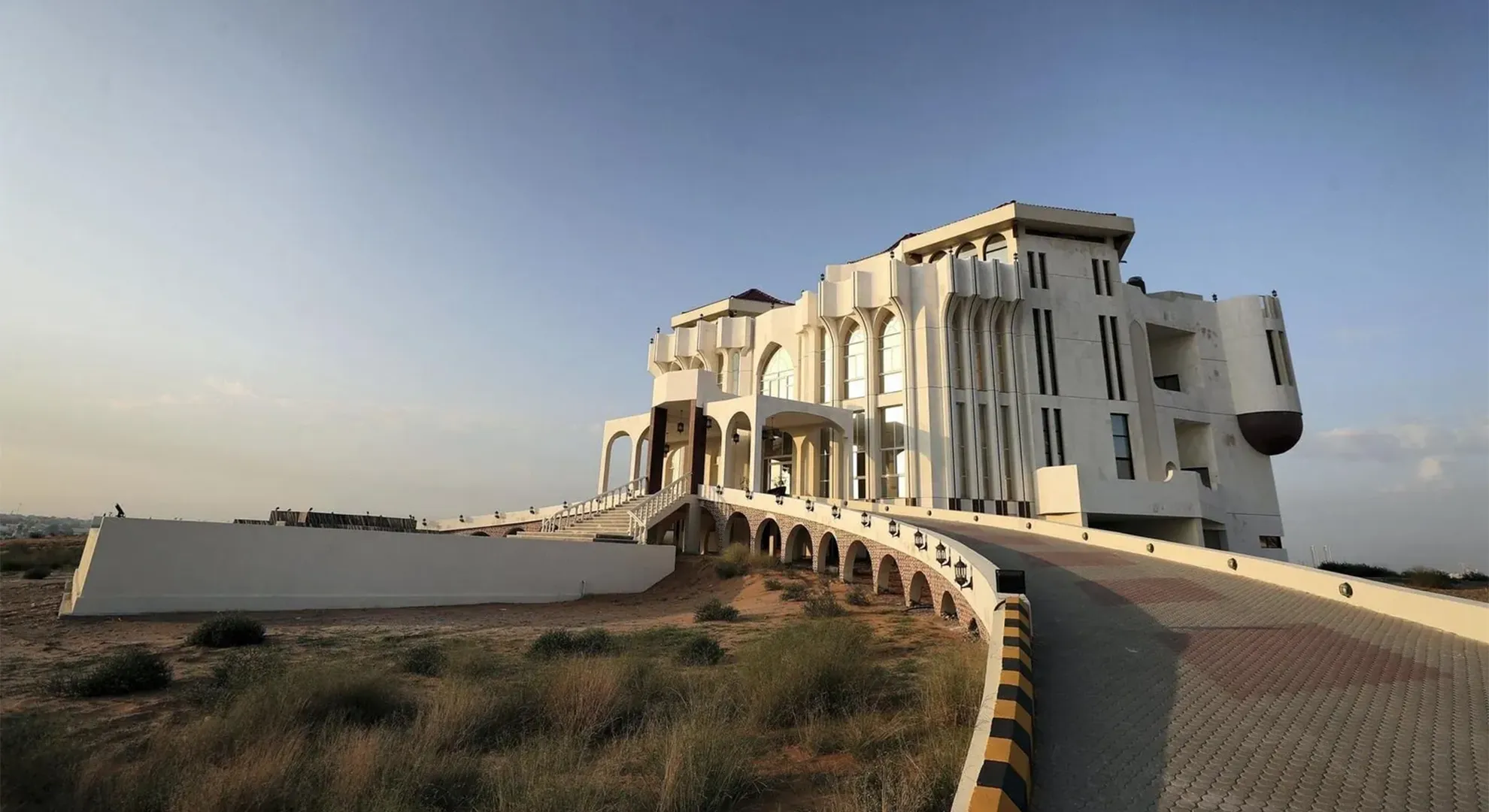
For years, Al Qasimi Palace has attracted widespread fascination because of the eerie stories surrounding it. Now, its mysterious and allegedly haunted past appears to be adding to the property’s appeal, turning an unusual reputation into a potential advantage for prospective buyers.
Ras Al Khaimah’s Famous ‘Haunted Palace’ Returns to the Market
A mysterious palace in Ras Al Khaimah that has fascinated residents and visitors for decades is once again available for purchase. Known widely as the “Haunted Palace”, the striking property has developed an unusual reputation over the years, with stories surrounding its empty rooms and elaborate interiors becoming part of its identity.
Rather than putting buyers off, however, the palace’s mysterious history appears to be contributing to its appeal. Property representatives say the landmark has already attracted attention from investors who are considering a variety of ways to transform and make use of the unusual estate.
The Al Qasimi Palace is currently being offered at Dh22.5 million without its furniture and decorative contents. Buyers who want the property together with its original artefacts and collectibles can acquire it for Dh23.5 million.
The enormous estate features 35 bedrooms and sits on a plot measuring approximately 191,742 square feet. The built-up area covers around 33,827 square feet, giving the property considerable scope for redevelopment or conversion into a destination with a commercial or hospitality purpose.
The sale is being handled by Bishop & Knight. Managing partner Josh Henry said the company has already spoken with several potential purchasers, each of whom appears to have a different concept for the future of the palace.
According to Henry, discussions with interested parties have revealed a wide range of ideas about how the property could eventually be used. The distinctive architecture, large size and location make it a property that could potentially appeal to buyers looking beyond a conventional private residence.
Bishop & Knight is working alongside Abubakr Siddiq, a luxury property adviser at Mehar Properties, to promote the palace to a wider pool of prospective buyers. Siddiq has also been using his substantial Instagram following to showcase the property to investors and people interested in high-value real estate.
Interest has not been limited to buyers based in the UAE. Siddiq said enquiries have also arrived from overseas, demonstrating that the unusual property has attracted attention beyond the local market.
Potential buyers from countries including the UK and India, as well as investors from elsewhere in the region, have reportedly shown interest and submitted bids for the estate.
For many of those considering the property, the attraction extends beyond the palace itself. The continuing development of Ras Al Khaimah, particularly the growth of its tourism industry and the expansion of Marjan Island, is believed to be an important factor behind investor interest.
The emirate has been increasingly developing its profile as a destination for tourism, hospitality and luxury real estate. Against that backdrop, a large and distinctive property such as the Al Qasimi Palace could offer investors an opportunity to create something that stands apart from more conventional developments.
A Palace Surrounded by Mystery
The story of Al Qasimi Palace stretches back several decades. Built in 1985, the grand residence was commissioned by the late Sheikh Abdulaziz bin Humaid Al Qasimi, a member of Ras Al Khaimah’s ruling family.
Constructed on elevated ground, the palace was designed to be an extraordinary architectural statement rather than a typical family home. Its interiors brought together artistic influences from several different countries, resulting in a highly elaborate and eclectic style.
Craftspeople from Iran, Morocco, India and China are said to have contributed to the palace’s decoration. The interiors incorporated intricate mosaics, colourful painted tiles, frescoes and decorative walls featuring artistic designs, including images of birds and lines of poetry known as ghazals.
The attention to detail extended throughout the building. French and Belgian crystal chandeliers were installed in the palace, adding to the grandeur of its large interior spaces. Decorative plasterwork was also used extensively, with sculptures resembling pigeons and owls incorporated into some of the walls.
The scale and extravagance of the project reportedly came at a huge cost, with construction said to have exceeded Dh500 million.
Despite the enormous investment involved in creating the palace, Sheikh Abdulaziz reportedly never moved into the property.
One explanation associated with the decision relates to objections from members of the family regarding sculptures and artworks depicting people and animals. As a result, the lavish residence remained largely unused.
Its long period of emptiness eventually became central to the stories that surrounded it.
Decades of Rumours
For close to 35 years, the palace remained unoccupied. During that time, rumours about strange occurrences began to circulate, helping create the eerie reputation that eventually earned the property its nickname.
Stories about unexplained incidents and unusual experiences helped turn the building into a source of fascination for people in the UAE. The combination of its isolated appearance, imposing architecture and years of vacancy provided plenty of material for speculation.
Over time, the nickname “Haunted Palace” became closely associated with Al Qasimi Palace. While the stories surrounding the building have contributed significantly to its public image, they have also made it one of the more recognisable unusual properties in Ras Al Khaimah.
The palace’s reputation has continued to attract curiosity from people interested in its history, architecture and the stories that have emerged around it.
Rather than allowing the building to remain forgotten, a new chapter began in 2019 when Tareq Ahmad Al Sharhan took steps to revive the property.
From Abandoned Mansion to Museum
In 2019, the palace was given a new lease of life when it was transformed into a museum. The attraction was given the name Al Qasr Al Ghamedh, which translates roughly as “the palace of ambiguity”.
The conversion allowed members of the public to enter a building that had previously been largely inaccessible and surrounded by mystery.
Visitors were able to explore the palace’s elaborate interiors and see its distinctive architectural and artistic features for themselves. The museum offered an opportunity to experience the building beyond the rumours that had surrounded it for years.
Entry was priced at Dh75 per person, allowing visitors to see the unusual collection of interiors, artwork and decorative elements inside the property.
The museum phase also added another dimension to the palace’s story. Instead of existing solely as an empty and mysterious landmark, the building became a destination where people could experience its architecture and learn more about its past.
New Possibilities for the Landmark
The palace’s return to the property market now raises questions about what could come next.
The agents handling the sale say prospective buyers have different concepts for the estate. Its size, distinctive design and location mean that it could potentially be adapted for several purposes, depending on the vision and investment strategy of its eventual owner.
For some investors, the palace could represent an opportunity to preserve an unusual piece of local history. Others may see potential for a hospitality, tourism or entertainment concept that takes advantage of the property’s distinctive character.
Its unusual reputation could also become part of any future business strategy. The “Haunted Palace” identity has already made the building recognisable, while its elaborate interiors provide a setting unlike that of a typical luxury property.
At the same time, the wider development taking place in Ras Al Khaimah could give the property additional significance.
The emirate has been attracting increasing attention from investors and tourists as it develops its hospitality and leisure sectors. Marjan Island, in particular, has become a major focus of investment and tourism development.
For potential buyers, the palace’s location within this changing landscape may be as important as the building itself. An investor could potentially use the property’s history and unusual architecture to create a destination aimed at tourists, visitors or luxury consumers.
The reported interest from buyers in the UK, India and other parts of the region suggests that the palace has already captured attention beyond Ras Al Khaimah.
A Property With a Story of Its Own
Luxury properties often compete on location, size, design and amenities. Al Qasimi Palace offers something considerably different: a long and unusual story.
Its history combines royal connections, international craftsmanship, extravagant architecture, decades of vacancy, rumours of paranormal activity and a later transformation into a museum.
That combination has helped make the property a distinctive part of Ras Al Khaimah’s landscape.
The palace’s 35 bedrooms and expansive grounds provide the scale expected from a major luxury estate, while its highly decorated interiors distinguish it from conventional residential properties.
The decision to offer the palace with or without its original furnishings and collectibles also gives prospective buyers different options. Those seeking to preserve the property’s existing character could acquire it complete with its artefacts, while another buyer may prefer the lower asking price and greater freedom to introduce a new concept.
The difference between the two asking prices is Dh1 million, with the unfurnished option available for Dh22.5 million and the version containing the original artefacts and collectibles priced at Dh23.5 million.
For investors interested in heritage properties, the contents could be an important part of the attraction because they contribute to the atmosphere and identity that have made the palace famous.
What Comes Next?
The future of Al Qasimi Palace is now in the hands of whoever ultimately acquires it.
According to the agents involved, potential purchasers are approaching the property with different plans. While some may be attracted by its history, others may focus on the opportunities created by its location and the continued development of Ras Al Khaimah.
The palace therefore stands at an interesting point in its history. A building that once remained empty for decades, and later opened its doors as a museum, is now looking for a new owner and potentially another transformation.
Whether its next chapter involves tourism, hospitality, private use or another concept altogether remains to be seen.
What is clear is that the building’s unusual past remains one of its defining features. The stories that once surrounded an empty palace have helped turn it into a recognisable landmark, and that same reputation is now forming part of the property’s appeal to prospective investors.
With an asking price of Dh22.5 million without its furnishings, or Dh23.5 million including its original artefacts and collectibles, the 35-bedroom estate is once again attracting attention from the property market.
As Ras Al Khaimah continues to strengthen its position as a tourism and investment destination, buyers will be considering not only the palace itself but also the possibilities that could emerge from its location, scale and extraordinary history.
Future Possibilities for the Palace
With the Al Qasimi Palace now back on the market, potential buyers are looking beyond its unusual history and considering what the property could become in the years ahead. According to luxury property adviser Abubakr Siddiq, the estate offers several possible directions, ranging from private residential use to hospitality and tourism-related projects.
Its enormous size and distinctive character mean that the palace does not necessarily have to remain a conventional home. Depending on the buyer’s objectives and the required approvals, the property could potentially be transformed into a private residence, an exclusive hospitality destination or a venue designed to attract visitors.
For many prospective buyers, however, the palace’s identity is impossible to separate from the stories that have surrounded it for decades.
The building has long been associated with tales of unexplained events. Local stories about lights appearing to flicker inside the property and unexplained noises have circulated for years. As these accounts have been repeated and retold, they have become part of the mythology surrounding the palace.
Whether or not people believe the stories, they have undoubtedly contributed to the building’s unusual appeal. The “Haunted Palace” nickname has become an important part of its public identity and is frequently mentioned when the property is discussed with interested purchasers.
Rather than viewing the reputation as an obstacle, some potential investors may see it as an opportunity to create a distinctive experience around the property.
A future owner could, for example, choose to preserve the mysterious character of the palace while developing a concept that makes its history part of the visitor experience. Alternatively, the buyer could take a completely different approach and focus on the estate as a private retreat, with little emphasis on its reputation.
The property’s surroundings also make it different from an isolated abandoned mansion. Abubakr pointed out that the palace is located within an active community, with mosques, shops and other everyday amenities in the surrounding area.
That setting could be an important consideration for anyone planning a major redevelopment project. While the palace itself has an imposing and almost otherworldly appearance, it exists within a functioning neighbourhood where ordinary residential and commercial activity continues around it.
This combination of an extraordinary landmark and a conventional urban environment gives potential owners considerable room to explore different possibilities.
A Private Estate for Generations
For Josh Henry of Bishop & Knight, one possible future would be to retain the palace primarily as a private family property.
He believes that the right purchaser could transform the estate into a highly personalised retreat, effectively creating a private world within the large grounds.
Rather than treating the property simply as another luxury home, an owner could use its size to create a multigenerational estate where family members could spend extended periods together.
The palace’s extensive grounds could be redesigned according to the preferences of the new owner. Landscaping, gardens, recreational spaces and other private facilities could potentially be introduced, while the existing structure could be restored or adapted to suit contemporary requirements.
Such an approach could also allow the buyer to preserve elements of the palace’s original identity while introducing modern features.
The scale of the property means that a future owner would have space to develop a highly individual concept. The building could be restored, redesigned or partially remodelled, depending on the purchaser’s objectives.
For a family looking for a unique private residence, the estate could provide something that conventional luxury villas cannot easily offer: a large historic structure with an established identity and enough land to accommodate future changes.
The idea would be to create a place where several generations could gather under one roof, while still having enough space for privacy and recreation.
The property could therefore become less of a traditional residence and more of a long-term family estate.
Potential for Hospitality and Events
A completely different vision could involve turning the palace into a destination for visitors.
According to Josh, another buyer may see potential in developing the property for hospitality or events, provided all necessary permissions and approvals are obtained.
The building’s architecture and history could make it an unusual setting for a range of experiences. Its distinctive interiors could potentially provide a dramatic backdrop for private functions, cultural activities, celebrations or other events.
A hospitality concept could also make use of the palace’s reputation.
The unusual stories associated with the building could become part of its marketing identity, creating an experience centred around its history and atmosphere. A future operator could choose to highlight the mystery surrounding the palace while offering guests a luxury-focused experience.
Alternatively, the property could be positioned around its architectural and artistic qualities rather than its “haunted” reputation.
Its intricate decorative elements, expansive rooms and unusual design already give the building a visual character that could potentially appeal to visitors interested in architecture, history and distinctive destinations.
A successful hospitality concept would, of course, depend on the necessary regulatory approvals, investment and redevelopment work.
The property’s future use would ultimately be determined by the purchaser and by what is permitted under applicable planning and development requirements.
Preserving the Past While Creating Something New
One of the more interesting aspects of the property is the possibility of combining its history with a completely new purpose.
The palace has already experienced several stages during its existence. It began as an ambitious private residence, remained unused for decades, developed an unusual reputation and was later opened to visitors as a museum.
Its return to the market could therefore represent another turning point.
The next owner may decide to preserve much of the existing building, restore sections that require attention and introduce carefully selected modern additions.
Alternatively, the purchaser may want to undertake a more extensive transformation.
Unlike many properties with historic significance, the Al Qasimi Palace does not reportedly carry heritage restrictions that would prevent an owner from making major changes.
This gives the buyer an unusually broad range of options.
Flexibility for the New Owner
The absence of heritage restrictions means that the future owner is not necessarily required to maintain the property exactly as it currently exists.
Depending on the relevant permissions, the purchaser could renovate the existing structure, remodel the interiors, redesign parts of the grounds or undertake much more substantial redevelopment.
The possibility of demolition and rebuilding also reportedly remains open.
That level of flexibility can be significant for an investor considering a property of this scale. Instead of being limited to restoration, a buyer can potentially approach the site as a blank canvas while deciding how much of the existing palace should remain.
For someone interested in preserving history, that flexibility could be used to restore the original architecture and decorative details.
For another investor, it could provide an opportunity to create an entirely new development that incorporates selected elements of the existing palace.
The choice ultimately depends on the purchaser’s vision, budget and intended use.
A Property With Multiple Identities
The Al Qasimi Palace is unusual because it can be viewed from several different perspectives.
To some, it is a grand private residence with considerable potential as a family estate.
To others, it is a distinctive architectural landmark with the potential to become a tourism or hospitality destination.
For some visitors and investors, the stories surrounding the building are its biggest attraction.
And for others, the property may simply represent a large development opportunity in a growing emirate.
These different interpretations are reflected in the range of ideas being discussed by prospective buyers.
The palace’s future does not appear to be tied to a single predetermined concept. Instead, its new owner will have the opportunity to decide what role the property should play.
That could make the sale particularly interesting because the buyer is not simply acquiring a finished product. They are acquiring a property with the potential for a new identity.
The Surrounding Area
The palace’s location is another factor that could influence its future.
Although the building has acquired an almost legendary reputation, it is situated in an area where normal daily life continues around it.
Mosques, shops and other community facilities are located nearby, meaning that any future development would need to take its surroundings into account.
At the same time, the presence of existing amenities could be beneficial for a residential or hospitality project.
The property is therefore not completely detached from the wider community. Its future use would form part of the broader environment of Ras Al Khaimah.
For a private buyer, this provides access to everyday facilities while still offering the privacy and scale associated with a large estate.
For a commercial investor, the surrounding activity could potentially support a destination-based concept, subject to planning and regulatory considerations.
Turning an Unusual History Into an Opportunity
The stories associated with the palace have helped keep public attention focused on the property for years.
Accounts of unexplained sounds, flickering lights and other unusual incidents have become part of the building’s folklore. Over time, the stories have been repeated often enough to contribute significantly to its “Haunted Palace” identity.
For a prospective buyer, that reputation could be approached in different ways.
One owner might prefer to distance the property from the supernatural stories and focus entirely on its architecture, privacy and luxury.
Another could embrace the history and incorporate the mystery into a tourism or entertainment concept.
The ability to choose between these approaches is one of the property’s distinctive characteristics.
The future owner could essentially decide which aspects of the palace’s identity should remain central and which should be left behind.
A New Chapter
Whatever direction the eventual purchaser chooses, the property appears to offer significant room for reinvention.
A private owner could turn it into a multigenerational family retreat. An investor could explore a hospitality project. An events operator could potentially create a distinctive venue. Another buyer could undertake a major redevelopment and build something almost entirely new.
The absence of heritage restrictions gives the purchaser additional freedom to determine how far that transformation should go.
At the same time, the palace’s history provides something that cannot easily be recreated: a story.
Its architectural design, decades of vacancy, museum chapter and reputation for mysterious occurrences have combined to give the property an identity that is already known to many people.
That history could either be preserved as a central part of its future or used as a foundation for something entirely different.
For now, the next chapter remains unwritten.
The Al Qasimi Palace has already gone from an ambitious private residence to an empty and mysterious landmark, and later to a museum open to visitors. Its latest transition is likely to be determined by the vision of whoever eventually acquires it.
As potential buyers consider the possibilities, the palace stands as a rare type of property: one where the new owner has the opportunity not only to purchase a substantial estate, but also to decide what its next identity will be.