A ferry operating near Palawan in the Philippines caught fire, resulting in the deaths of five people, according to the country’s coast guard. Authorities are investigating the incident while efforts continue to assess the full extent of the tragedy.
Ferry Blaze Near Philippines’ Palawan Claims Five Lives, Coast Guard Reports.
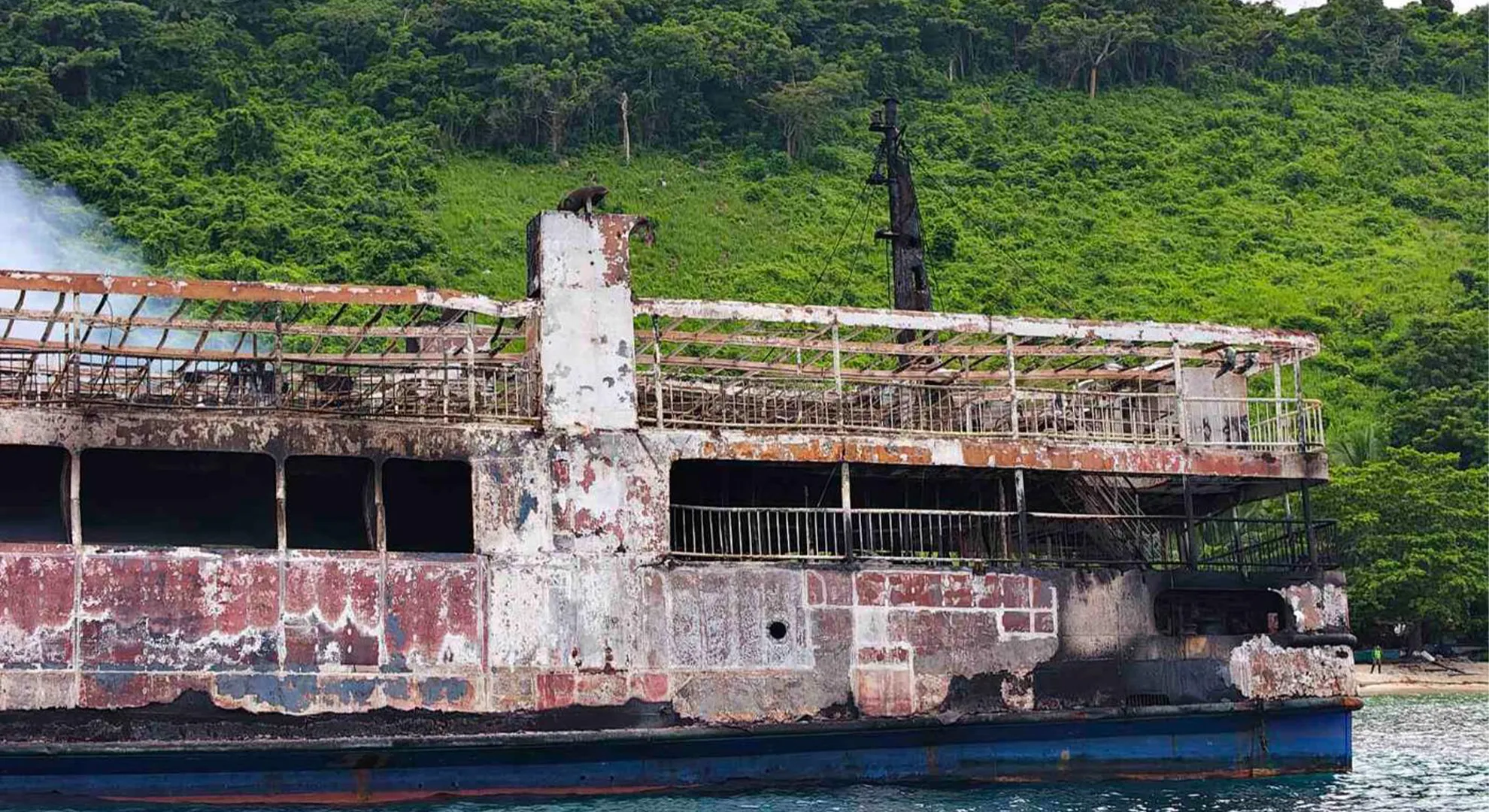
According to photographs released by the Coast Guard, the boat was carrying more than 100 people when it caught fire near a popular tourist destination, with the entire vessel rapidly becoming engulfed in flames.
A fire erupted aboard a passenger vessel in the waters off Palawan on Wednesday evening, prompting an emergency response from the Philippine Coast Guard and leaving at least five people dead, according to authorities and local media reports.
The incident involved the M/V June Aster, a vessel that was reportedly carrying more than 100 passengers along with members of its crew. The fire occurred near Coron, one of Palawan’s best-known tourist destinations, as the ship was operating in waters close to the municipality.
The Philippine Coast Guard said its personnel moved quickly after receiving reports of the blaze. In a statement posted Wednesday night, the agency said the incident took place approximately 1.2 nautical miles northeast of Barangay Marcilla, an area within the municipality of Coron.
The Coast Guard identified the vessel as the M/V June Aster and said it immediately dispatched responders to assist those aboard. The emergency operation focused on rescuing passengers and crew members and bringing those affected by the incident safely to shore.
Images released by the Coast Guard showed the vessel surrounded by thick smoke and intense flames. Much of the ship appeared to be on fire, with flames spreading across the vessel as emergency personnel worked to respond to the situation.
In a subsequent update, the Coast Guard reported that five casualties had initially been recorded. The agency said the bodies were brought ashore, while photographs accompanying the update showed several body bags at the scene.
Authorities also reported that dozens of people had survived the incident. According to the Coast Guard’s initial information, 42 individuals had been rescued following the fire.
The total number of people aboard the vessel was reported to be significantly higher. GMA News, citing a Coast Guard official, reported that the ship had 117 passengers and 17 crew members on board. If confirmed, that would put the total number of people aboard the vessel at 134.
The difference between the number of people reported aboard and the number confirmed rescued in the initial Coast Guard update means that authorities were still working to establish the full status of everyone who had been on the ship. Search-and-rescue efforts and efforts to account for passengers and crew were therefore an important part of the emergency response.
The incident occurred in an area that attracts large numbers of visitors because of Coron’s reputation as a major tourist destination. The municipality is known for its coastal scenery, islands, beaches and diving locations, making marine transportation an important part of travel in the region.
The fire therefore unfolded in waters frequented by passenger and tourist vessels, adding urgency to the response. The Coast Guard’s intervention was aimed at reaching the vessel, assisting people in distress and transporting survivors and casualties to safety.
Photographs distributed by the Coast Guard provided a visual indication of the severity of the blaze. The vessel could be seen heavily engulfed by flames, while dark smoke rose above the ship. The images underscored the scale of the emergency faced by those aboard.
In its social-media updates, the Coast Guard provided information about the rescue operation as authorities continued to assess the situation. The agency’s initial statement described the location of the incident and confirmed that its personnel had responded to the reported fire.
The Coast Guard later announced the initial number of casualties and rescues. At that stage, officials were still gathering information about the circumstances surrounding the incident and determining the status of everyone who had been aboard.
Marine traffic-tracking information also provided details about the vessel’s movements before the fire. Data from MarineTraffic indicated that the M/V June Aster had departed from Manila.
The tracking information offers context about the vessel’s journey before the emergency occurred, although the available reports do not by themselves establish what caused the fire or precisely when it began. Authorities would need to conduct a separate investigation to determine how the blaze started and how quickly it spread.
As with many maritime emergencies, establishing the cause can require examination of the vessel, interviews with survivors and crew members, and analysis of its route and operating conditions. Investigators may also examine safety procedures, emergency equipment and the circumstances under which passengers and crew were evacuated.
At the time of the initial reports, the Coast Guard had not publicly provided a definitive explanation for the cause of the fire. The available information primarily concerned the location of the incident, the rescue effort and the number of casualties and survivors reported during the early stages of the response.
The incident highlights the risks faced by passengers traveling by sea, particularly in an island nation such as the Philippines, where ferries and other vessels are an essential means of transportation. Maritime travel connects major cities with coastal communities and tourist destinations across the country’s thousands of islands.
Palawan is particularly dependent on sea transportation because of its geography. Coron, located in northern Palawan, serves as a gateway for travelers heading to surrounding islands and marine attractions. Boats and passenger vessels regularly operate in the area, carrying residents, workers and tourists.
The M/V June Aster was reportedly traveling with a large number of people when the emergency occurred. The reported figure of 117 passengers and 17 crew members illustrates the scale of the incident and the challenge faced by rescuers attempting to account for everyone on board.
The initial rescue figure of 42 people represented an important development in the response, but it did not provide a complete picture of the fate of all passengers and crew. Authorities were expected to continue gathering information as the operation progressed.
The Coast Guard’s reports also indicated that five people had died in the incident. The bodies were reportedly brought ashore, where authorities could begin the process of identification and notification of relatives.
For families waiting for information about loved ones, maritime disasters can be particularly difficult because communications may be disrupted and passenger manifests may need to be checked against those rescued or transported to medical facilities.
The authorities’ early updates were therefore significant in establishing what was known about the emergency. However, initial casualty figures in a developing maritime incident can change as rescue teams locate additional survivors or determine the status of missing individuals.
Local media reports also contributed to the emerging account of the disaster. GMA News cited a Coast Guard official for the figure of 117 passengers and 17 crew members aboard the vessel. The report provided additional detail about the scale of the voyage beyond the initial Coast Guard announcement.
The incident also attracted attention because it occurred close to a prominent tourist area. Coron is internationally recognized for its natural beauty and marine environment, and the surrounding waters are heavily associated with tourism. An emergency involving a passenger vessel in such an area can therefore affect both local residents and visitors.
The Coast Guard is responsible for responding to maritime emergencies and assisting vessels and people in distress. Its response to the June Aster fire involved rescuing those who were able to escape and bringing casualties to shore.
The photographs released by the agency showed the vessel in a dangerous condition. The intensity of the flames suggested that the fire had spread extensively by the time the images were taken. Such conditions can make it extremely difficult for people aboard a vessel to move safely and for rescuers to approach.
The emergency also demonstrates why rapid maritime response is critical when a passenger ship catches fire. Fires aboard vessels can spread quickly, particularly when they involve fuel, electrical systems, machinery or other combustible materials. Smoke can also create an immediate danger to people even before flames reach passenger areas.
However, the exact circumstances aboard the June Aster remained subject to investigation. The early reports did not establish which part of the vessel first caught fire, what caused the blaze or how passengers were evacuated.
Those questions are likely to form part of any subsequent inquiry into the incident. Investigators may seek statements from survivors and crew members, examine maintenance records and review the vessel’s safety systems.
The number of passengers and crew aboard will also be important to the investigation. Passenger manifests can help authorities determine who was traveling on the vessel and compare those records with the people who were rescued or accounted for after the fire.
At the time of the Coast Guard’s initial updates, the emergency remained a developing situation. Authorities were focused on rescue and recovery while information about the incident continued to emerge.
The first confirmed reports established several key facts: the M/V June Aster caught fire in waters near Coron; the vessel was carrying a large number of passengers and crew; Coast Guard personnel responded to the emergency; at least five people were reported dead; and dozens of people were rescued.
The vessel’s departure from Manila, as indicated by MarineTraffic tracking data, also helped establish the ship’s movements before the incident. Manila is the Philippines’ capital and a major transportation hub, from which passenger vessels regularly travel to destinations throughout the archipelago.
The journey from Manila toward Palawan would involve a significant stretch of maritime travel before reaching the waters around Coron. Tracking data can provide investigators with useful information about a vessel’s movements, although it cannot explain the cause of a fire or determine what occurred on board.
The Coast Guard’s public updates were issued through its social-media channels as emergency operations continued. The agency initially described the incident as a fire involving the M/V June Aster and gave the approximate location of the vessel in relation to Barangay Marcilla.
Later information provided the first casualty and rescue figures. Five deaths were initially reported, while 42 people were said to have been rescued. Additional information from local media indicated that the vessel’s manifest reportedly included 117 passengers and 17 crew members.
Because the incident involved a large number of people, authorities faced the difficult task of accounting for everyone aboard. Rescue teams may also have needed to determine whether anyone had entered the water during the emergency or was transported separately for medical treatment.
The condition of the rescued passengers was another matter for authorities and medical responders to assess. People escaping a ship fire can suffer from burns, smoke inhalation, injuries sustained during evacuation or exposure to the surrounding water.
At the same time, the recovery of those who died would require authorities to coordinate with local officials and families. Identification procedures are especially important following large-scale maritime accidents because passenger lists may contain incomplete or outdated information.
The tragedy occurred against the broader backdrop of the Philippines’ reliance on maritime transportation. With communities and tourist destinations spread across numerous islands, boats and ferries remain an essential component of everyday travel.
For the tourism industry in Palawan, marine transportation is also central to the movement of visitors. Travelers frequently use boats to reach islands, beaches, diving sites and other attractions around Coron. The fire involving the June Aster consequently drew attention because of both the loss of life and its proximity to a major tourist destination.
Despite the severity of the incident, the Coast Guard’s rescue operation resulted in dozens of people being brought to safety, according to its initial report. The agency continued to gather information while authorities worked to establish the complete number of people affected.
The circumstances leading to the fire were not immediately clear. Neither the Coast Guard’s initial account nor the reported tracking information provided a definitive cause. A full explanation would depend on the findings of investigators and any additional statements released by authorities.
For now, the known account centers on a passenger vessel that caught fire near Coron on Wednesday evening, a rapid response by the Philippine Coast Guard, and a rescue effort that brought at least 42 people ashore while five deaths were initially confirmed.
The disaster serves as a reminder of the dangers associated with emergencies at sea, where distance from shore, weather, vessel conditions and the speed at which a fire can spread can all complicate rescue operations.
As officials continue to establish the final number of passengers and crew affected, further details may emerge about how the fire began, how people were evacuated and what safety measures were in place aboard the vessel.
The Philippine Coast Guard’s initial reports, together with information from local media and MarineTraffic, provide the first outline of what happened. A more complete picture will depend on the results of the authorities’ continuing response and investigation.
For the families of those involved, however, the incident is already a devastating tragedy. The reported deaths aboard the June Aster have turned what began as a routine sea journey into a major maritime emergency, while the search for information about those still unaccounted for remains a critical priority.
The focus of authorities will now be on confirming the status of everyone who was aboard, assisting survivors, recovering and identifying those who died, and determining the cause of the fire. Those findings will be important not only for the families affected but also for understanding how the disaster occurred and whether additional measures are needed to improve passenger safety on similar voyages.