The Abu Dhabi falcon auction witnessed intense competition among bidders, with enthusiasm building rapidly as offers continued to rise, eventually pushing the highest bid to an impressive Dh200,000.
Abu Dhabi Falcon Auction Sees Fierce Bidding as Prices Climb to Dh200,000.
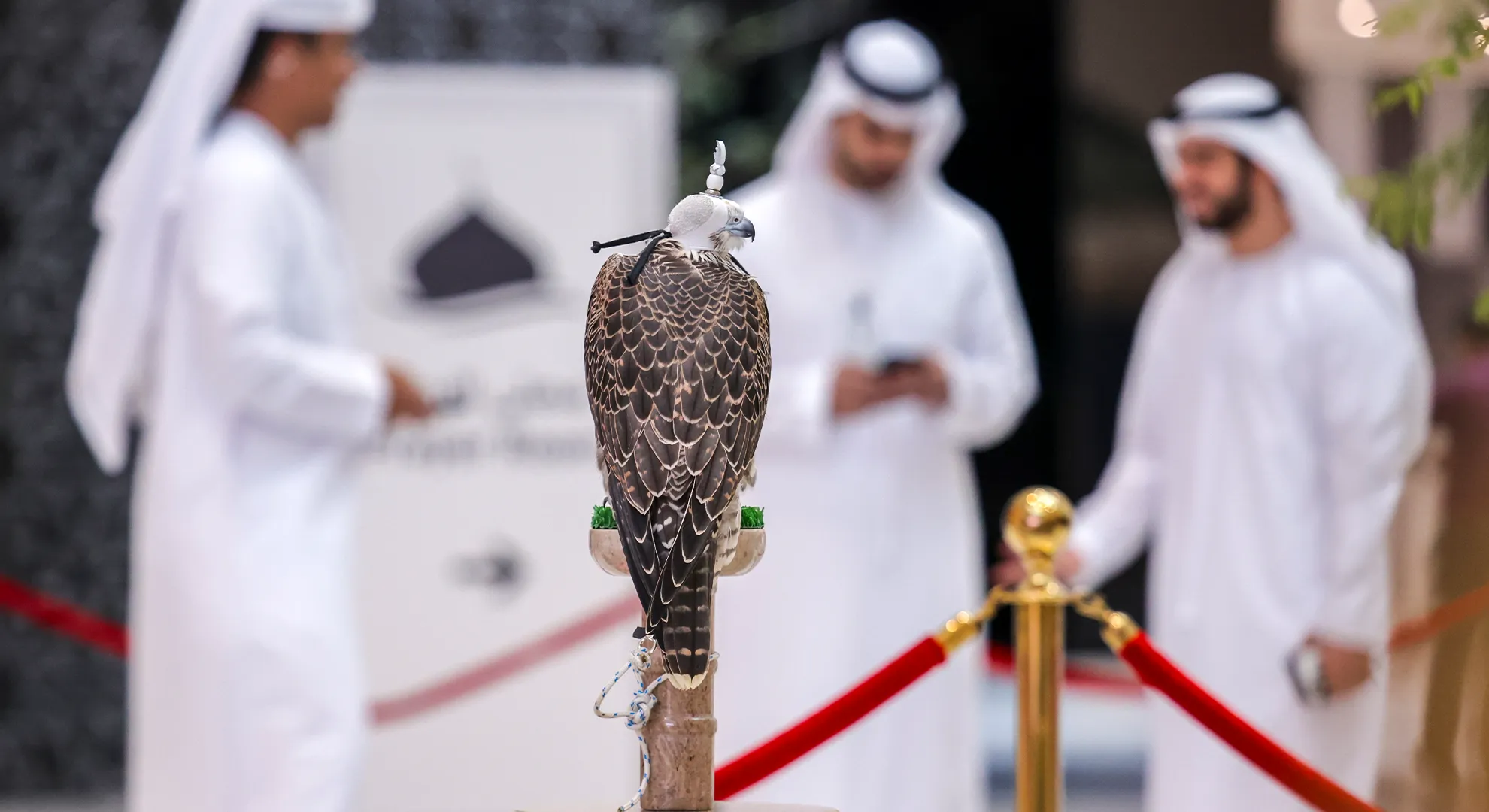
Abu Dhabi’s falcon auctions are known for their lively atmosphere and unexpected moments, where the competition among bidders and rising excitement can be just as captivating as the prized birds themselves.
A Slow Start Turns Into a Fierce Bidding Contest
For several tense minutes, attention at the Abu Dhabi falcon auction remained fixed on a distinctive white falcon displayed prominently on the auction platform. Despite the bird attracting interest from those attending the event, the room remained unusually quiet after the auctioneer announced an opening price of Dh20,000.
No bidder immediately stepped forward with an offer. The auctioneer continued to encourage the audience to participate, attempting to generate momentum around the sale. He reminded potential buyers that opportunities to acquire a falcon of this type could be limited, urging them not to let the opportunity pass without making a bid.
The opening silence created a moment of suspense. At an auction, the first bid often establishes the pace for everything that follows, but in this case, participants appeared reluctant to be the first to raise the price.
The auctioneer continued his appeal to the room, waiting for someone to make the initial move.
Eventually, the silence was broken when a bidder offered Dh21,000.
That first increase immediately changed the atmosphere. Another participant followed with Dh22,000, and the price moved to Dh23,000 soon afterwards.
Although the increases were initially modest, the steady stream of offers indicated that interest in the falcon was beginning to build.
The auctioneer continued to encourage participants to remain involved, moving between bidders in the room and those taking part through online channels. Each new offer kept the contest alive and prevented the sale from losing momentum.
The price eventually reached Dh30,000, marking a noticeable jump from the initial asking figure.
At that stage, however, the bidding once again appeared to slow.
The offers paused at around Dh32,000 and then moved to Dh33,000. For a moment, it appeared that the auction might settle at that level, with bidders seemingly unwilling to make another significant move.
But the auctioneer continued working the room.
Rather than allowing the contest to end quietly, he repeatedly invited participants to reconsider their positions. His attention shifted between people seated in the venue, cameras covering the event and bidders participating remotely.
The interaction between the auctioneer and the audience became an important part of the sale itself.
With each pause, he attempted to reignite interest and encourage another offer. The process demonstrated how auctioneers can influence the pace of a sale, particularly when bidders are hesitant to increase their offers.
Eventually, another bid pushed the price higher.
The falcon reached Dh38,000, significantly above its original Dh20,000 starting point.
What had begun as a lengthy period of silence had developed into a competitive contest, with the price rising steadily as more bidders became involved.
The sequence also illustrated the unpredictable nature of falcon auctions in Abu Dhabi. A bird can initially attract little visible interest before competition suddenly intensifies.
At the beginning of the sale, there was no indication that the falcon would generate such a progression in bids. The absence of an immediate response to the opening price created uncertainty about whether the auction would attract enough interest to move forward.
Yet once the first bidder entered the contest, other participants followed.
The gradual increases from Dh21,000 to Dh22,000 and Dh23,000 showed that buyers were willing to test the market without immediately making a major financial commitment.
As the price reached Dh30,000, the competition took on a different character.
Participants now had to decide how much they were prepared to spend and whether to continue competing as the value increased.
The pauses at Dh32,000 and Dh33,000 added another layer of tension. At such moments, an auction can either lose momentum or see a fresh wave of competition.
In this case, the auctioneer continued to press for additional offers.
His repeated engagement with both the audience and remote participants reflected the increasingly hybrid nature of modern auctions. The event was not limited to people physically present in the auction hall. Online bidders were also able to follow proceedings and participate in the contest.
This meant that the auctioneer had to maintain the attention of several groups at once.
He addressed people in the room while also acknowledging the possibility of further offers from bidders participating remotely.
The presence of cameras added another dimension to the event, allowing the wider audience to follow the action as the price changed.
For those watching, the progression from a quiet opening to a series of increasingly higher bids provided the kind of suspense that has become associated with high-profile falcon sales in Abu Dhabi.
The falcon itself remained at the centre of attention, but the bidding process created a spectacle of its own.
The opening Dh20,000 figure provided a starting point, but it quickly became clear that the final value would depend on the willingness of buyers to compete.
The eventual Dh38,000 bid represented an Dh18,000 increase over the opening price.
That rise was achieved through a combination of small increments and larger jumps as the contest developed.
The early stage of the auction was characterised by hesitation. Once the first bid was placed, however, the atmosphere changed.
Each additional offer demonstrated that another participant was prepared to stay in the competition.
The auctioneer’s role was particularly important during the quieter moments. By repeatedly inviting higher offers, he sought to prevent the bidding from coming to an early conclusion.
He also had to judge the mood of the participants, allowing enough time for potential buyers to respond while maintaining the energy of the auction.
This back-and-forth contributed to the drama surrounding the sale.
Falcon auctions have a long-standing cultural significance in the UAE, and events such as these combine commercial activity with a strong interest in the heritage and traditions associated with falconry.
For collectors and enthusiasts, acquiring a falcon can be about more than simply purchasing a bird. Factors such as appearance, lineage, characteristics and perceived quality can influence interest and the price bidders are willing to offer.
That helps explain why the bidding process can become highly competitive even after an initially quiet start.
In this particular case, the white falcon’s distinctive appearance made it an obvious focus of attention.
However, its presence alone was not enough to immediately trigger a bidding war.
The auction demonstrated that interest can take time to develop. Potential buyers may wait to see whether others are willing to enter the competition before committing themselves.
Once one bidder makes the first move, others may become more comfortable participating.
The progression from Dh20,000 to Dh38,000 therefore reflected not only the perceived value of the bird but also the dynamics of the auction itself.
Every increase created a new decision point for the participants.
A bidder who had offered Dh23,000, for example, had to decide whether to continue when the price moved towards Dh30,000. Those who remained involved had to reassess their willingness to spend as the figure climbed.
The pauses at Dh32,000 and Dh33,000 were particularly significant because they suggested that bidders were reaching points where they needed to consider their next move carefully.
The auctioneer’s continued efforts helped keep the process moving.
He called on participants to make further offers and ensured that those watching online remained part of the contest.
Eventually, the price reached Dh38,000, demonstrating how dramatically the situation had changed from the opening moments.
What initially appeared to be a slow and uncertain sale had developed into an engaging bidding sequence.
The episode also highlighted one of the defining characteristics of live auctions: unpredictability.
There is often no certainty about how quickly a sale will develop or how high the final price might go. A lack of early interest does not necessarily mean a low final value.
In this case, the initial hesitation was followed by a series of offers that steadily increased the falcon’s price.
For spectators, the changing pace added to the excitement.
The auctioneer’s calls, the responses from bidders and the possibility of another offer from the room or online all contributed to the sense of anticipation.
The cameras capturing the event further amplified the spectacle, allowing viewers to observe the progression from the opening bid to the higher offers.
By the time the bidding reached Dh38,000, the white falcon had become the focus of a considerably more competitive contest than the opening minutes had suggested.
The episode was a reminder that at Abu Dhabi’s falcon auctions, the final price can be shaped as much by the dynamics among bidders as by the bird initially placed on the stand.
The quiet beginning gave way to gradual participation, followed by increasingly confident offers.
From Dh20,000 to Dh38,000, the sale demonstrated how quickly an auction can change once bidders decide to compete.
For the auctioneer, the challenge was to keep that momentum alive through periods of hesitation. For the bidders, the challenge was deciding how far they were prepared to go.
And for spectators, the unfolding contest offered another example of why falcon auctions in Abu Dhabi can become compelling events in their own right.
The white falcon may have been the subject of the sale, but the sequence of bids, pauses and renewed competition provided much of the drama that kept attention focused on the auction stand.
Abu Dhabi Falcon Auction Delivers a Night of High-Stakes Bidding
The excitement surrounding Abu Dhabi’s falcon auctions extends well beyond the birds themselves. The atmosphere, the auctioneer’s calls and the competitive exchanges between bidders can turn each sale into a lively spectacle, with prices sometimes rising far beyond their opening levels.
The evening’s auction at ADNEC Centre Abu Dhabi began with the sale of a striking White Jeer Pure from YSL Farm. It was the first of six falcons presented to bidders on Sunday night. By the end of the session, the six birds had generated a combined Dh326,000, reflecting the strong interest in high-quality falcons and the competitive nature of the event.
However, the most dramatic moment of the evening came shortly after the opening sale.
A Qarmousha Pure produced in the UAE by Bheiran Farm quickly became the centre of attention. The bird entered the auction with a starting price of Dh20,000, but what followed was a remarkable escalation in bids.
Rather than moving gradually through small increases, the competition intensified rapidly, eventually taking the price all the way to Dh200,000.
The extraordinary jump transformed the sale into the standout moment of the evening. The final figure was ten times the opening bid and became the highest price recorded during that night’s auction.
A key figure throughout the event was auctioneer Khalid bin Saifan Al Muhairi, who played an active role in maintaining the energy inside the venue.
Al Muhairi was already familiar to many attendees because he had himself participated as a buyer during the previous night’s opening auction. On Saturday, he paid Dh250,000 for a Jeer Pure Super White, adding another interesting dimension to his role at the following night’s event.
As auctioneer, he combined traditional salesmanship with humour and detailed commentary about the birds being presented.
Rather than simply announcing prices and waiting for bids, he attempted to explain why each falcon deserved attention. He discussed their characteristics, previous performances and potential value in competitions.
Focus on UAE-Bred Falcons
The Qarmousha Pure from Bheiran Farm received particular attention because it was produced locally in the UAE.
As bidding began, Al Muhairi repeatedly highlighted its UAE origins and encouraged the audience to recognise the significance of locally produced birds.
He pointed towards its previous performances in domestic competitions and suggested that the falcon could have an important role to play in future events.
His comments were intended to remind potential buyers that the bird’s value was not simply based on its appearance or the amount being bid.
Its competitive record and potential future performance were also important considerations.
The auctioneer repeatedly drew attention to the fact that the falcon had already demonstrated its capabilities in local competition rounds.
This helped build a narrative around the bird as an established performer rather than simply another entry in the auction.
The Bird Takes Centre Stage
As interest increased, Al Muhairi encouraged bidders and spectators to examine the falcon closely.
He asked the cameraman to provide a closer view so that people watching could see its physical characteristics more clearly.
The camera focused on details including the bird’s body structure, feathers and talons, giving potential buyers a better opportunity to assess its appearance.
This added a visual element to the auction and allowed people following the proceedings to see the falcon in greater detail.
The auctioneer’s approach demonstrated that the bidding process was not based solely on numbers.
Potential buyers were being encouraged to consider the bird’s overall qualities, including its build and physical condition, as well as its background and competitive potential.
At another point during the rapidly escalating bidding, Al Muhairi emphasised that the falcon had undergone careful selection and inspection before being presented for sale.
That reassurance was particularly relevant as the price continued to climb.
Once the bidding moved well beyond the opening figure, buyers were committing substantial sums to the purchase. The emphasis on selection and inspection helped underline the quality associated with the bird being offered.
From Dh20,000 to Dh200,000
The progression of the Qarmousha Pure’s sale was the defining moment of the evening.
Starting at Dh20,000, the bird attracted increasingly higher offers as bidders competed for the opportunity to acquire it.
The momentum continued until the price reached Dh200,000.
At that point, the sale had become the clear highlight of Sunday’s auction.
The final figure also demonstrated the considerable difference that can emerge between an opening price and the amount buyers are ultimately prepared to pay.
For spectators, the rapid increase created a sense of anticipation as each new bid pushed the value higher.
The auctioneer’s commentary and encouragement helped maintain the momentum and kept attention focused on the bird.
The eventual Dh200,000 result stood out against the combined total of Dh326,000 generated by all six falcons sold that evening.
More Than a Price Tag
The auction also highlighted the importance of breeding and competition records in the falcon market.
The Qarmousha Pure’s UAE production was repeatedly emphasised during the sale, along with its previous performances.
For enthusiasts and competitors, such factors can influence the perceived potential of a falcon.
A bird with a strong physical profile and proven performance may attract greater interest from buyers looking for a falcon capable of competing in future events.
The auction therefore served as both a commercial marketplace and a platform for showcasing falcons with notable characteristics and competitive backgrounds.
The emphasis on UAE production also reflected the growing interest in birds bred locally.
By highlighting the Qarmousha Pure’s origins, the auctioneer encouraged bidders to recognise the achievements of UAE-based breeding operations.
A Memorable Evening at ADNEC
The Sunday auction provided another lively chapter in Abu Dhabi’s falcon-selling tradition.
Six birds were presented to buyers, with the combined proceeds reaching Dh326,000. While the opening White Jeer Pure from YSL Farm started the evening’s sales, it was the locally produced Qarmousha Pure that ultimately captured the greatest attention.
Its journey from a Dh20,000 starting point to a Dh200,000 final sale made it the undisputed headline of the evening.
The auctioneer’s energetic approach contributed significantly to the atmosphere.
His combination of humour, detailed descriptions and repeated encouragement kept bidders engaged and ensured that the auction remained lively even as prices moved higher.
His previous experience as a buyer also gave him a distinctive connection to the event. Having purchased a Jeer Pure Super White for Dh250,000 on the previous night, he was not unfamiliar with the high values that premium falcons can command.
The result was an auction that offered more than a straightforward sequence of sales.
For those in attendance and watching remotely, the event provided an opportunity to see prized falcons up close, learn about their competitive records and witness intense bidding as buyers competed for the most desirable birds.
The Dh200,000 Qarmousha Pure sale ultimately became the defining moment.
It demonstrated how quickly a falcon auction can shift from a routine opening bid into a major bidding contest when a bird captures the attention of potential buyers.
By the time the final bid was accepted, the Qarmousha Pure had moved from an initial valuation of Dh20,000 to a remarkable Dh200,000, making it the evening’s most valuable sale and underscoring the strong demand for quality, competition-ready falcons in Abu Dhabi.
A Falcon Purchase Driven by Rarity, Bloodline and Purpose
The previous evening’s auction remained a major topic of conversation, particularly because auctioneer Khalid bin Saifan Al Muhairi had also taken part as a buyer. His purchase of a Jeer Pure Super White for Dh250,000 stood out as one of the notable transactions surrounding the event.
For Khalid, the decision to bid heavily on the falcon was based on several qualities that he considered difficult to find together. The bird’s lineage, unusual white colouring and potential to perform across different areas of falconry all contributed to its appeal.
He explained that the falcon’s pure Jeer bloodline was particularly significant. Pure-bred birds can have an important role in breeding programmes because they can be used to produce hybrids with desired characteristics. For someone familiar with falcon breeding and competition, that potential can make a particular bird considerably more valuable.
The falcon’s colour was another factor that caught his attention. Its exceptionally white appearance made it distinctive and added to its appeal as a bird that could attract attention in beauty competitions as well as in other falconry activities.
Khalid described the bird as unusually versatile, saying it had the qualities needed to participate in several different pursuits.
Rather than being suited to only one discipline, he believed the falcon could potentially be used for hunting, racing and beauty contests.
That versatility helped justify the substantial amount he was willing to spend.
He Was Prepared to Bid Higher
Although the bird ultimately changed hands for Dh250,000, Khalid revealed that he had been prepared to spend considerably more.
He said he had set a personal limit of Dh350,000 for the falcon, meaning he was willing to offer another Dh100,000 beyond the final amount required to secure it.
His approach demonstrates how experienced buyers can enter an auction with a clear understanding of what they want and how much they are prepared to spend.
For Khalid, the decision was not simply about winning a bidding contest. He was interested in acquiring a bird that fulfilled a specific need and possessed qualities that could be difficult to find elsewhere.
He explained that his strategy is straightforward: when a particular falcon is needed and is difficult to locate, he is prepared to continue bidding rather than allow the opportunity to disappear.
However, that willingness does not extend to every bird.
If he already owns something similar, he would not necessarily be prepared to spend the same amount again.
The distinction is based on scarcity and purpose.
When a bird fills a gap in his collection or breeding plans and is difficult to replace, its value to him can increase significantly.
Khalid illustrated this philosophy by saying that if they genuinely need a particular bird and finally find it, the price itself will not necessarily stop them.
The Value of Scarcity
His comments highlight the importance of supply and demand in the falcon market.
A bird that is widely available may not attract the same level of competition as one with unusual characteristics or a rare bloodline.
When buyers believe that an opportunity may not return soon, they can be willing to bid much higher to secure the bird immediately.
That appears to have been the case with Khalid’s Dh250,000 purchase.
The combination of a pure Jeer lineage, distinctive white colouring and versatility gave him several reasons to regard the falcon as difficult to replace.
For collectors, breeders and competitive falconers, these characteristics can carry significant importance.
The value of a falcon therefore cannot always be judged simply by its appearance or starting price. Its ancestry, performance potential, breeding value and suitability for different activities can all influence what buyers are prepared to pay.
A Passion Passed Down Through Generations
Khalid’s involvement in falconry is not a recent interest.
He said his connection with the birds comes from his family and that he inherited the passion from both his father and grandfather.
His family history has helped shape his understanding of falconry and its importance as more than simply a competitive activity.
He recalled that his father travelled to Pakistan in 1983 in connection with falconry, reflecting the family’s long-standing involvement with the tradition.
For Khalid, this heritage has helped make falconry an important part of his life.
His participation in auctions, breeding and competitions is therefore connected to a family tradition that has continued across generations.
More Than Competition and Breeding
Although falconry can involve breeding, hunting and competitive events, Khalid said his relationship with the birds extends beyond those activities.
One of the most valuable lessons he believes falcons have taught him is patience.
Working with a falcon requires an understanding of the bird’s behaviour and temperament. A handler cannot simply expect the bird to respond immediately in every situation.
Over time, the relationship between the handler and the falcon develops through repeated interaction.
Khalid described this relationship as a form of communication that does not rely on spoken language.
Although falcons cannot communicate verbally with their handlers, he believes they can still convey messages through their behaviour, movements and reactions.
A Hunting Story Illustrates the Bond
Khalid recalled an incident during a hunting trip that demonstrated this unusual relationship.
During the outing, his falcon pursued a rabbit that escaped into a dense area of vegetation.
The bird continued looking for its quarry after the rabbit disappeared beneath a tree, apparently struggling to determine where it had gone.
Khalid watched the falcon searching and jokingly tried to direct it towards the rabbit.
The moment became humorous for him because he felt that the interaction resembled a conversation between a person and an animal, even though the falcon could not respond verbally.
He later joked with a group of older men that he and the bird appeared to communicate like humans, except that the falcon could not speak.
For Khalid, the story captures something fundamental about falconry.
The relationship between handler and bird develops through observation, trust and patience.
The Auction Continues
While Khalid’s personal purchase remained a major talking point, the auction itself continued with a series of other sales.
The event maintained a lively atmosphere, with the auctioneer interacting with bidders and using humour and commentary to keep the proceedings moving.
Several other falcons attracted attention and generated competitive bidding.
A Jeer Taba produced by Bheiran Farm in the UAE was one of the birds presented to buyers.
The falcon had a distinctive appearance, including a hazel-striped chest and black wings.
It entered the auction with an opening price of Dh10,000 and eventually sold for Dh13,000.
Although the final figure was considerably lower than the headline Dh200,000 sale, the transaction added to the variety of birds available during the evening.
Another notable sale involved a British Jeer Pure from KH Falcon Team.
The bird also opened at Dh10,000, but competition pushed its final price to Dh30,000.
The increase demonstrated once again how the opening figure does not necessarily indicate where the bidding will finish.
Other Falcons Find Buyers
A British white Qarmousha Pure was another bird sold during the event.
It ultimately fetched Dh23,000, adding another substantial transaction to the night’s total.
A further UAE-produced Jeer Pure from Bheiran Farm was sold for Dh22,000.
Together, these sales reflected the range of prices that can emerge depending on a falcon’s characteristics, origin and appeal to buyers.
The auction therefore featured birds from both local and international bloodlines, giving breeders and enthusiasts an opportunity to compare different types and identify birds that matched their individual requirements.
Part of a Larger Exhibition Programme
The auction was not an isolated event.
It formed part of the programme surrounding the 23rd Abu Dhabi International Hunting and Equestrian Exhibition (ADIHEX).
A total of eight auctions are being organised in connection with the exhibition.
Four sales are scheduled before the exhibition officially opens, while another four are planned to take place during the main event.
The exhibition itself is scheduled to run from August 28 to September 6.
The auction programme provides breeders, falconers, collectors and enthusiasts with multiple opportunities to acquire birds from different sources.
The participation of both local and international breeders also adds variety to the offerings.
A Meeting Point for Falconry Enthusiasts
The auctions bring together people with different interests within the falconry community.
Some participants are interested in breeding, while others focus on hunting, racing or beauty competitions.
There are also enthusiasts who simply appreciate the birds and their heritage.
The availability of different bloodlines allows buyers to search for specific characteristics.
For breeders, lineage may be particularly important.
For competitors, performance records and physical attributes may influence their decisions.
For collectors and enthusiasts, rare colours or distinctive appearances can make a particular falcon especially desirable.
This diversity of interests helps create the competitive atmosphere associated with the auctions.
Bidding From the Venue and Online
The sales are also accessible to people participating remotely.
Bidders can compete in person or through online platforms, creating a wider pool of potential buyers.
This means that a falcon displayed on the auction stand can attract attention from people beyond those physically present at the venue.
The combination of live and online participation can also influence the pace of bidding.
A sale that appears quiet inside the hall can suddenly become competitive when a remote bidder enters the contest.
For auctioneers, maintaining the attention of both groups is an important part of managing the event.
Supply and Demand Drive Prices
Khalid’s view of the market is ultimately based on a simple principle: supply and demand.
If a particular type of falcon is readily available, buyers may have less reason to compete aggressively.
But when a bird with desirable qualities is difficult to find, the situation changes.
Potential buyers may be prepared to pay significantly more because they cannot be certain when another similar opportunity will appear.
This is why Khalid said he would continue bidding when a bird fulfilled a genuine need.
For him, the key question is not simply whether the price is high. It is whether the bird offers something that is difficult to obtain elsewhere.
That could be its bloodline, colour, performance, breeding potential or combination of characteristics.
A Buyer Who Knows What He Wants
Khalid’s Dh250,000 purchase provides a clear example of this approach.
He had identified a falcon with several qualities that he considered valuable and was prepared to compete strongly to secure it.
His willingness to go as high as Dh350,000 shows the importance he placed on the bird.
At the same time, his comments indicate that he does not approach every auction in the same way.
A buyer who already possesses a similar falcon may have little reason to compete at an extremely high price.
The difference is therefore between purchasing something desirable and obtaining something genuinely needed.
Tradition Meets Modern Competition
The auction also demonstrates how traditional falconry continues to evolve alongside modern commercial and competitive practices.
The heritage of falconry remains central, but today’s events involve organised auctions, international breeders, online bidding and highly competitive sporting circuits.
For people like Khalid, the modern auction environment provides a platform through which they can continue a family tradition while also pursuing contemporary breeding and competition goals.
His personal connection to falconry, passed down from his father and grandfather, adds another layer to his involvement.
The birds are not simply assets to be bought and sold. They represent a cultural tradition, a competitive pursuit and, for many participants, a personal passion.
An Auction Defined by Passion
The evening’s sales demonstrated the range of factors that can influence the value of a falcon.
Some birds attracted modest increases over their opening prices, while others generated dramatic bidding battles.
Khalid’s own purchase was among the most expensive, but his explanation of why he bought the bird provided insight into what experienced buyers look for.
A rare bloodline, unusual colouring and versatility can transform a falcon from an ordinary purchase into an opportunity that a buyer is unwilling to miss.
For Khalid, that is ultimately what makes the auction exciting.
The price matters, but it is secondary to finding the right bird.
When something is rare, useful and genuinely needed, he believes the opportunity should not be allowed to pass simply because the bidding becomes expensive.
That attitude captures much of the energy surrounding Abu Dhabi’s falcon auctions.
The events bring together heritage, breeding, sport, commerce and personal passion, with every bird offering a different combination of characteristics.
And as Khalid’s own Dh250,000 purchase demonstrated, when the right falcon appears on the stand, competition can quickly become intense.