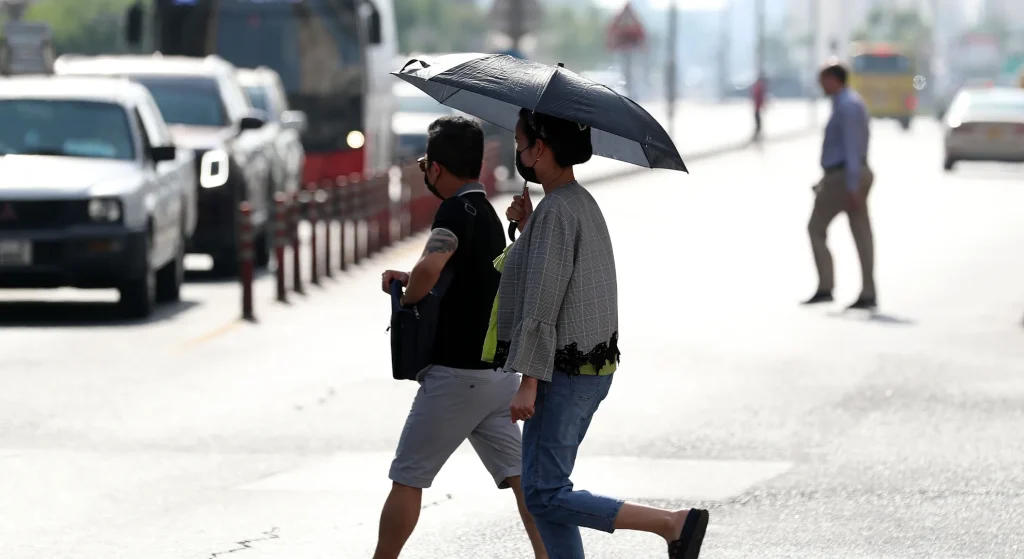
Despite temperatures soaring to nearly 50°C, the UAE is experiencing stronger summer rainfall as cloud seeding operations continue to encourage cloud formation and increase precipitation across several regions.
Cloud Seeding Enhances Rainfall in UAE as Summer Downpours Continue Amid 50°C Temperatures.

Rainfall triggered by an upper-level atmospheric trough has provided cooler conditions and welcome relief across several regions of the UAE.
UAE Weather Update: Cloud Seeding Supports Rainfall as Unsettled Conditions Continue
The United Arab Emirates has witnessed periods of rainfall in recent days as unstable weather combined with cloud seeding operations created favorable conditions for showers across several parts of the country. Meteorologists say the rainfall has provided temporary relief from the intense summer heat that has dominated the region.
According to the National Centre of Meteorology (NCM), cloud seeding flights were carried out whenever weather experts detected suitable cloud formations capable of responding to the technique. These operations are designed to encourage naturally occurring clouds to produce more rainfall by increasing the size of water droplets, allowing more of them to reach the ground.
The recent spell of wet weather was largely influenced by an upper-level atmospheric trough, a weather pattern that promotes cloud formation and atmospheric instability. As a result, several areas across the Emirates experienced scattered showers, along with increased cloud cover and relatively cooler daytime conditions compared with previous days.
Although the rainy period reached its most active stage recently, meteorologists expect the current weather system to gradually lose strength. Forecast models indicate that the upper-air disturbance will slowly shift toward the south, reducing its influence over much of the country in the coming days.
Despite the weakening system, weather officials say conditions will still be favorable for the development of convective clouds during the afternoon, particularly over eastern and western parts of the UAE. These clouds could produce isolated rainfall in some locations where moisture and atmospheric instability remain sufficient.
The NCM has also indicated that western regions may continue to experience occasional showers before the weather pattern begins to stabilize. Residents are advised to stay informed through official weather updates, as localized rainfall can sometimes develop quickly during the summer season.
By Friday, forecasters expect the upper-level trough to move farther south, leading to a noticeable decline in cloud activity across most parts of the Emirates. While skies are likely to become clearer in many areas, there will still be a limited possibility of isolated rain, mainly around the Al Ain region, where localized cloud development may continue.
Cloud seeding remains an important component of the UAE’s long-term water management strategy. Rather than creating clouds, the technology is used to enhance rainfall from existing suitable clouds by introducing specialized particles that encourage moisture to combine into larger droplets. The approach aims to maximize rainfall potential during favorable weather events and support the country’s efforts to strengthen its water resources.
As the current weather system gradually exits the region, temperatures are expected to return to more typical summer levels. Even so, meteorologists will continue monitoring atmospheric conditions for any new developments that could bring additional cloud formation or rainfall over the coming days.


High temperatures and rain
UAE’s Summer Heat and Rainfall: Why Showers Can Occur Even During 50°C Weather
The United Arab Emirates has recently experienced an unusual combination of scorching temperatures and periods of rainfall, demonstrating how complex summer weather patterns can be. Although daytime temperatures have climbed to around 50°C in some locations, meteorologists say such extreme heat can actually contribute to the formation of rain-producing clouds under the right atmospheric conditions.
Strong solar heating warms the Earth’s surface throughout the day, causing the air near the ground to rise rapidly. As this warm air ascends, it cools at higher altitudes, allowing moisture to condense into clouds. This process is especially active during the summer months and is responsible for the development of towering convective clouds.
However, high temperatures alone do not guarantee rainfall. Weather specialists explain that several additional ingredients must come together before showers can develop. Moisture carried into the region by humid air masses is one of the most important factors, as dry air cannot produce significant precipitation. Atmospheric instability is another key requirement because it allows warm air to continue rising, supporting the growth of large cloud systems.
Upper-level weather disturbances also play an important role. These systems encourage upward motion in the atmosphere, making cloud formation more likely. Wind direction and speed at different heights further influence whether clouds can mature into thunderstorms capable of producing rain. When these factors occur simultaneously, the UAE can experience localized showers despite the intense summer heat.
The recent rainfall has provided temporary relief from exceptionally high temperatures in several parts of the country. Cloud cover associated with these weather systems can reduce direct sunshine for short periods, while rain briefly cools the surrounding air and improves outdoor conditions.
In recent days, the country has experienced several episodes of unstable weather. Thunderstorm activity has developed in multiple regions, accompanied by rainfall, strong winds, and reduced visibility caused by blowing dust. Such conditions are common when powerful convective clouds form during the hottest part of the day.
Weather authorities have also issued alerts to inform residents about changing conditions. Advisories warned of heavy rain in some locations, along with strong wind gusts capable of lifting dust and sand into the air. Reduced visibility affected motorists in several areas, prompting officials to recommend extra caution while travelling.
Some eastern parts of the UAE also experienced hail during the recent period of unstable weather. Hail can form inside powerful thunderstorm clouds where strong upward currents repeatedly lift water droplets into freezing layers of the atmosphere. As these frozen particles grow larger, they eventually fall to the ground once they become too heavy for the rising air to support.
The combination of rainfall, thunderstorms, hail, and dust storms illustrates the dynamic nature of the UAE’s summer climate. While prolonged rainfall is uncommon during this season, localized storms can still develop whenever atmospheric moisture, instability, and upper-level weather systems combine with intense daytime heating.
Meteorologists continue to monitor weather patterns closely throughout the summer, as convective activity can develop quickly and affect different regions with little warning. Residents are encouraged to follow official forecasts and weather advisories, particularly during periods of unstable atmospheric conditions, to stay informed about potential rain, strong winds, or reduced visibility.