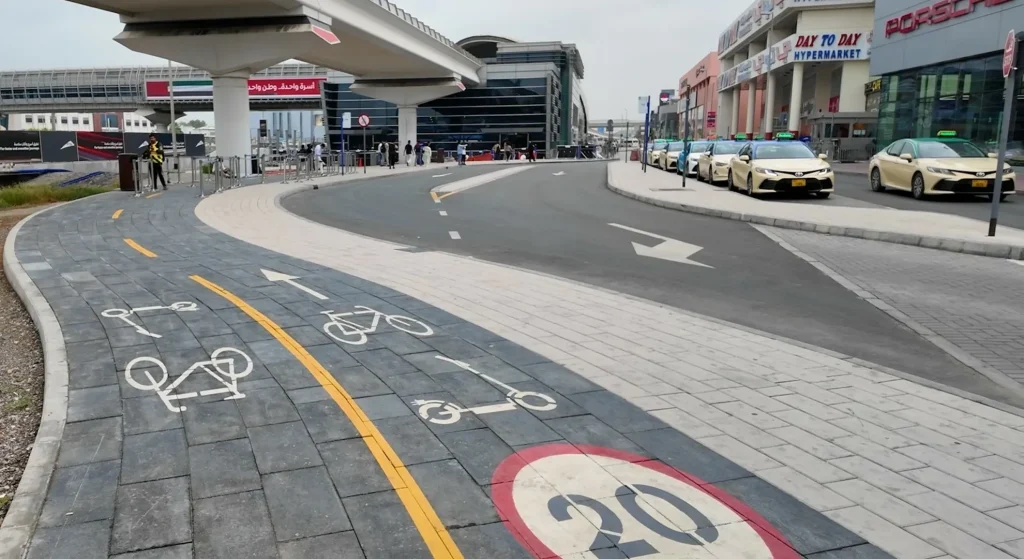
Dubai is set to construct 31 pedestrian bridges by 2030 as part of efforts to enhance walkability and cycling infrastructure, responding to increasing demand for active and sustainable transport options.
Dubai Plans 31 New Pedestrian Bridges by 2030 Amid Rising Walking and Cycling Traffic.
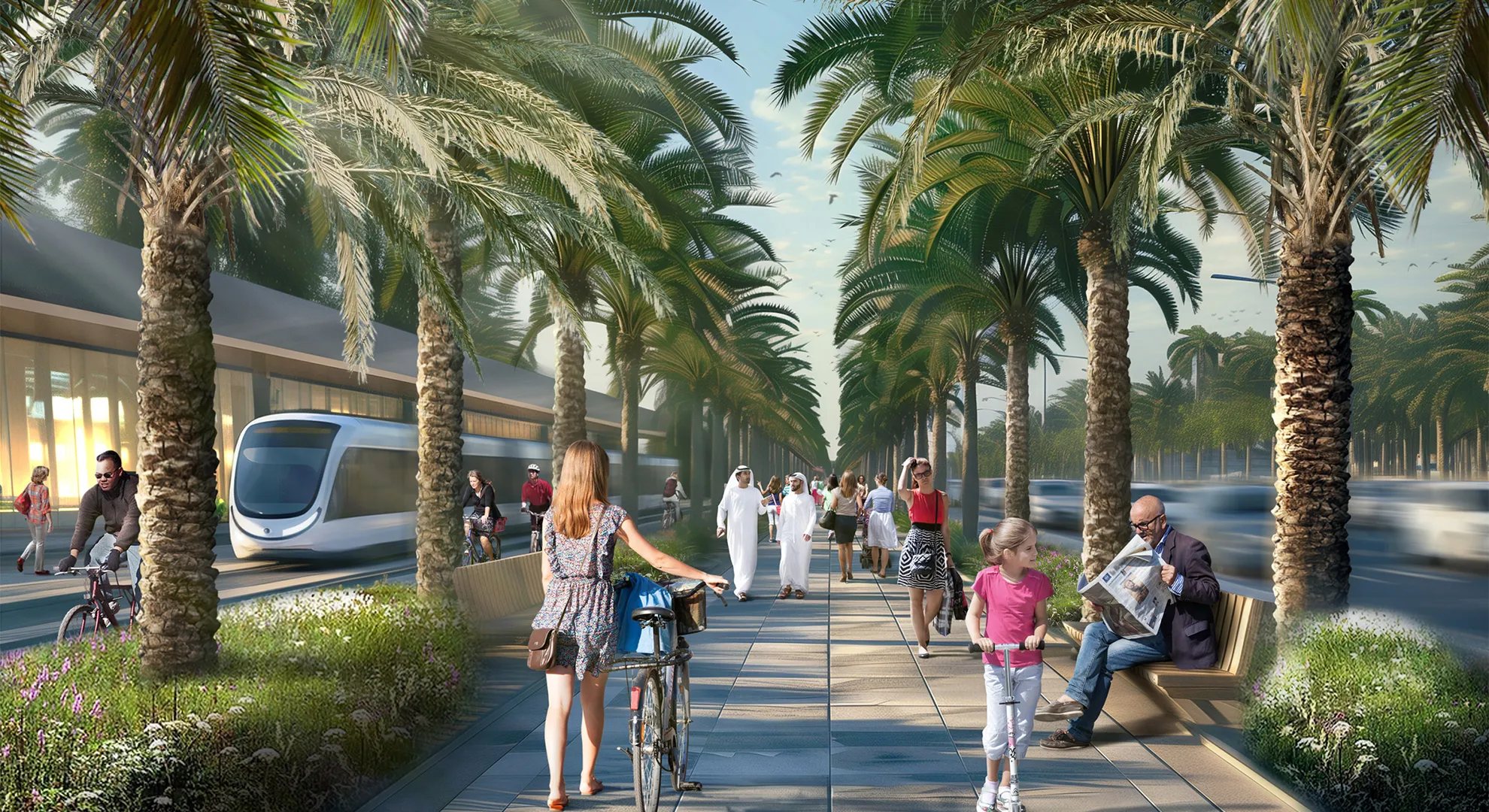
Dubai is preparing to significantly expand its pedestrian infrastructure with the construction of 31 new footbridges and tunnels over the next five years, in a move aimed at strengthening road safety, improving connectivity, and promoting sustainable modes of transport such as walking and cycling. The initiative, announced by the Roads and Transport Authority (RTA), will be implemented between 2026 and 2030 across key locations in the emirate.
The planned infrastructure project is part of a broader strategy to make it easier for residents and visitors to move between residential neighbourhoods, commercial districts, tourist destinations, and public transport hubs. By enhancing pedestrian accessibility, authorities aim to encourage more people to adopt “soft mobility” options for short-distance travel and first- and last-mile connections.
According to the RTA, the expansion of pedestrian crossings reflects Dubai’s long-term vision of creating a more walkable and connected urban environment. The new bridges and tunnels will be strategically positioned across major roads to reduce barriers for pedestrians and provide safer, more convenient routes in areas with high traffic density.
Officials highlighted that the project builds on years of progress in improving road safety in the emirate. Over the past 18 years, Dubai has achieved a remarkable reduction in pedestrian fatalities, with deaths falling by approximately 98 percent. This significant decline is attributed to a combination of improved infrastructure, stricter traffic regulations, enhanced enforcement, and increased public awareness of road safety measures.
At the same time, pedestrian activity in the city has grown substantially. Data shows that walking trips now exceed 326 million annually, reflecting changing mobility patterns among residents. This increase is linked to urban development, improved public transport integration, and growing interest in healthier and more environmentally friendly modes of travel.
The RTA’s new plan is designed to respond directly to this rising demand for pedestrian-friendly infrastructure. By providing safer and more efficient crossings, the authority aims to support the continued growth of walking and cycling as practical transportation options rather than purely recreational activities.
Mattar Al Tayer, Director General and Chairman of the Board of Executive Directors of the RTA, said the upcoming network of bridges will play a key role in strengthening connectivity across the city. He explained that the new infrastructure will help link residential communities with key commercial centres, tourism zones, and transport systems, creating a more seamless urban mobility experience.
He added that the pedestrian bridges, along with existing and planned infrastructure, are being developed as part of an integrated network designed to improve mobility across Dubai. This network approach ensures that pedestrian routes are not isolated structures but interconnected pathways that support continuous movement between different parts of the city.
According to Al Tayer, the objective is to encourage residents to make greater use of sustainable transport options, particularly for short trips and last-mile journeys. He noted that improving access to public transport stations is a central focus of the project, as convenient pedestrian access is essential for increasing public transport usage and reducing reliance on private vehicles.
The planned bridges and tunnels will be designed to enhance safety by allowing pedestrians to cross busy roads without interacting directly with vehicular traffic. This separation is expected to reduce the risk of accidents while also improving traffic flow for vehicles, as fewer at-grade crossings will be required on major highways and arterial roads.
Urban mobility experts note that pedestrian infrastructure plays a critical role in shaping how cities function. When walking routes are safe, direct, and well-connected, people are more likely to choose walking as part of their daily commute. This, in turn, contributes to reduced traffic congestion, lower emissions, and improved public health outcomes.
Dubai’s emphasis on pedestrian infrastructure also aligns with its broader sustainability and urban development goals. As the city continues to grow, planners are focusing on creating a more balanced transport system that integrates walking, cycling, metro services, and road networks into a unified mobility framework.
The rise in walking trips, which now exceed hundreds of millions annually, highlights a gradual shift in how residents navigate the city. Improved urban design, shaded walkways, and better connectivity to metro and bus stations have all contributed to making walking a more practical option for many daily journeys.
Authorities believe that the new bridges will further support this trend by addressing gaps in the current pedestrian network, particularly along major roads where safe crossing points are limited. By filling these gaps, the city aims to make walking not only safer but also more attractive and efficient.
In addition to safety improvements, the project is expected to support economic and social activity by improving access between residential and commercial areas. Easier pedestrian movement can increase foot traffic in retail and business districts, enhance tourism experiences, and promote greater community interaction.
The RTA has also emphasised that the design of new pedestrian infrastructure will take into account user comfort and accessibility. Features such as shaded pathways, escalators, elevators, and climate-responsive design elements are expected to be incorporated to ensure usability in varying weather conditions and for people of all ages and mobility levels.
As Dubai continues to expand its urban footprint, the integration of pedestrian infrastructure is becoming an increasingly important component of city planning. The upcoming network of bridges is expected to play a key role in shaping future mobility patterns, particularly as the city encourages more sustainable and people-centric transport solutions.
Overall, the 31 new pedestrian bridges and tunnels represent a significant investment in the city’s long-term vision of safe, connected, and sustainable urban mobility. By building on years of progress in road safety and increasing pedestrian activity, Dubai aims to further strengthen its position as a modern city designed around efficient and accessible movement for all residents and visitors.
Dubai’s planned expansion of pedestrian infrastructure includes several strategically chosen locations across the emirate’s busiest transport corridors, reflecting a data-driven approach to urban mobility planning. The new pedestrian crossings will be developed along major arterial roads such as Sheikh Zayed Road, King Salman bin Abdulaziz Al Saud Street, Al Ittihad Road, and Omar bin Al Khattab Street. These sites were not selected randomly but were identified through comprehensive studies that analysed multiple urban factors, including population density, existing land use patterns, proximity to key destinations, and accessibility to public transport networks.
Urban planners and transport authorities assessed how people currently move through these areas, identifying gaps where safe pedestrian access is limited or where crossing roads poses challenges due to heavy traffic volumes. The selected locations are intended to address these gaps and improve overall connectivity between residential communities, commercial zones, leisure destinations, and transit hubs.
This latest phase of development builds on a rapid and sustained expansion of Dubai’s pedestrian infrastructure over the past two decades. In 2006, the city had only 26 pedestrian bridges and tunnels in operation. By the end of 2025, this number had increased dramatically to 178 structures, representing a growth of approximately 585 percent. This significant expansion reflects Dubai’s long-term commitment to enhancing walkability and improving safety for non-motorised road users.
With the addition of 31 more crossings planned by 2030, the network is expected to expand further, creating a more interconnected system of pedestrian routes across the city. Authorities view this network not as isolated structures but as part of a broader mobility framework designed to integrate walking, cycling, and public transport into a seamless travel experience.
The Roads and Transport Authority (RTA) has highlighted that this sustained investment in pedestrian infrastructure has had a measurable impact on road safety outcomes. Over the years, Dubai has recorded a substantial decline in pedestrian-related fatalities. According to official figures, the rate of pedestrian deaths dropped from 9.5 per 100,000 residents in 2007 to just 0.22 per 100,000 residents in 2025. This represents one of the most significant improvements in urban road safety indicators in the region.
Authorities attribute this decline to a combination of factors, including improved infrastructure design, stricter traffic enforcement, enhanced driver awareness campaigns, and the gradual introduction of safer crossing facilities such as pedestrian bridges and tunnels. The shift away from at-grade crossings on major roads has played an especially important role in reducing the risk of accidents involving pedestrians and vehicles.
In addition to safety improvements, Dubai has also witnessed strong growth in active mobility trends, particularly walking and cycling. Data released by the RTA indicates that pedestrian activity has increased significantly in recent years, rising from 307 million recorded walking trips in 2023 to 326 million trips in 2025. This steady upward trend reflects changing mobility preferences among residents, supported by improved urban design and better integration with public transport systems.
Cycling activity has also seen notable expansion during the same period. The number of cycling trips increased by 23 percent, climbing from 46.6 million trips in 2024 to 57.3 million trips in 2025. This growth suggests that cycling is becoming an increasingly viable mode of transport for both recreational and commuting purposes, particularly in areas where dedicated cycling infrastructure has been introduced or upgraded.
Alongside these usage statistics, public perception of Dubai’s pedestrian and cycling infrastructure remains highly positive. Surveys conducted by relevant authorities indicate that resident satisfaction currently stands at approximately 88 percent. This high level of approval reflects growing confidence in the city’s efforts to create safer, more accessible, and more comfortable environments for non-motorised transport.
In recent developments, the RTA has completed construction on three major pedestrian and cycling bridges, further strengthening the city’s active mobility network. Among these are two landmark structures located on Sheikh Zayed Road and Al Khail Road, both of which serve as key transport corridors with high traffic volumes and significant pedestrian movement demand.
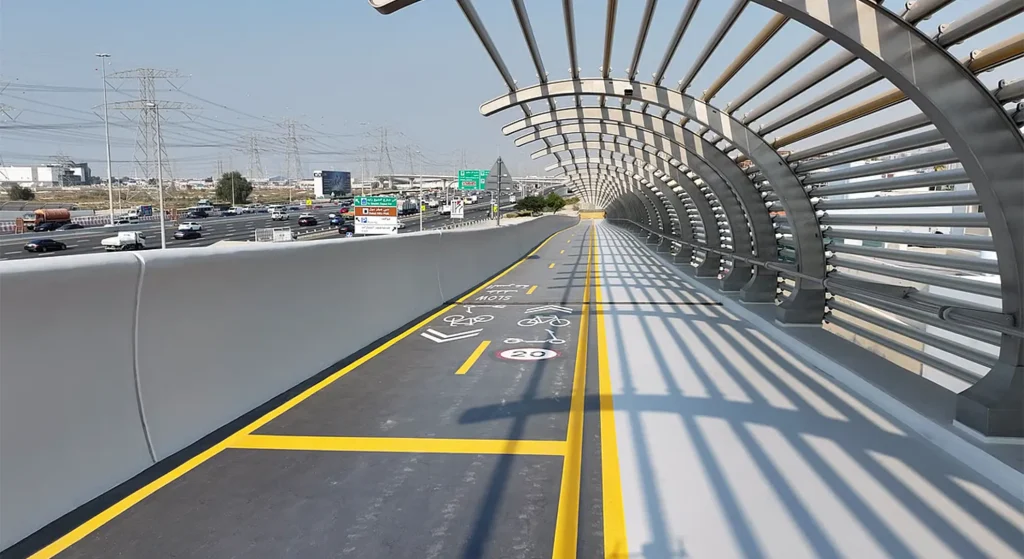
These newly completed bridges have been designed to accommodate multiple types of users, including pedestrians, cyclists, and users of electric scooters. By incorporating dedicated lanes for different mobility modes, the structures aim to reduce conflicts between users while enhancing safety and efficiency. This multi-modal design approach reflects a broader shift towards more inclusive and flexible transport infrastructure in urban environments.
The new bridge on Sheikh Zayed Road spans approximately 528 metres and is considered one of the most prominent pedestrian structures in the city. Its architectural design incorporates thematic elements that symbolise connectivity and continuity, reflecting the role of the bridge as a link between different parts of the urban landscape. The structure is intended not only as a functional crossing but also as a visual representation of Dubai’s commitment to integrated urban mobility.
Similarly, the pedestrian and cycling bridge on Al Khail Road extends around 501 metres and features a design that interacts with natural light and movement. Its architectural concept incorporates reflective and dynamic elements that change appearance depending on lighting conditions throughout the day. This design approach enhances the visual experience for users while also contributing to the identity of the surrounding urban environment.
Both bridges are strategically positioned to connect key residential and commercial districts, including Al Sufouh, Dubai Internet City, Barsha Heights, Al Barsha, and Dubai Hills. These areas represent some of the city’s most active and rapidly developing communities, where demand for safe and efficient pedestrian crossings has grown alongside population and infrastructure expansion.
Transport planners view these developments as part of a broader effort to reshape mobility patterns in Dubai by encouraging more people to choose walking, cycling, and public transport for short and medium-distance journeys. By improving connectivity between neighbourhoods and major destinations, the city aims to reduce reliance on private vehicles, ease traffic congestion, and support environmental sustainability goals.
The integration of pedestrian bridges with surrounding infrastructure is also seen as a key factor in improving first- and last-mile connectivity to metro stations and bus routes. When pedestrians can safely and conveniently reach public transport hubs, the overall efficiency of the transport system improves, encouraging greater use of mass transit options.
As Dubai continues to expand its urban footprint, pedestrian and cycling infrastructure is expected to play an increasingly central role in shaping future development. The ongoing investment in bridges, tunnels, and connected pathways reflects a long-term vision of a city where mobility is not dominated solely by vehicles, but balanced across multiple sustainable modes of transport.
Overall, the continued expansion of pedestrian infrastructure, combined with strong improvements in safety indicators and rising usage trends, highlights Dubai’s progress towards building a more walkable, connected, and people-friendly urban environment. The planned additions through 2030 are expected to further strengthen this trajectory, creating a comprehensive network that supports safe and efficient movement across the emirate.
Dubai’s ongoing expansion of pedestrian infrastructure also includes developments within key urban districts, with particular attention given to improving internal connectivity and enhancing access to surrounding destinations. In the Al Quoz Creative Zone, a third pedestrian bridge has been completed on Al Manara Street. This structure has been designed to strengthen movement within the district while also improving links to nearby cultural, commercial, and recreational areas. The addition of this bridge supports the broader goal of making creative and mixed-use neighbourhoods more accessible and pedestrian-friendly.
In addition to completed projects, several new pedestrian bridges are currently under active construction across the emirate. These upcoming structures form part of a larger effort to expand Dubai’s network of safe crossing points, particularly in high-traffic corridors where pedestrian movement has historically been more challenging due to road width, vehicle density, and limited crossing options.
Among the most significant developments are two major pedestrian and cycling bridges that are being built on a large scale. These projects are notable not only for their length but also for their dual-purpose design, which accommodates both walkers and cyclists within a single integrated structure. The inclusion of cycling lanes reflects Dubai’s increasing emphasis on supporting multiple forms of active mobility within its transport infrastructure.
One of these major bridges is being constructed at the intersection of Tunis Street and Al Nahda Street along Sheikh Mohammed bin Zayed Road, one of the city’s busiest highway corridors. This bridge is designed to improve connectivity between the residential community of Muhaisnah 1 and the neighbouring area of Al Twar. In addition to linking these communities, the structure will also provide a safer and more direct route for pedestrians heading towards Al Mamzar Beach, a popular recreational destination in the city.
By offering a secure crossing over a heavily trafficked road, this bridge is expected to significantly reduce the risks faced by pedestrians who previously relied on longer or less safe routes. It also enhances accessibility to leisure areas, making it easier for residents to reach key destinations without depending on private vehicles.
Another large-scale project currently under construction is a 730-metre pedestrian and cycling bridge spanning Dubai–Al Ain Road. This structure is among the longest of its kind in the emirate and is designed to serve as a critical link between residential and developing urban zones. The bridge will connect the Liwan community in Wadi Al Safa 4 with Nad Hessa in Dubai Silicon Oasis, two rapidly growing districts that have seen increased population density and development activity in recent years.
This connection is expected to improve daily mobility for residents in both areas by providing a safe and efficient route across a major highway. It will also support better integration between residential communities and business or technology hubs, reducing travel barriers and encouraging more sustainable transport choices such as walking and cycling for short-distance trips.
A third pedestrian infrastructure project is also underway on Al Sukook Street. This bridge is being developed as part of the broader Al Mustaqbal Street Development Project, which aims to enhance traffic flow and urban connectivity in one of Dubai’s key central corridors. The structure is currently in the construction phase and is scheduled for completion in the first quarter of 2027.
Once completed, this bridge will contribute to improving pedestrian safety in a busy urban area while also supporting smoother movement between surrounding districts. Its inclusion in a larger road development project highlights the integrated approach being taken in Dubai’s infrastructure planning, where pedestrian facilities are designed alongside broader transport upgrades rather than as separate elements.
The Roads and Transport Authority (RTA) has emphasised that these ongoing and planned projects are a core part of Dubai’s wider Traffic Safety Strategy. This long-term strategy is focused on reducing road incidents and improving overall safety for all road users, with a particular emphasis on vulnerable groups such as pedestrians and cyclists.
A central objective of this strategy is to move towards the goal of zero road fatalities, reflecting a vision in which transportation systems are designed to eliminate preventable deaths and serious injuries. To achieve this, authorities are investing in infrastructure improvements, advanced traffic management systems, public awareness campaigns, and stricter enforcement measures.
The expansion of pedestrian bridges and tunnels plays a key role in this broader vision. By physically separating pedestrian movement from vehicular traffic on major roads, these structures significantly reduce the likelihood of accidents while also improving traffic efficiency for vehicles. This separation of transport modes is considered one of the most effective ways to enhance urban road safety in high-density cities.
In addition to safety benefits, these infrastructure projects contribute to Dubai’s ambition of positioning itself among the safest cities in the world for road users. Over the years, the emirate has made substantial progress in reducing traffic-related fatalities through a combination of engineering solutions, regulatory frameworks, and continuous improvements in urban planning.
The current wave of pedestrian infrastructure development reflects a continuation of this long-term commitment. By expanding the network of bridges and improving connectivity across key districts, Dubai is working to ensure that residents have access to safe, efficient, and convenient mobility options regardless of their mode of travel.
Urban planners also view these developments as essential for supporting the city’s future growth. As new residential communities, business districts, and tourism destinations continue to emerge, the demand for safe pedestrian access is expected to increase further. The integration of pedestrian infrastructure into major development projects ensures that mobility needs are addressed from the earliest stages of urban expansion.
Overall, the combination of completed, ongoing, and planned pedestrian bridge projects demonstrates a comprehensive and forward-looking approach to urban mobility in Dubai. By linking communities, improving access to key destinations, and enhancing safety across major road networks, these initiatives are helping to create a more connected and walkable city environment aligned with long-term sustainability and safety goals.