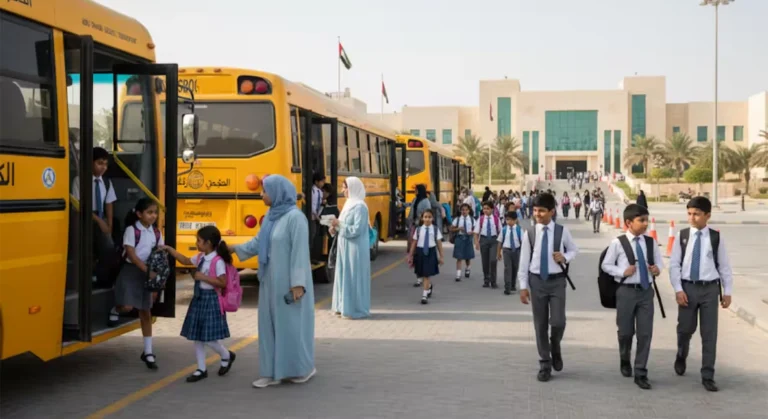
Amid rising financial pressure, schools across the UAE are providing flexible tuition payment solutions to families affected by layoffs, reduced incomes, and employment uncertainty, helping parents manage educational expenses more comfortably.
UAE parents dealing with job cuts and lower salaries offered more manageable school fee options.

Economic uncertainty and regional tensions are placing increasing financial strain on many families in the UAE, prompting schools to introduce more supportive and flexible approaches toward fee payments. Educational institutions across the country say they are working closely with parents who are struggling due to salary reductions, job instability, unpaid leave, and rising living costs. School leaders explain that their aim is to ensure students can continue their education without interruption while also acknowledging the difficult circumstances some households are currently facing.
Many schools have responded by offering customised payment arrangements, extended deadlines, instalment-based tuition plans, and one-on-one discussions with families experiencing financial hardship. Administrators say maintaining open communication with parents has become especially important during this period, as families try to balance educational expenses alongside broader economic concerns linked to global and regional instability, including the ongoing tensions involving the United States, Israel, and Iran.
The conversation around school fee pressures gained renewed public attention after well-known radio personality Kris Fade spoke openly about his dissatisfaction with how a school handled overdue payment reminders sent to his family. His remarks resonated with many residents who said they have faced similar challenges while trying to manage tuition costs during uncertain economic conditions. Several parents expressed concern over the emotional stress caused by repeated payment notices, especially at a time when many households are already coping with reduced income and financial insecurity.
The incident sparked wider debate online and within parent communities about how schools should communicate with families regarding outstanding fees. While some parents called for greater sensitivity and understanding, others acknowledged that schools also face operational realities that cannot be ignored. Education providers note that tuition fees are the primary source of funding for most private institutions, covering essential expenses such as teacher salaries, facility maintenance, technology upgrades, transport services, and academic resources.
School representatives emphasise that despite showing compassion and flexibility, institutions must continue to meet their own financial commitments in order to maintain educational quality and day-to-day operations. Administrators explain that delayed fee payments can affect budgeting, staffing, and the delivery of services to students. As a result, schools are trying to strike a careful balance between supporting families in need and ensuring the long-term sustainability of their institutions.
Education experts say collaboration and transparent dialogue between parents and schools are becoming increasingly important during periods of economic uncertainty. They encourage families facing financial difficulties to communicate early with school management rather than avoiding discussions about overdue payments. Many schools, they say, are willing to consider practical solutions when parents are open about their circumstances and actively seek assistance.
At the same time, schools are reviewing internal communication policies to ensure fee-related reminders are handled in a respectful and considerate manner. Some institutions have introduced dedicated parent support teams or counselling channels to help families navigate financial concerns more privately and constructively.
As economic pressures continue to affect households across the UAE, both parents and schools appear to be searching for solutions that protect students’ educational stability while recognising the financial realities faced by families and educational institutions alike.


Schools stress empathy and dialogue
Several schools told Insider 18 that supporting families through periods of financial difficulty has become an important priority, with many institutions already working closely with parents experiencing temporary economic setbacks. Education providers say they understand that some households are currently dealing with salary cuts, delayed payments, employment uncertainty, and rising living expenses, prompting schools to adopt more flexible and understanding approaches when it comes to tuition fees.
Dino Varkey, Chief Executive Officer of the GEMS Education group, said the organisation remains focused on ensuring students continue to receive a stable and uninterrupted educational experience despite the financial pressures affecting some families. According to him, schools are placing significant emphasis on student wellbeing, continuity in learning, and maintaining strong relationships with parents during uncertain times.
He explained that school teams are maintaining regular communication with families to better understand their individual circumstances and identify practical ways to offer support. These discussions often involve personalised payment solutions, flexible arrangements, and other assistance measures designed to reduce immediate financial stress while allowing children to continue their studies without disruption.
Varkey noted that every family’s situation is different, which is why schools are assessing requests on a case-by-case basis rather than applying a single standard approach. He said institutions are trying to respond thoughtfully and sensitively, recognising that parents may be facing a variety of challenges ranging from temporary income reductions to broader financial instability.
As part of these efforts, families within the GEMS network can access payment structures that allow tuition fees to be paid in monthly instalments, giving parents greater flexibility in managing household budgets. In cases where additional support may be necessary, schools may also connect families with broader assistance initiatives available within the wider educational community.
He stressed that early communication between parents and schools plays a crucial role in finding workable solutions. According to Varkey, open and honest dialogue helps schools understand the specific difficulties families are facing and enables both sides to cooperate in developing manageable payment plans before issues escalate further.
Varkey added that education is built on long-term trust and partnership between schools and parents. He said schools have a dual responsibility: maintaining high educational standards and operational stability while also approaching sensitive financial conversations with compassion, privacy, and understanding. He emphasised that schools are committed to handling such matters respectfully, ensuring families feel supported rather than pressured during periods of temporary hardship.
Monthly instalments, flexible arrangements
Education groups across the UAE say they are continuing to adopt flexible and family-focused approaches to tuition fee payments as many households navigate economic uncertainty, rising living expenses, and employment-related pressures. School leaders explain that while educational institutions must ensure financial stability and uninterrupted operations, they also recognise the growing need to support parents who may be facing temporary financial challenges.
Asmal Ahmed, Chief Executive Officer of Woodlem Education, said the group has intentionally structured its fee collection model in a way that minimises financial strain on parents. Rather than requiring families to pay large sums at the beginning of the academic year or in heavy quarterly blocks, the institution has designed a payment process based on smaller monthly instalments. According to Ahmed, this system was introduced to make tuition payments more manageable and practical for parents from different financial backgrounds.
He explained that the goal is to reduce the burden that large upfront expenses can place on households, especially during periods of economic instability or fluctuating income. By dividing school fees into smaller payments spread across the academic year, families are better able to organise their monthly budgets and maintain financial stability without compromising their children’s education.
Ahmed noted that the institution’s approach is built around the idea of balancing educational continuity with financial flexibility. He said schools understand that many parents are juggling multiple responsibilities, including housing costs, transportation expenses, healthcare bills, and other daily commitments. Flexible fee structures, he added, can help ease pressure on families while ensuring students continue to benefit from a stable academic environment.
According to him, the monthly payment model also helps parents avoid the stress often associated with lump-sum tuition payments. He said the objective is not only to simplify the payment process but also to support families in managing their broader financial obligations more comfortably. Educational institutions, he explained, have an important role to play in helping students remain focused on learning rather than being affected by financial difficulties at home.
Ahmed stressed that maintaining uninterrupted education remains a top priority for schools. He said institutions are trying to create systems that allow parents to meet their financial responsibilities in a realistic and sustainable manner, particularly during times when some families may be experiencing reduced income, salary delays, or job insecurity.
A similar approach is being followed by Swiss International Scientific School Dubai, where school officials say communication and understanding are central to how fee-related matters are handled. The institution has encouraged parents facing financial hardship to speak openly with school representatives so that appropriate support arrangements can be explored before situations become more difficult.
Femees Vala Kettil, Finance Manager at the school, said the institution believes transparency, empathy, and constructive dialogue are essential when working with families experiencing financial pressure. She explained that schools can often provide workable solutions when parents communicate their concerns early and honestly.
According to Kettil, the school offers flexible instalment options to families who require assistance, allowing them to spread payments over a more manageable period. She said school representatives regularly engage with parents through private meetings, phone discussions, and direct communication channels to ensure sensitive financial matters are handled respectfully and professionally.
She emphasised that personal interaction is important because every family’s situation is unique. Some parents may be dealing with temporary job loss, while others could be facing salary reductions, medical expenses, or broader financial uncertainty. By speaking directly with families, schools are able to better understand individual circumstances and tailor support arrangements accordingly.
Kettil added that the institution aims to create an atmosphere where parents feel comfortable discussing their concerns without fear of embarrassment or judgment. She said respectful communication can help build trust between schools and families, making it easier to identify practical solutions that benefit both sides.
At the same time, she acknowledged that schools must continue operating within clear financial frameworks. Educational institutions, she explained, rely heavily on tuition payments to cover operational expenses such as teacher salaries, facility maintenance, classroom resources, transportation services, technology systems, and extracurricular programmes. Delayed fee payments can therefore create challenges for schools in maintaining smooth day-to-day operations and long-term planning.
Kettil pointed out that schools are also required to maintain transparent communication regarding payment responsibilities and institutional policies. She explained that certain administrative processes, including the release of report cards, transfer certificates, and re-enrolment procedures, may be affected when tuition payments remain outstanding for extended periods.
According to her, schools try to balance compassion with accountability by ensuring parents are informed about both the support options available and the obligations linked to fee payments. She stressed that clear communication helps avoid misunderstandings and encourages cooperation between schools and families.
The perspectives shared by education leaders also align closely with the broader guidance consistently promoted by the Knowledge and Human Development Authority, commonly known as KHDA, Dubai’s education regulator. The authority has repeatedly highlighted the importance of transparency, fairness, and open communication between schools and parents, particularly when financial matters are involved.
KHDA has maintained that schools should communicate fee-related policies clearly and professionally while also encouraging families facing genuine hardship to engage directly with school management. At the same time, the regulator emphasises that tuition fees remain an essential component of sustaining educational services and maintaining institutional quality standards across the emirate.
The authority has clarified that school fees continue to apply whenever educational services are provided and accessible to students, regardless of whether learning takes place physically on campus or through approved alternative methods such as distance learning. This policy became especially significant during periods when online and hybrid education models were widely adopted, reinforcing the principle that schools continue delivering educational services even when teaching formats change.
Education experts say the ongoing conversation surrounding school fees reflects a broader challenge faced by both parents and educational institutions during uncertain economic conditions. Families are increasingly seeking flexibility and understanding as they navigate financial pressures, while schools must ensure they remain operationally stable and capable of delivering high-quality education.
Many private schools across the UAE have therefore adopted more collaborative approaches in recent years, focusing on dialogue rather than confrontation when dealing with overdue payments. Instead of relying solely on standard payment reminders, some institutions are now creating dedicated parent support teams, introducing financial counselling services, and implementing customised payment schedules tailored to individual family circumstances.
School administrators say these measures are intended to strengthen relationships with parents and reduce stress for students, who can sometimes be indirectly affected by financial disputes between schools and families. Maintaining emotional wellbeing and academic consistency for students has become a key concern for many institutions, particularly during periods of economic volatility.
Parents, meanwhile, are being encouraged to approach schools proactively if they anticipate difficulties meeting tuition deadlines. Education specialists note that schools are generally more able to provide flexible arrangements when communication takes place early rather than after payments become significantly overdue.
The issue of school fees continues to generate widespread discussion across the UAE as families balance educational expenses with broader household financial responsibilities. Rising living costs, changing employment conditions, and regional economic uncertainty have all contributed to growing pressure on household budgets.
Despite these challenges, school leaders say their primary objective remains ensuring that students receive uninterrupted access to quality education in a supportive environment. While institutions continue to stress the importance of fulfilling fee obligations, many also acknowledge that compassion, flexibility, and respectful communication are increasingly necessary in helping families navigate difficult financial periods.
Education providers believe that maintaining strong partnerships with parents is essential to achieving this balance. By combining structured payment systems, flexible instalment plans, and open communication channels, schools aim to support families while preserving the financial sustainability needed to continue delivering educational services effectively.
As the economic landscape continues to evolve, both schools and families appear to be adapting to a new reality in which cooperation, transparency, and mutual understanding are becoming more important than ever in managing the challenges surrounding tuition payments and educational continuity in the UAE.