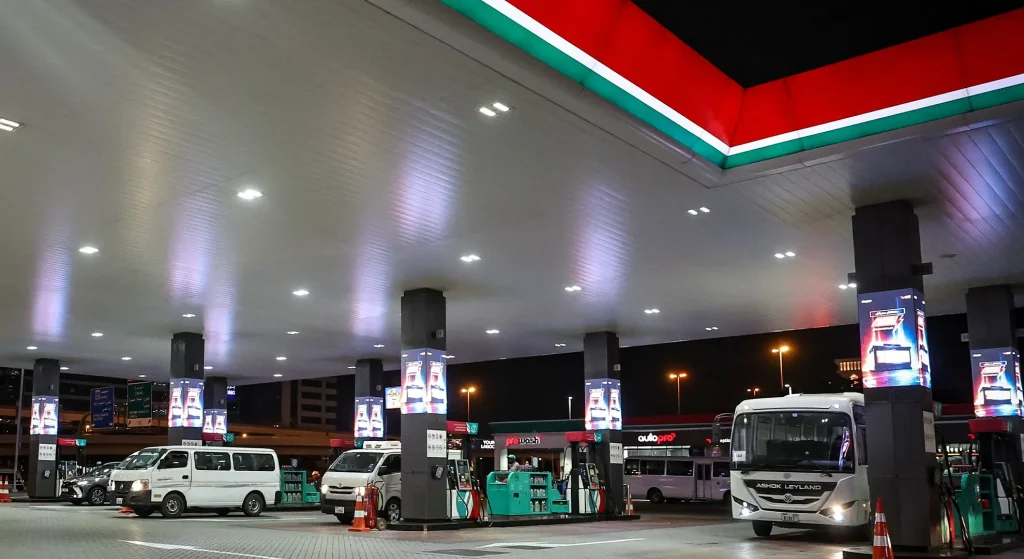
A UAE court has imposed Dh50,000 fines on two people following an altercation with petrol station employees. The incident reportedly began during a disagreement over windshield cleaning services, escalating into an assault involving staff members at the fuel station.
UAE Court Orders Two to Pay Dh50,000 Each After Petrol Station Workers Are Assaulted in Windshield-Cleaning Dispute.

The Al Ain Misdemeanour Court has sentenced the two defendants to complete two months of community service at the petrol station where the confrontation occurred, as part of the penalties handed down following the incident.
Court imposes fines and community service after petrol station altercation in Al Ain
Two individuals have been found guilty by an Al Ain court following a confrontation with a petrol station employee that reportedly began over the cleaning of a vehicle’s windscreen.
The incident occurred while the worker was carrying out his regular responsibilities at the petrol station. A disagreement over the windscreen-cleaning service subsequently escalated, resulting in the employee being assaulted.
The case was brought before the Al Ain Misdemeanour Court, which examined the circumstances surrounding the confrontation and issued penalties against both defendants.
As part of the ruling, the court ordered each person to complete two months of community service. The service is to be carried out at the same petrol station where the incident occurred.
In addition to the community-service requirement, both defendants were ordered to pay a Dh50,000 fine each.
The penalties were imposed in connection with the assault of an employee while he was performing his official duties, as well as conduct considered to have disrupted public order.
Dispute began during windscreen cleaning
According to the case details, the incident began with a disagreement concerning the cleaning of a vehicle’s windscreen.
The petrol station employee was performing his assigned duties when the dispute developed. What initially appears to have been a disagreement over a routine service eventually escalated into a physical confrontation.
The employee was assaulted during the incident, prompting the matter to be reported to the relevant authorities and subsequently referred to the courts.
The case highlights how disputes over relatively routine services can escalate when disagreements are not resolved peacefully.
Petrol station employees regularly interact with motorists while carrying out tasks such as refuelling vehicles, cleaning windscreens and assisting customers. The ruling reinforces the importance of maintaining appropriate conduct when disagreements arise at service facilities.
Community service included in the sentence
Rather than limiting the punishment to financial penalties, the court also ordered the defendants to undertake community service.
Both individuals must complete two months of service at the petrol station where the confrontation took place.
Community service forms part of the court’s sentence and requires the defendants to carry out assigned duties for the specified period.
The decision means that, in addition to paying the fines, the defendants will be required to fulfil the community-service order.
Dh50,000 fine for each defendant
The financial penalty imposed by the court amounts to Dh100,000 in total, with each defendant responsible for paying Dh50,000.
The fines were handed down in connection with the assault of an employee while he was carrying out his work, as well as behaviour that was considered disruptive to public order.
The combination of financial penalties and community service reflects the seriousness with which the court treated the incident.
The ruling also serves as a reminder that disagreements at public-facing businesses can have legal consequences if they develop into violence or behaviour that disrupts public order.
Employees are protected while carrying out their duties
The incident involved an employee who was reportedly performing his normal responsibilities when the confrontation took place.
Workers at petrol stations frequently deal directly with customers and are expected to provide services while following workplace procedures.
A disagreement about how a service is delivered does not justify threatening or assaulting an employee.
In this case, the court found the defendants responsible for the assault and imposed penalties that went beyond a simple financial sanction.
The community-service requirement adds another element to the sentence and requires both individuals to spend a period carrying out assigned work at the location connected to the incident.
A routine disagreement escalated
The case demonstrates how quickly an ordinary disagreement can become a legal matter when tempers rise.
Windscreen cleaning is a routine service provided at many petrol stations, and disagreements can arise over whether a service has been completed, how it was performed or other aspects of the interaction.
However, such disputes are expected to be handled through communication or by seeking assistance from station management.
When a disagreement develops into physical violence, it can lead to police involvement, prosecution and court proceedings.
That is what ultimately occurred in this case.
The court’s ruling shows that the consequences can include both monetary fines and other forms of punishment.
Court ruling covers two offences
The defendants were fined in relation to two aspects of their conduct.
The first concerned the assault of a public service employee while the worker was carrying out his duties.
The second involved behaviour that disturbed public order.
Both defendants received the same Dh50,000 financial penalty, while the community-service requirement was also imposed on each of them.
The total financial value of the fines is therefore Dh100,000.
The two-month community-service order applies separately to both defendants.
The incident took place at a petrol station
The location of the incident is also significant because the court ordered the community service to be completed at the same petrol station.
This means the defendants will carry out the court-ordered service at the location where the original confrontation occurred.
The order forms part of the punishment determined by the Al Ain Misdemeanour Court.
The ruling follows the court’s consideration of the case and the circumstances surrounding the confrontation.
Importance of resolving disputes peacefully
The case is also a reminder to motorists and customers that disagreements with service workers should be addressed without resorting to threats or physical confrontation.
If a customer is unhappy with a service at a petrol station, the appropriate response is to raise the matter with station staff or management.
Physical aggression can transform what may have started as a minor disagreement into a criminal case.
In this incident, the dispute concerned a vehicle windscreen, but the consequences extended far beyond the original disagreement.
The two defendants now face substantial financial penalties as well as a two-month community-service order.
Consequences extend beyond the initial dispute
A disagreement that may initially appear minor can have lasting consequences once authorities become involved.
Following the alleged assault, the matter proceeded through the legal system and ultimately resulted in convictions.
The court’s sentence includes both financial and community-based penalties.
Each defendant must pay Dh50,000 and complete two months of community service at the petrol station.
The case therefore illustrates how an incident at a commercial premises can result in significant legal consequences when it escalates into violence.
Court stresses public order
The defendants were also penalised for disturbing public order.
Public-facing locations such as petrol stations are regularly used by large numbers of motorists and workers. Incidents involving violence or serious disruption can affect not only the people directly involved but also other customers and employees nearby.
The court’s decision to impose penalties relating to public order reflects the wider impact that such confrontations can have.
Maintaining a safe environment at petrol stations is particularly important because these facilities handle fuel and operate around vehicles, staff and customers.
Any confrontation that disrupts normal operations can therefore create risks beyond the individuals involved.
Community service adds a corrective element
The two-month community-service order gives the sentence a practical component beyond the Dh50,000 fines.
Both defendants have been directed to perform service at the petrol station where the incident occurred.
The requirement means that the punishment includes a period of assigned work rather than being limited to a monetary payment.
Community service can form part of judicial penalties and requires those sentenced to fulfil specific duties for the duration ordered by the court.
In this case, the court specified the same petrol station as the location where the service is to be performed.
The financial penalty
With a Dh50,000 fine imposed on each defendant, the combined value of the fines reaches Dh100,000.
The amount represents a substantial financial consequence for the two individuals.
However, the court’s sentence does not end with the fines. The defendants must also fulfil the two-month community-service requirement.
The combination of the two measures means the court has imposed both a monetary and service-based penalty.
What happened at the petrol station
The incident centred on an interaction between motorists and a petrol station employee who was cleaning a vehicle’s windscreen.
The worker was reportedly carrying out his duties when a dispute developed.
The disagreement subsequently escalated and resulted in the employee being assaulted.
The case was then taken through the legal process, leading to the Al Ain Misdemeanour Court’s decision.
The court ultimately convicted the two defendants and imposed the penalties outlined in the ruling.
A reminder for motorists and customers
The case provides a broader reminder that employees should be allowed to carry out their duties without facing intimidation or physical aggression.
Customers who have concerns about a service can raise them through appropriate channels, including speaking with management or requesting assistance from responsible staff.
An argument does not need to become physical.
Once violence occurs, those involved may face legal proceedings and serious penalties.
In this instance, the dispute over windscreen cleaning resulted in court action, Dh50,000 fines for each defendant and two months of community service.
Final takeaway
The Al Ain Misdemeanour Court has convicted two individuals after a dispute at a petrol station escalated into an assault on an employee who was performing his duties.
Both defendants were ordered to complete two months of community service at the petrol station where the incident occurred.
They were also each fined Dh50,000, resulting in combined fines of Dh100,000.
The penalties were linked to the assault of a public service employee and conduct that disturbed public order.
What began as a disagreement over the cleaning of a vehicle’s windscreen ultimately became a court case with significant consequences.
The ruling highlights the potential legal repercussions of allowing disputes with service workers to escalate into physical confrontation and underlines the importance of resolving disagreements through peaceful and appropriate channels.
Dispute at petrol station escalated into assault, court hears
According to the details presented in the case, the incident began as a routine request at a petrol station. A driver arrived at the station and asked an attendant to clean the vehicle’s windscreen.
The request itself was not unusual, but the situation quickly became tense when the employee asked the individuals involved to wait.
At the time, the petrol station was reportedly busy, meaning the attendant was unable to immediately attend to the vehicle. The request to wait led to a disagreement between the station employee and the defendants.
What began as a discussion over the timing of a routine service subsequently developed into an argument.
The disagreement did not end with verbal exchanges. According to the case, the confrontation escalated and the employee was physically assaulted.
Employee suffered injuries
The assault left the victim with physical injuries, including bruising and pain.
The injuries were subsequently documented in a medical report, which became part of the evidence considered by the court.
The medical documentation provided evidence of the physical impact of the incident and was presented alongside other material gathered during the investigation.
The case therefore involved more than a disagreement between customers and a service worker. The court considered evidence indicating that the confrontation had progressed to physical violence and resulted in injuries to the employee.
CCTV footage played a role in the case
Surveillance footage from the petrol station was among the evidence reviewed by the court.
The security cameras captured the interaction between the parties, including the argument and the subsequent assault.
CCTV footage can provide an independent record of what occurred at a location, particularly when there are conflicting accounts of an incident.
In this case, the recorded footage formed part of the case file and was considered by the court when reaching its decision.
The footage was accompanied by other evidence, including statements from witnesses who provided information about the incident.
Defendants admitted to the incident
The court also considered admissions made by the defendants during the proceedings.
Their statements were examined together with the other evidence rather than being considered in isolation.
The case file included the CCTV recording, witness accounts and the medical report documenting the employee’s injuries.
Taken together, the evidence provided the basis on which the court reached its verdict.
Witness accounts supported the case
Statements from witnesses were another important part of the evidence.
People who witnessed the incident were able to provide accounts of what happened during the confrontation.
Witness testimony can help establish the sequence of events and provide additional context around an incident.
In this case, those statements were considered alongside the surveillance footage and medical documentation.
The court therefore had several forms of evidence available when assessing the circumstances surrounding the confrontation.
Medical report documented the injuries
The medical report was also central to establishing that the employee had suffered physical harm.
According to the case details, the victim experienced bruising and pain following the assault.
Medical documentation can provide an objective record of injuries following an alleged physical confrontation.
The report was included among the materials considered by the court when determining the case.
Court referred to UAE law
In its judgment, the court referred to provisions of the Crimes and Penalties Law dealing with assaults on public employees and individuals assigned to perform public services.
The relevant provisions address the use of force or violence against a public employee or a person carrying out a public service while performing their duties, or because of those duties.
The court found that the conduct in the case fell within the scope of the applicable legal provisions.
The ruling therefore was not based solely on the fact that a physical confrontation occurred. It also considered the circumstances in which the employee was assaulted and the fact that he was carrying out his work at the time.
Employee was performing his duties
An important aspect of the case was the employee’s status at the time of the incident.
The station attendant was carrying out his work when the disagreement began.
He had been asked to clean the vehicle’s windscreen but reportedly requested that the defendants wait because the petrol station was busy.
The confrontation followed that exchange.
The court’s reference to the employee’s duties is significant because the law provides specific protections concerning violence or resistance directed at public employees or individuals assigned to public services while performing their responsibilities.
A routine request became a legal matter
The incident illustrates how a relatively ordinary disagreement can quickly develop into a serious legal matter.
The original issue concerned the timing of a windscreen-cleaning service.
The station was busy, and the employee asked the customers to wait.
Instead of ending there, the interaction developed into an argument and ultimately an assault.
Once the employee was injured and the matter was reported, the incident moved beyond a customer-service disagreement and into the criminal justice system.
The subsequent investigation produced multiple pieces of evidence that were later reviewed by the court.
Importance of surveillance systems
The case also highlights the role that security cameras can play when incidents occur in public or commercial locations.
Petrol stations generally have surveillance systems covering areas where customers and employees interact.
In this case, the footage reportedly captured the dispute and the assault.
The recording became part of the evidence presented to the court and helped establish what happened during the confrontation.
For businesses, surveillance systems can provide an important record when disputes arise.
For individuals involved in incidents, CCTV footage may also provide evidence that can confirm or challenge accounts of what occurred.
Evidence considered as a whole
The court did not rely on a single piece of information when deciding the case.
Instead, the ruling was based on material contained in the case file, including the surveillance footage, admissions made by the defendants, witness statements and the medical report.
Each form of evidence contributed to the court’s assessment of the incident.
The CCTV footage provided a visual record.
The defendants’ admissions provided their own statements during the legal proceedings.
Witness accounts offered additional observations.
The medical report documented the physical consequences suffered by the employee.
Together, these materials formed the evidentiary basis for the judgment.
Disputes should be handled through official channels
The court also emphasised the importance of using lawful and official methods when disagreements occur.
If a customer has a complaint about a service, the appropriate response is to raise the concern with the relevant employee or management rather than allowing the situation to become confrontational.
Where a dispute cannot be resolved directly, individuals can use established complaint procedures or contact the appropriate authorities.
The court stressed that respecting the law and following official channels can help prevent disagreements from developing into situations that result in legal liability.
Physical confrontation can have serious consequences
The case serves as a reminder that a disagreement over a service can have consequences far beyond the original issue if it becomes physical.
The initial dispute involved a request to clean a vehicle’s windscreen and a request by the attendant for the customers to wait.
The subsequent assault resulted in injuries to the employee and led to legal proceedings.
The court considered the circumstances and evidence before applying the relevant provisions of the law.
For members of the public, the broader message is that frustration over delays or services should not lead to violence.
Employees dealing with the public
Petrol station workers regularly interact with motorists and other customers as part of their jobs.
Their responsibilities can include refuelling vehicles, assisting customers, cleaning windscreens and carrying out other station services.
Because these interactions take place in busy environments, disagreements may occasionally occur.
However, employees remain entitled to carry out their duties without being subjected to physical aggression.
The court’s ruling reinforces the legal consequences that can follow when violence is directed at a worker in the course of performing duties protected under the relevant law.
The role of the medical evidence
The medical report also helped establish the consequences of the confrontation.
The victim reportedly suffered bruising and pain, which were recorded by medical professionals.
Such documentation can be particularly important in cases involving allegations of physical assault because it provides evidence of the injuries associated with the incident.
In this case, the medical report was considered alongside the CCTV recording, witness statements and other material in the case file.
The court’s conclusion
After reviewing the evidence, the court found the defendants responsible for the assault.
The judgment referred to the applicable provisions of the Crimes and Penalties Law, which address assaulting or resisting a public employee or someone assigned to perform a public service through force or violence while carrying out their duties or because of those duties.
The court’s decision reflects its finding that the conduct met the requirements of the relevant legal provisions.
A reminder about lawful conduct
The incident began with something as ordinary as a request for a vehicle windscreen to be cleaned.
The attendant’s response was that the defendants needed to wait because the station was busy.
That delay became the source of an argument, and the disagreement subsequently escalated into physical violence.
The resulting case demonstrates why disagreements should be kept within peaceful and lawful boundaries.
Customers who are dissatisfied with a service can ask to speak with a supervisor, raise a formal complaint or use other official mechanisms available to them.
Those options can help resolve disagreements without exposing anyone to the consequences associated with assault or public disorder.
What the case highlights
Several key points emerge from the court proceedings.
First, the incident began over a routine service at a petrol station.
Second, the employee had reportedly asked the customers to wait because the station was busy.
Third, the disagreement escalated into an assault.
Fourth, the employee suffered bruising and pain, which were documented in a medical report.
Fifth, the court considered several forms of evidence, including security footage, witness statements and the defendants’ admissions.
Finally, the court relied on relevant provisions of the Crimes and Penalties Law when reaching its decision.
The case demonstrates that the circumstances surrounding an incident matter when determining legal responsibility.
Avoiding escalation
For motorists and customers, one of the simplest lessons from the case is the importance of stepping away from a disagreement before it escalates.
A delay at a petrol station may be frustrating, particularly when a customer is in a hurry. However, waiting for an employee to become available is preferable to allowing frustration to develop into confrontation.
If communication breaks down, requesting assistance from station management is another option.
Where a serious dispute occurs, contacting the relevant authorities is preferable to attempting to settle it through force.
Legal accountability
The court’s final observation focused on compliance with the law and the use of official channels.
That principle applies broadly to disputes involving businesses, employees and members of the public.
People who believe they have been treated unfairly can pursue their concerns through recognised procedures.
Once physical force or violence becomes involved, however, the nature of the dispute changes considerably.
In this case, the original disagreement over windscreen cleaning eventually resulted in a criminal case, medical documentation, examination of surveillance footage and a court ruling.
Final takeaway
The case began when a driver asked a petrol station attendant to clean a vehicle’s windscreen. Because the station was busy, the employee reportedly asked the defendants to wait. The exchange then turned into an argument before escalating into a physical assault.
The employee suffered bruising and pain, with his injuries recorded in a medical report.
During the court proceedings, the Al Ain Misdemeanour Court considered several pieces of evidence, including surveillance footage from the petrol station, statements from witnesses, admissions made by the defendants and the medical documentation.
The court relied on provisions of the Crimes and Penalties Law concerning the use of force or violence against a public employee or a person performing a public service while carrying out their duties or because of those duties.
The case ultimately underlines a straightforward message: disagreements over services or delays should be resolved through communication, management procedures or official channels rather than confrontation.
When a routine dispute escalates into violence, the consequences can extend well beyond the original disagreement and may result in criminal proceedings and legal accountability.