Recent satellite data has identified a significant oil slick spreading in waters close to an important oil storage and export site in Iran, raising environmental and operational concerns in the area.
Satellite imagery reveals a substantial oil spill near a major Iranian petroleum facility.
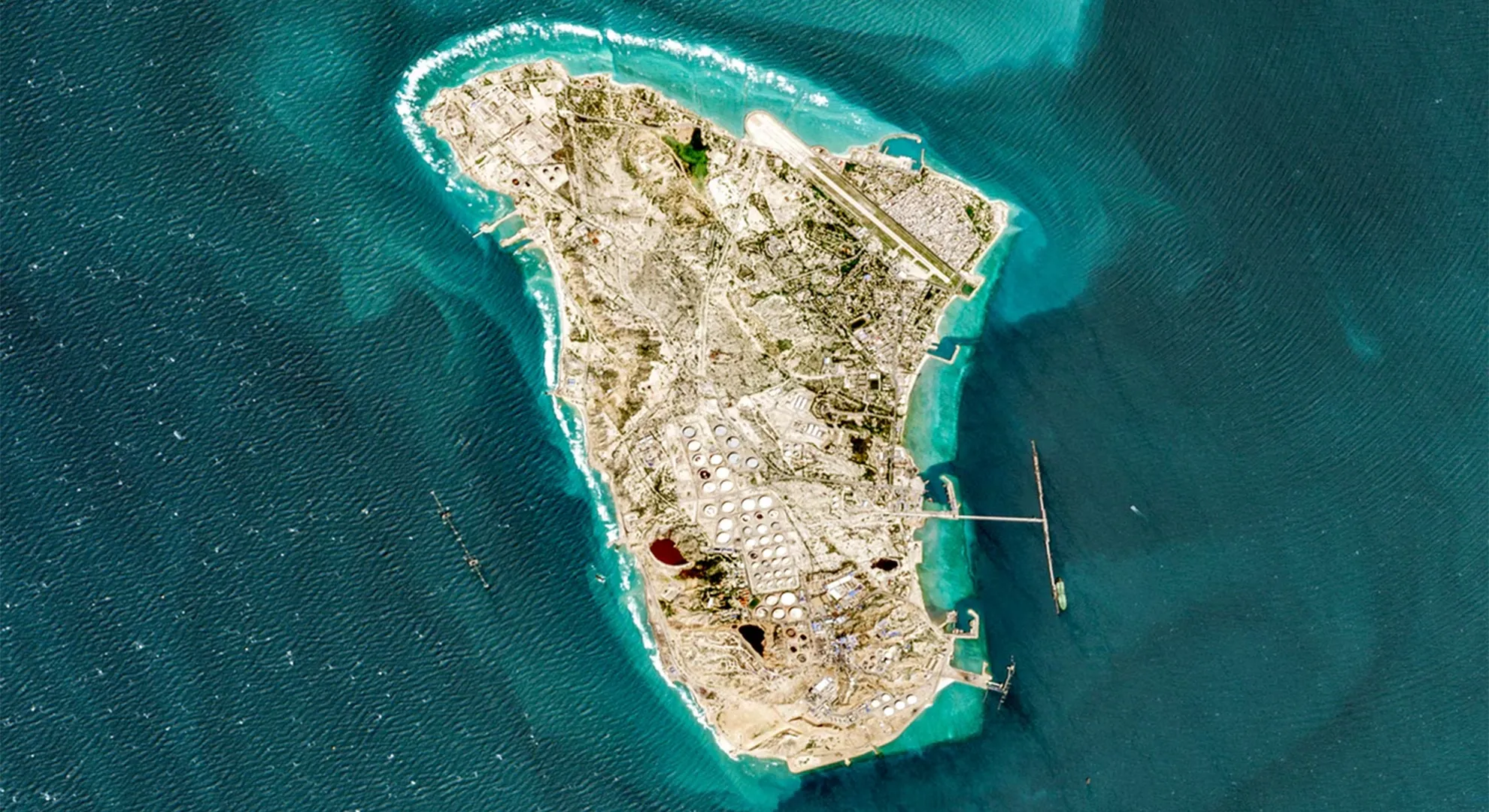
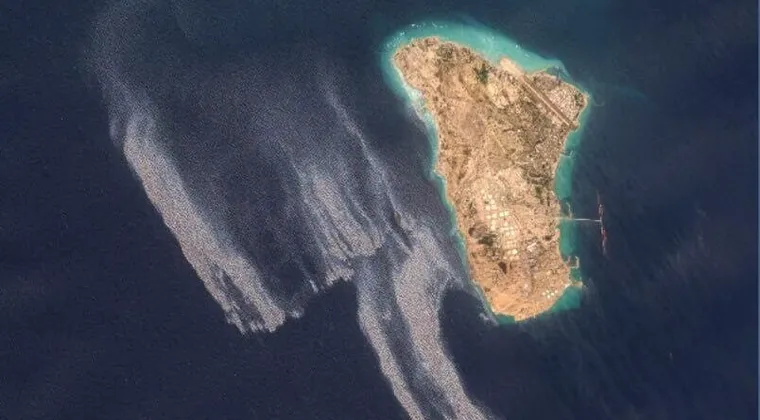
A large oil slick has been detected in the waters of the Persian (Arabian) Gulf near Kharg Island, Iran’s most important crude oil export hub, according to recent satellite imagery. The observation has raised renewed concerns about the condition and resilience of Iran’s oil infrastructure, which is already operating under significant geopolitical pressure.
Kharg Island, located off Iran’s southwestern coast, plays a central role in the country’s oil exports. It serves as a major loading point for crude shipments leaving Iran for international markets. Satellite monitoring data indicates that the oil slick, situated near the western shoreline of the island, has expanded considerably in size, covering an estimated area of more than 20 square miles as of Thursday.
Environmental tracking assessments from Orbital EOS, a global organization that specializes in monitoring oil spills through satellite technology, suggest that the leak may involve more than 3,000 barrels of crude oil. However, the exact volume of oil released has not been independently confirmed, and investigations into the source and cause of the spill are still ongoing.
At this stage, authorities have not publicly identified what triggered the incident. The uncertainty has led to increased scrutiny of the region’s oil infrastructure, particularly given the broader geopolitical tensions affecting energy transport routes in the area.
Iran’s oil and gas facilities have reportedly been under sustained operational pressure due to restrictions and tensions linked to the Strait of Hormuz. This narrow maritime passage is one of the most strategically important shipping lanes in the world, connecting the Persian (Arabian) Gulf to global sea routes.
A significant share of global oil exports passes through this corridor, with estimates suggesting that roughly one-fifth to one-quarter of all seaborne oil trade moves through the strait under normal conditions. Any disruption or perceived threat to navigation in this region can therefore have wide-reaching implications for global energy markets.
Observers note that ongoing political and security tensions in and around the Strait of Hormuz have contributed to concerns about maritime safety and operational stability in nearby oil facilities. These pressures may also increase the risk of incidents involving oil infrastructure, although no direct cause has been officially established for the Kharg Island spill.
As monitoring continues, environmental agencies and energy analysts are closely watching developments in the region to assess both the ecological impact of the spill and its potential effect on Iran’s export capabilities.
The situation around Iran’s oil export network has become increasingly complex, with authorities reportedly tightening control over maritime movement in and out of the Strait of Hormuz as diplomatic discussions over reopening or easing restrictions remain unresolved. This strategic waterway is essential for global energy transport, and any disruption to traffic through it has immediate consequences for regional oil flows.
At the same time, infrastructure in and around Iran’s key oil export facilities has reportedly suffered repeated damage in recent years, including incidents linked to US and Israeli military actions. According to analysts, such disruptions have not only affected operational stability but have also heightened the risk of technical failures, including leaks and spills at critical storage and loading sites.
One of the key outcomes of these constraints has been a buildup of crude oil within the system. With fewer vessels able to move freely and export shipments facing delays, tankers have increasingly been used as temporary storage units. This has created logistical pressure across the supply chain, as available storage capacity on land and at sea has become stretched.
Energy observers warn that this situation may be creating additional vulnerability at major hubs such as Kharg Island, where large volumes of crude oil are being held in tankers anchored offshore. The concentration of stored oil in floating vessels, rather than fixed infrastructure, increases the operational risks in the event of technical failures, accidents, or security-related disruptions.
Dalga Khatinoglu, an analyst tracking Iran’s energy sector at Iran Open Data, an independent research initiative, noted that the limited storage capacity has forced operators to rely more heavily on tankers as temporary reservoirs. This, he said, has significantly increased the risk of accidental leaks or spills, particularly if vessels remain stationary for long periods or operate beyond their intended storage limits.
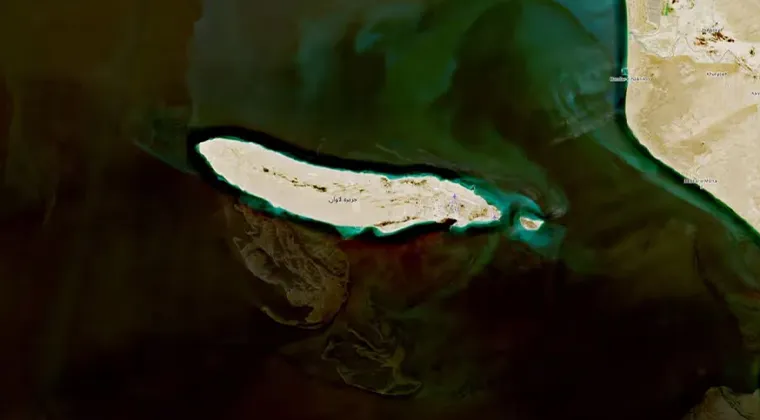
Khatinoglu also pointed to another possible technical explanation for environmental concerns in the region: damage to underwater pipeline systems. In particular, he referenced a submarine pipeline linking Kharg Island with the Abuzar oil field, one of Iran’s important offshore production sites located to the west of the island.
According to his assessment, this older pipeline has experienced maintenance challenges over time and has been associated with multiple leak incidents in recent years. He highlighted a previous rupture reported in October 2024, suggesting that aging infrastructure combined with limited maintenance access could increase the likelihood of further failures. Such pipelines, if not properly maintained, can gradually weaken under pressure, leading to gradual seepage or sudden breaches.
Alongside these technical explanations, some alternative theories have also circulated, suggesting that oil may have been intentionally released into the sea due to insufficient storage capacity. However, there is currently no verified evidence supporting this claim, and it remains speculative.
Experts emphasize that the broader geopolitical and logistical environment has created a fragile operational setting for Iran’s oil sector. According to Professor Nima Shokri of the School of Civil and Environmental Engineering at Hamburg University of Technology, the ongoing pressure on maritime routes and export infrastructure has likely pushed the entire system into a precarious condition.
He explained that when oil production facilities face restrictions on export routes, operators are often forced to keep wells running even when storage and transportation options are limited. Shutting down oil wells, he noted, is not a simple process. If production is halted abruptly, it can lead to blockages within the wells or connected pipelines, and in some cases may even damage underground reservoirs.
Such damage can make it significantly more difficult and expensive to restart production later, as pressure imbalances and sediment buildup can reduce efficiency. For this reason, oil producers often try to maintain continuous output, even under challenging storage or transport conditions.
However, this approach can also increase strain on the entire system when export routes are restricted. When storage options become limited and tankers are forced to remain stationary for extended periods, the risk of operational incidents rises.
Taken together, analysts argue that the combination of restricted maritime access, aging infrastructure, storage bottlenecks, and geopolitical tensions has created a highly sensitive environment for Iran’s oil operations. While the exact cause of recent environmental concerns remains unclear, experts caution that the system is operating with reduced flexibility and heightened risk, particularly around key export hubs such as Kharg Island.
Professor Nima Shokri emphasized that oil production systems are complex industrial networks and cannot be treated like simple mechanical devices that can be turned off and on without consequences. He explained that shutting down oil wells abruptly is not a straightforward process, as it can lead to technical complications underground and within connected infrastructure. Restarting production after a shutdown can also require significant time, cost, and technical effort, making continuous operation the more common approach even during difficult conditions.
Meanwhile, satellite observations indicate that the oil slick detected near Kharg Island continued to move over time, with reports suggesting a southward drift toward waters closer to Saudi Arabia by Thursday afternoon. Despite growing international attention to the incident, Iranian state media had not issued any detailed public reporting on the spill at that point. In addition, Iran’s Ministry of Foreign Affairs did not provide an immediate response when asked for comment regarding the situation, leaving several aspects of the incident officially unaddressed.
Energy and environmental specialist Keyvan Hosseini from the University of Southampton noted that the incident should be viewed in a broader context of long-standing structural challenges affecting Iran’s energy sector. He explained that international sanctions, regional tensions, and years of limited investment have all contributed to difficulties in maintaining and upgrading critical oil infrastructure.
According to Hosseini, these combined pressures have slowed down the modernization of facilities and reduced the capacity of operators to replace aging equipment with newer, more resilient systems. As a result, parts of the oil production and transportation network may be operating under increasing strain, making them more vulnerable to operational failures and environmental incidents.
He also highlighted that the Persian (Arabian) Gulf is already an environmentally sensitive and heavily stressed marine region. Much of the Gulf is relatively shallow, which makes it more vulnerable to pollution accumulation and slower natural dispersion of contaminants. In recent years, the region has been exposed to rising sea temperatures, increasing salinity levels, industrial discharge, oil-related pollution, and rapid coastal development, all of which have placed additional pressure on marine ecosystems.
Hosseini explained that when oil enters such environments, it does not simply remain on the surface but can gradually sink into seabed sediments and spread along coastal areas. This process can have long-lasting environmental consequences, as oil residues may persist in the ecosystem for extended periods.
He added that several forms of marine life are particularly vulnerable to oil contamination. Mangrove forests, which act as important coastal protection and breeding zones, can suffer significant damage when exposed to oil. Coral reef ecosystems are also highly sensitive, as oil exposure can disrupt their growth and reproductive cycles. In addition, species such as seabirds, sea turtles, and fish that rely on coastal spawning grounds can be severely affected, both directly through contact and indirectly through habitat degradation.
The expert further warned that a spill in the vicinity of Kharg Island could extend its impact beyond immediate ecological damage. According to him, such an incident has the potential to disrupt local fisheries, which many coastal communities depend on for their livelihoods. Any contamination of fishing zones could reduce catch levels and affect food supply chains in nearby regions.
He also pointed out that desalination plants located along the Gulf coast could face operational risks if oil contamination reaches water intake systems. These facilities are crucial for providing freshwater in many Gulf countries, and any disruption could have broader implications for water security in the region.
In addition, sensitive marine habitats and breeding grounds could face long-term degradation if oil residues persist in the environment. Recovery of such ecosystems often takes years, and in some cases, full restoration may not be possible depending on the severity of the contamination.
Hosseini stressed that environmental incidents in enclosed or semi-enclosed bodies of water like the Persian (Arabian) Gulf can escalate quickly due to limited water circulation. This means that pollutants may remain concentrated for longer periods compared to open ocean environments.
He also warned that delays in response efforts could significantly worsen the overall impact of a spill. Rapid containment and cleanup operations are critical in preventing oil from spreading further and reducing damage to marine life and coastal infrastructure.
“Even a spill that initially appears manageable can escalate into a much larger environmental emergency if action is not taken quickly and effectively,” he noted, emphasizing the importance of immediate coordination and response capability in such situations.
Overall, experts suggest that the combination of geopolitical tensions, aging infrastructure, environmental sensitivity, and delayed response mechanisms creates a complex risk landscape in the region. In such conditions, even a single incident near a key hub like Kharg Island can have consequences that extend far beyond its immediate location, potentially affecting ecosystems, economies, and communities across the wider Gulf region.