A UAE-developed Arabic AI model has achieved superior performance, outperforming rival systems twice its size and highlighting regional innovation in efficient, high-impact artificial intelligence technology.
UAE-Developed Arabic AI Model Surpasses Larger Rivals
Abu Dhabi has unveiled a new artificial intelligence system that sets a global benchmark for Arabic language understanding, proving that size is not the sole determinant of performance. The model, known as Falcon-H1 Arabic, demonstrates stronger Arabic comprehension than any other AI currently measured on international benchmarks, while remaining significantly smaller and more efficient than rival systems developed by major technology firms.
Created by the Technology Innovation Institute (TII), Falcon-H1 Arabic has secured the top position on the Open Arabic Large Language Model Leaderboard, a widely referenced standard for evaluating how effectively AI systems process and understand Arabic. Its most advanced version contains 34 billion parameters, yet it outperforms models such as Meta’s Llama-70B and China’s Qwen-72B, both of which are more than twice its size.
For Arabic speakers, this achievement addresses long-standing frustrations with AI tools. Many popular systems generate Arabic responses that appear grammatically correct but fail to capture true meaning, mishandle dialects, or overlook cultural nuance. These shortcomings are especially noticeable in daily interactions, from online searches and translations to customer service chatbots. Falcon-H1 Arabic was designed specifically to overcome these issues by prioritising authentic language understanding rather than surface-level translation.
Arabic is widely recognised as one of the most complex languages for artificial intelligence to model accurately. Its structure allows words to change meaning depending on subtle contextual shifts, sentence order is flexible, and speakers frequently move between Modern Standard Arabic and regional dialects in everyday conversation. Most global AI systems are trained primarily on English data, leaving them ill-equipped to deal with this linguistic diversity.
Academic research, including studies published in Communications of the ACM, highlights a critical challenge: Arabic lacks large, high-quality annotated datasets, particularly for dialectal and informal speech. As a result, many AI tools perform poorly in real-world Arabic use cases. These limitations are evident across education platforms, healthcare services, government portals, and business applications, where Arabic-language performance often lags behind English.
Falcon-H1 Arabic tackles this problem through an Arabic-first approach to training. Instead of adapting an English-centric model, TII built the system using datasets specifically curated for Arabic, covering formal writing, spoken dialects from across the region, and culturally relevant material. This foundation allows the model to understand meaning, intent, and context more accurately.
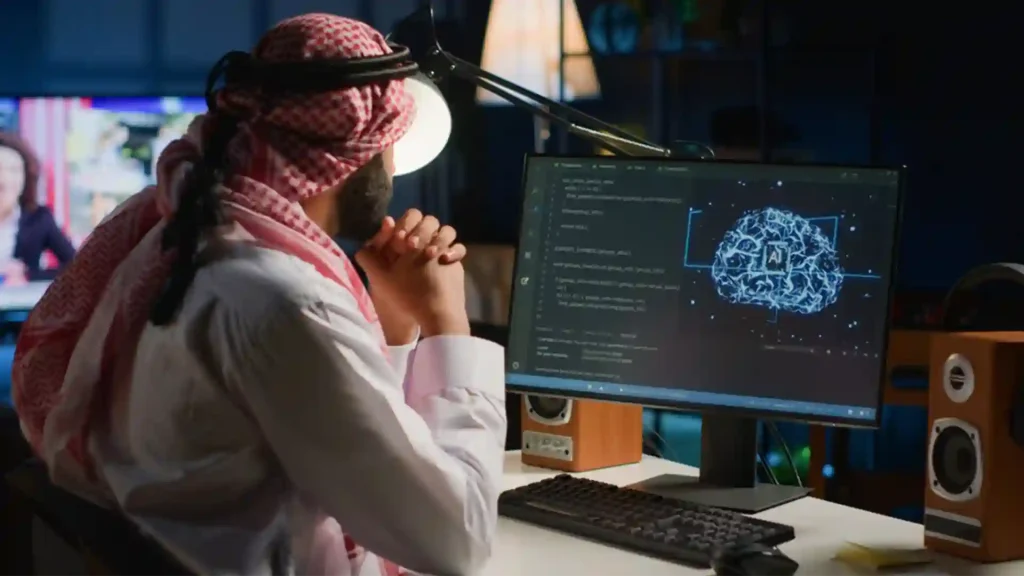
The Falcon-H1 Arabic family is available in three configurations — 3 billion, 7 billion, and 34 billion parameters — enabling organisations to select a version that aligns with their technical and computational capabilities. Despite its smaller scale, even the most compact model delivers impressive results. The 3B version surpasses Microsoft’s Phi-4 Mini by 10 percentage points on Arabic benchmarks, while the 7B model leads its performance category. The flagship 34B model achieves 75.36 percent accuracy on comprehensive Arabic understanding tests, exceeding systems more than double its size.
Performance metrics tell only part of the story. Falcon-H1 Arabic excels in tasks that directly impact everyday use. It can interpret regional expressions, maintain coherent and extended conversations, reason in Arabic without reverting to English structures, and understand context rather than translating word by word. With the ability to process up to 192,000 words in a single interaction, the model can analyse lengthy documents such as legal agreements, academic papers, or complete medical records without losing continuity.
Faisal Al Bannai, Adviser to the UAE President and Secretary-General of the Advanced Technology Research Council, described the development as a major step toward ensuring that Arabic-speaking communities benefit from technology that is “accessible, relevant, and impactful.” His remarks underline the broader ambition behind the project: to place Arabic on equal footing with English and other dominant languages in artificial intelligence.
Although Arabic is spoken by more than 450 million people across over 20 countries, it has historically been underrepresented in global AI development. Many international systems claim Arabic support, but this is often limited to translations layered on top of English-trained models. Falcon-H1 Arabic differs fundamentally by placing Arabic at the core of its design from the outset.
The implications of this breakthrough extend across multiple sectors in the UAE and the wider region. In education, AI tutors can engage students using language and dialects they naturally understand. In healthcare, AI tools can communicate with patients while respecting linguistic and cultural sensitivities. Businesses can deploy customer support systems that feel local rather than generic, and government agencies can offer digital services in fluent, natural Arabic instead of translated English phrasing.
TII’s Falcon models have consistently ranked at the top of global leaderboards since 2023, and the release of Falcon-H1 Arabic continues that trend. More importantly, it fills a critical gap in the AI landscape by delivering a foundation model purpose-built for Arabic speakers rather than adapted from another language.Falcon-H1 Arabic is freely accessible through chat.falconllm.tii.ae, giving developers, startups, researchers, media organisations, and public-sector institutions the opportunity to create AI applications that operate in Arabic with the same fluency and reliability that English users have come to expect from mainstream tools.