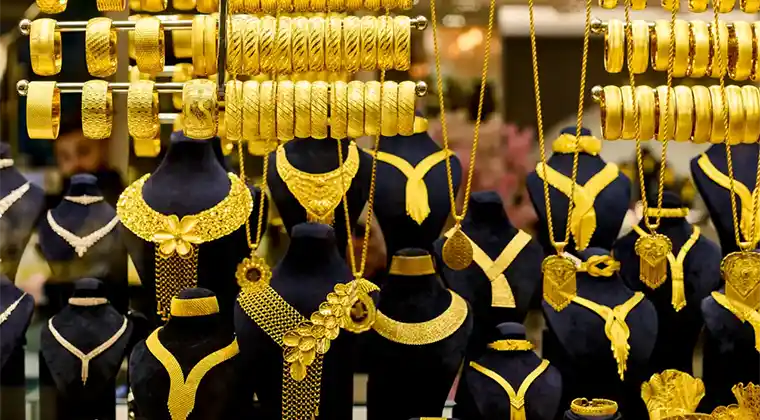
Gold prices in Dubai edged slightly lower after touching record highs, as minor profit-taking and market adjustments led to a modest pullback while rates continued to remain near historic peak levels.
Dubai Gold Prices Dip Marginally After Reaching Record Levels.

Gold Prices in Dubai See Slight Pullback After Historic Rise — What’s Behind the Move?
Gold trading in Dubai opened on Tuesday with a modest decline following an extraordinary run that pushed prices to record levels in the previous session. While the dips were relatively slight, the movement reflects ongoing market dynamics influenced by a blend of international economic pressures, investor sentiment, and entrenched global uncertainty that continues to support the precious metal’s elevated valuation.
Opening Figures Show a Softening After Sharp Gains
At the start of market activity Tuesday morning, gold prices in the United Arab Emirates adjusted slightly from Monday’s peaks. By 9 a.m. Gulf Standard Time, the price of the purest grade — 24‑carat gold — was quoted at around Dh554 per gram, marginally lower than the previous session’s record.
Other common jewellery grades likewise exhibited a small downward shift:
22K gold stood near Dh513 per gram,
21K around Dh491.75 per gram,
18K near Dh421.50 per gram, and
14K about Dh328.75 per gram.
These readings show that although prices eased, they remained extremely elevated compared with longer‑term averages, signalling that the underlying strength in the market persists well beyond a simple short‑term spike.
Monday’s Record Levels: What Happened?
The prior trading session saw gold surge to unprecedented heights in the UAE market. The price of 24‑carat bullion — long considered the benchmark for investment‑grade gold in the region — climbed sharply by approximately Dh12.50 to Dh555.75 per gram on Monday. Comparable jumps were seen across other karats, with 22K gaining roughly Dh11.75 to reach Dh514.75 per gram and slightly smaller but still significant increases in 21K, 18K, and 14K variants.
This breakout to a new local record for premium gold prices reflected broader global trends, as international bullion valuations also remained near all‑time highs. Around the same time, global spot prices were trading above $4,500 per ounce, briefly surpassing $4,600 at points last week before stabilising — levels supported by persistent risk aversion in financial markets worldwide.
Global Markets and Gold: A Safe Haven Takes Center Stage
Gold’s ability to hit and sustain elevated price points — even when there is no fresh stimulus from major central banks — suggests that significant underlying forces are at work. Across international markets, investors have steadily increased their allocations to gold and other safe‑haven assets, driven largely by a constellation of geopolitical tensions, monetary policy expectations, and structural shifts in global capital flows.
According to recent global market analyses, rising geopolitical risks — including military conflicts, trade policy frictions between major economies, and political uncertainty in key regions — are among the central drivers spurring demand for gold. These developments have heightened the appeal of bullion as a store of value when equity markets, sovereign debt instruments, and currencies appear increasingly vulnerable or volatile.
Spot gold’s climb past historic price benchmarks reflects this mindset. Investors and institutions around the world have been reallocating capital toward gold as a hedge against instability and inflationary pressures. At times when conventional assets such as high‑yield stocks and government securities falter or carry greater perceived risk, gold frequently emerges as an alternative reservoir of value.
Analysts: Not Just Speculation — Structural Demand Is Persisting
Market commentators point out that the current strength in gold prices is not merely a speculative burst that will quickly reverse. Instead, they argue, there are deeper economic and financial currents at play that have shifted how investors perceive gold’s role in portfolios.
Senior analysts have emphasised that the enduring proximity of gold prices to their all‑time highs, even with only minor corrective moves, signals robust structural demand rather than fleeting momentum trading. In this environment, motivations for buying gold are rooted more in risk mitigation and long‑term protection rather than short‑term speculation. Investors appear to be increasingly focused on shielding capital from systemic vulnerabilities, geopolitical shocks, and uncertainties surrounding interest rate policy in major economies.
One notable trend is the gradual erosion of global risk appetite. With traditional investment avenues such as equities and foreign exchange facing sustained pressure from market volatility, a growing number of capital allocators are reevaluating their exposure to credit‑based or yield‑dependent instruments. This has resulted in a re‑anchoring of strategies toward assets that are perceived as outside the conventional credit system — such as physical gold and gold‑backed financial products — which do not carry direct liabilities tied to a government or private institution.
Geopolitical Unrest: A Key Catalyst
Investors’ renewed embrace of gold is being heavily influenced by a set of geopolitical flashpoints that have intensified perceptions of risk in global markets. Conflicts in Europe’s eastern regions, persistent instability in parts of the Middle East, diplomatic tensions across East Asia, and emerging threats in other strategic corridors collectively serve as ongoing reminders of the unpredictability affecting both economies and supply chains.
These scenarios have significant implications for investor psychology. When the outlook on global geopolitical stability is cloudy or deteriorating, asset holders often seek safe harbours — commodities like gold that are traditionally seen as reliable stores of value when fiat currencies, bond yields, and stock markets lose their luster. The global fear index — a composite measure that gauges collective investor anxiety — has remained elevated in recent months, further bolstering demand for gold as a defensive play.
Monetary Policies and Market Expectations
Another important factor underpinning gold’s elevated levels is the evolving stance of key central banks, especially in major economies such as the United States. While gold typically thrives in environments of low interest rates and easy monetary policy, the current picture is nuanced. Expectations that central banks may pivot toward easier conditions — even without direct announcements — can lift gold’s attraction because lower interest rates reduce the opportunity cost of holding non‑yielding assets like bullion.
At the same time, persistent inflationary pressures in several advanced and emerging markets have sustained concerns about currency depreciation. As a hedge against inflation eroding the purchasing power of fiat money, gold has often outperformed other asset classes, prompting both institutional and retail investors to increase their allocations.
Role of Central Banks and Strategic Reserve Management
A significant structural driver of gold’s strength has been the activities of central banks themselves. Over the past few years, numerous sovereign entities have aggressively acquired gold reserves as part of a broader strategy to diversify away from a heavy reliance on any single currency, most notably the U.S. dollar. Recent data indicates that global official sector purchases have remained unusually robust, with central banks continuing to accumulate bullion as a buffer against economic shocks and systemic risk.
This shift toward diversification is not merely financial engineering; it reflects a growing recognition among policymakers that geopolitical and economic uncertainty can quickly undermine confidence in traditional reserve assets. In many cases, gold has been elevated to a strategic hedge — a foundation on which nations seek to protect their sovereign wealth in an increasingly complex and interdependent global marketplace.
How Regional Markets Like Dubai Respond
Dubai has long been recognised as a major hub for gold trading, both for bullion and jewellery. Local price dynamics in the UAE often mirror global spot prices while also incorporating regional supply and demand factors, import flows, and consumer sentiment.
In recent sessions, despite the slight easing from record highs, gold remains deeply entrenched at elevated levels across all categories. Dealers and traders in the UAE have noted strong interest from both investors and consumers, particularly in investment‑grade 24K bullion. Even when prices retract fractionally after sharp upward moves, market participants often interpret these pullbacks as opportunities for accumulation rather than indications of a broader downturn.
The demand picture for certain jewellery categories has been more mixed, with some segments seeing slower retail uptake as prices climbed. However, the investment demand — particularly from buyers seeking to preserve wealth or hedge against uncertainty — has remained resilient.
Investor Sentiment and What Comes Next
Looking ahead, market watchers expect gold to continue playing a central role in diversified investment portfolios, especially as geopolitical and macroeconomic uncertainties persist. While short‑term price fluctuations will occur — as they always do — the broader trend suggests that gold’s appeal as a safe‑haven asset continues to resonate strongly with both institutional and retail investors.
Analysts are closely watching a range of indicators, including central bank policies, currency movements, inflation trends, and geopolitical developments, to gauge gold’s trajectory. Many believe that only significant improvements in global risk sentiment — such as the resolution of major conflicts or stabilisation of fiscal policy environments — could materially weaken the metal’s current elevated standing.
For now, gold’s ability to remain close to historic price ceilings, even amid intermittent corrections, underscores its enduring role as a refuge in times of uncertainty and volatility.