Venezuelans living in the UAE express mixed emotions after Maduro’s arrest, balancing relief and optimism with uncertainty about Venezuela’s future and what the political development may ultimately mean for citizens.
‘Joyful, hopeful, uncertain’: UAE-based Venezuelans respond to Maduro’s arrest

Reports claiming that Venezuelan President Nicolás Maduro had been seized by US forces after a wave of strikes triggered emotional reactions among Venezuelans living abroad. While many in the diaspora celebrated what they saw as a long-awaited turning point, others reacted with unease, anger and apprehension, warning of potential instability, foreign involvement and an unpredictable path ahead for the already troubled nation.
For UAE-based Venezuelan expat Alonso Morales, the news was almost impossible to process. “I waited 25 years for this moment,” he told insider18, visibly emotional. “I was the last person in my family to leave Venezuela.”
Now 50, Morales recalled his years as a young officer in the Venezuelan military, describing how families of those perceived as opponents were often harshly targeted. He said the authorities classified him as “low risk” only because they lacked evidence linking him directly to opposition activities.
“Five members of my family openly opposed the government,” he said, referring back to the era of Hugo Chávez in 2002. “One of them spent nearly six years in prison before escaping.” Morales added that his cousin’s mother and sister were repeatedly monitored and harassed by officials attempting to track down his cousin.
Although Morales said he had no political affiliations, he believed his education alone made him a target. “If you are well-educated, they consider you a threat,” he said, explaining that this perception limited his ability to rise through military ranks. “The system was designed to block people like me.”
Fearing continued surveillance and pressure, Morales eventually left Venezuela, relocating first to Saudi Arabia before settling in the UAE in 2018.
Reflecting on what the future could hold, Morales remained cautiously hopeful. “There is a huge amount of work ahead. Change is possible, but it won’t be easy,” he said. “Venezuela has resources and potential, but rebuilding will take time.”
‘A step toward justice’
Music teacher Glenangel Carrera was at home with her children when she heard the news. Her immediate response was overwhelming emotion. “I cried — from happiness, relief and shock,” she said. “I feel joyful, excited, but also confused. This feels like the first crack in the regime, the first move toward justice.”
Carrera left Venezuela in 2017, driven by worsening economic conditions, social pressures and political turmoil. For most of her life, she never believed she would witness a moment that suggested Maduro’s rule could end.
“So many people lost their lives without ever seeing justice,” she said. “In Venezuela, protesting can cost you everything.” Demonstrators, she explained, often faced beatings, detention without trial or even death.
Still, not all reactions were positive. Some Venezuelans loyal to the government denounced the reports, criticising what they described as foreign interference. Others worried that Maduro’s reported capture could lead to further unrest, violence or a dangerous power vacuum.
According to the BBC, pro-government voices cautioned that such developments could intensify divisions and destabilise the country further, while ordinary citizens expressed fears of retaliation and chaos in the aftermath.
Analysts cited in an earlier insider18 report described the alleged strikes and detention of a sitting president as an unprecedented move in contemporary US foreign policy. They warned that it could set a troubling international precedent, strain legal norms and heighten instability not only within Venezuela, but across the wider region.

Divided emotions across the diaspora
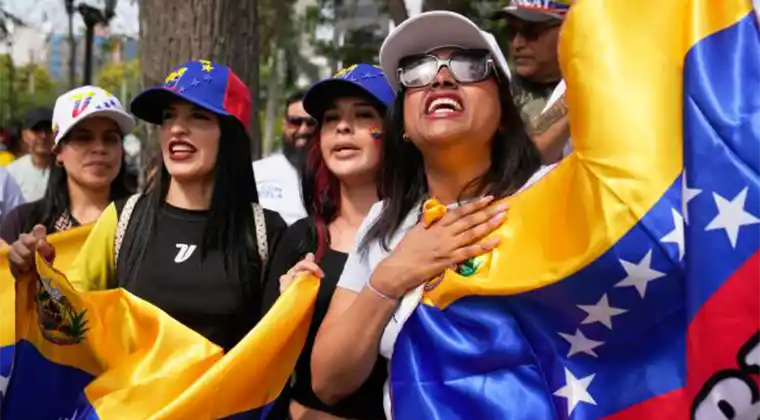
Across the UAE, Venezuelans described a wide spectrum of emotions following the reports, reflecting years of displacement and trauma. Community groups and family chats quickly filled with voice notes, prayers and heated debate. Some spoke openly of hope and the possibility of returning home one day, while others urged restraint, warning against premature celebration. For many expatriates, the news reopened painful memories of separation, loss and forced migration. Even those expressing happiness said it was tempered by anxiety, knowing that political change does not automatically translate into stability or justice for ordinary citizens who continue to struggle inside Venezuela.
Uncertainty over what comes next
Political observers say that even if the reports are confirmed, Venezuela faces a long and fragile transition. Years of economic collapse, weakened institutions and social division have left deep scars. Any sudden shift in leadership could test the country’s ability to maintain order and continuity of essential services. Venezuelans abroad voiced concerns about who would fill a potential power vacuum and whether meaningful reforms could follow. Many stressed that accountability, reconciliation and economic recovery must go hand in hand, warning that without a clear roadmap, the nation could slide into renewed turmoil rather than meaningful change.
Hope mixed with caution
Despite fears, some expatriates say the moment has reignited conversations about rebuilding Venezuela’s future. Professionals living overseas spoke of skills, investment and knowledge that could one day support recovery, if conditions allow. However, they also emphasised that trust must be rebuilt and safety guaranteed before any large-scale return becomes realistic. For now, most remain watchful rather than celebratory, following developments closely. As one expat put it, the news feels like a symbolic turning point — powerful, emotional, and historic — but whether it marks real change or another chapter of uncertainty remains to be seen.