
The Indian rupee tumbled to a record low of 90 against the U.S. dollar, prompting the central bank to take urgent measures to stabilize the currency and curb further losses.
Historic rupee depreciation to 90/USD; monetary authorities scramble to defend currency.

The Indian rupee slid past the psychologically significant 90-per-dollar mark on Wednesday, marking a historic low for the currency and highlighting ongoing pressures in the foreign exchange market. Analysts and market participants attribute the sharp depreciation to a combination of weaker trade flows, portfolio outflows, and broader external vulnerabilities, despite India maintaining strong economic growth and solid fundamentals. The breach of this key level underscores the challenges the currency faces even in a fast-growing economy.
As of mid-morning trading on Wednesday, the rupee was quoted at 90.07 per U.S. dollar, down 0.22 percent from the previous close, and on track for its sixth consecutive daily decline. Earlier in the session, the currency had slipped to 90.14, surpassing Tuesday’s previous record low of 89.9475. This sustained depreciation highlights the persistent demand for dollars in the market, driven by trade imbalances and investor sentiment favoring foreign assets.
Despite India being the world’s fifth-largest economy with robust GDP growth, the rupee continues to experience volatility. A widening trade deficit has emerged as a major factor influencing currency movements. Imports, particularly of crude oil and other essential commodities, continue to exert pressure on the local currency. At the same time, exports have not fully offset these outflows, creating a persistent gap that keeps the demand for dollars high.
Portfolio flows have also played a significant role in the rupee’s weakness. Foreign investors have scaled back purchases of Indian equities and debt in recent days amid global uncertainties, including rising U.S. interest rates and concerns about tighter financial conditions abroad. These outflows reduce liquidity in the domestic market and add downward pressure on the currency. Analysts note that foreign portfolio investors often respond quickly to global cues, and even short-term shifts can amplify rupee volatility.
The Reserve Bank of India (RBI) has intervened intermittently to support the rupee, using foreign exchange reserves to stabilize the currency and prevent disorderly fluctuations. However, persistent pressures from both trade and capital flows have made it challenging to maintain the rupee above critical thresholds. While the central bank maintains ample reserves and a proactive monetary policy stance, it is balancing the need to defend the currency with broader economic objectives, including managing inflation and supporting growth.
Market experts emphasize that the rupee’s decline does not necessarily signal a fundamental weakness in the Indian economy. India continues to record strong GDP growth, driven by domestic consumption, industrial output, and investment inflows. Structural reforms, infrastructure spending, and a large, young workforce underpin the economy’s long-term growth trajectory. Nonetheless, the currency remains sensitive to external factors, particularly fluctuations in global oil prices, the U.S. dollar’s strength, and shifts in investor sentiment in response to global economic developments.
Technically, the rupee’s movement past the 90 mark is significant because it represents a new psychological barrier that traders and policymakers closely monitor. Breaches of such levels often trigger short-term volatility, speculative activity, and interventions by the central bank. Analysts caution that while the rupee is trading at historic lows, its trajectory will depend on a combination of domestic macroeconomic conditions and external pressures, including global trade dynamics and movements in international capital markets.
Looking ahead, the near-term outlook for the rupee will likely remain volatile. Continued import demand, fluctuations in crude oil prices, and global monetary policy actions—particularly by the U.S. Federal Reserve—will continue to influence the currency. Similarly, any shift in investor confidence, whether from geopolitical developments, trade negotiations, or global market sentiment, could impact portfolio flows into or out of India, further affecting the rupee’s stability.
Despite these short-term pressures, experts remain cautiously optimistic about the rupee’s medium- to long-term prospects. India’s strong economic fundamentals, expanding export base, and growing foreign direct investment inflows provide underlying support for the currency. Policymakers are also focused on measures to strengthen external balances, improve trade competitiveness, and maintain sufficient foreign exchange reserves to manage volatility.
In summary, the Indian rupee’s drop past 90 per U.S. dollar on Wednesday marks a historic low, reflecting persistent pressures from trade imbalances and portfolio outflows. The currency weakened to 90.14, surpassing Tuesday’s previous low of 89.9475, and was last trading at 90.07, down 0.22 percent on the day and heading for a sixth straight decline. While these movements highlight external vulnerabilities, India’s strong economic growth, robust reserves, and ongoing policy measures provide a buffer against prolonged weakness. As global conditions continue to evolve, the rupee is likely to experience further volatility, with market participants closely watching trade flows, foreign investment activity, and central bank interventions for guidance on future direction.
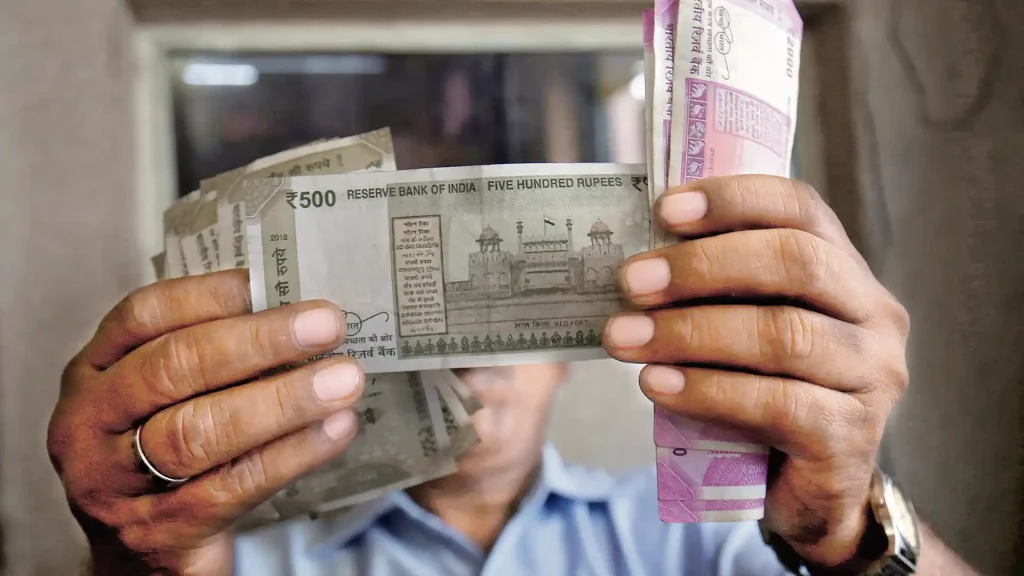
The recent depreciation of the Indian rupee highlights a growing disconnect between the country’s strong domestic economic performance and the pressures arising from external factors. While India continues to register GDP growth that exceeds expectations, the currency has struggled under the weight of international challenges, including trade tensions and subdued capital inflows. The contrast between robust internal economic fundamentals and adverse external conditions has created a scenario in which the rupee faces downward pressure despite India’s positive growth trajectory.
India’s economy has remained resilient, with domestic consumption, investment activity, and industrial output contributing to sustained growth. Analysts note that the country’s macroeconomic indicators, such as inflation control, rising employment, and stable government finances, reflect a fundamentally strong economy capable of withstanding global shocks. Even as international markets face uncertainty, India’s economic performance continues to surprise on the upside, signaling structural strength that should, in theory, support a stable currency.
However, external developments have overshadowed these positive domestic trends, particularly in trade and capital flows. Heightened tensions between the U.S. and its trading partners, including the imposition of punitive tariffs, have disrupted normal trade patterns and placed added strain on the rupee. Imports have become costlier in dollar terms, and exporters face challenges navigating shifting trade policies, which in turn affects the overall balance of payments.
In addition to trade-related pressures, capital flows have been relatively muted. Foreign investors, wary of global uncertainties and higher yields in developed markets, have limited their purchases of Indian equities and debt. This subdued investment inflow reduces the availability of foreign currency in domestic markets, creating additional demand for dollars and contributing to the rupee’s slide. The combination of trade friction and weaker capital movement illustrates how external factors can sometimes outweigh domestic economic strength in determining short-term currency performance.
Experts point out that this divergence between India’s domestic growth story and external pressures underscores the complex nature of exchange rate dynamics. Even when a country’s internal economy is expanding and structural indicators are positive, external vulnerabilities such as tariffs, geopolitical risks, or fluctuating investor sentiment can lead to currency weakness. For India, the challenge lies in managing these external pressures while sustaining domestic growth momentum.
Policymakers, including the Reserve Bank of India, have responded with measured interventions to stabilize the rupee. By utilizing foreign exchange reserves and signaling readiness to support the currency, authorities aim to prevent disorderly market movements and maintain investor confidence. At the same time, the government continues to focus on boosting export competitiveness, attracting foreign investment, and enhancing trade resilience, which are critical to bridging the gap between India’s domestic and external economic realities.
In summary, the rupee’s recent decline reflects a clear divergence between India’s strong internal growth and the external pressures weighing on the currency. While GDP performance and domestic economic indicators remain robust, punitive U.S. tariffs and weaker capital inflows have compounded challenges, keeping the rupee under stress. Addressing these external vulnerabilities, while sustaining the country’s positive domestic momentum, remains a key focus for policymakers as they navigate the complexities of an interconnected global economy.
The Indian rupee has been under significant pressure in 2025, declining roughly 5 percent year-to-date, positioning it for its steepest annual drop since 2022. This drop has made it the worst-performing currency in Asia, reflecting a combination of domestic and international pressures affecting India’s foreign exchange market. The depreciation highlights a growing disconnect between India’s strong macroeconomic fundamentals and the challenges posed by external factors, including trade imbalances and weaker foreign investment flows.
According to Dhiraj Nim, an FX strategist and economist at ANZ, the rupee’s slide is, in part, a necessary adjustment in response to the ongoing trade environment. “Until there is a trade deal, this is the sort of economic adjustment that India requires,” Nim explained, emphasizing the role of international trade negotiations in shaping currency performance. In line with this, ANZ has projected that the rupee could weaken further to 91.30 per U.S. dollar by the end of next year, assuming the current U.S. trade tariffs remain unchanged. Analysts also caution that the currency could reach this level sooner if external pressures intensify or global market sentiment shifts further against emerging markets.
A major factor driving the rupee’s weakness has been subdued foreign capital inflows. Foreign investors have pulled approximately $17 billion from Indian equities this year, reflecting caution amid global uncertainties and tighter liquidity conditions in international markets. Meanwhile, net foreign direct investment (FDI) flows have remained modest, and external commercial borrowings have been softer than expected. These broad-based outflows have amplified pressure on the rupee, limiting the availability of dollars in the domestic market and creating a sustained imbalance between supply and demand.
At the same time, India’s trade deficit has been widening, reaching a record high of over $40 billion in October. Rising imports, particularly of crude oil and other essential commodities, have outpaced export growth, increasing demand for foreign currency and further straining the rupee. The growing trade imbalance has skewed the supply-demand dynamics for dollars, compounding the currency’s downward trajectory.
Commenting on the broader macroeconomic context, Sat Duhra, a portfolio manager at Janus Henderson Investors in Singapore, highlighted that multiple weak economic indicators are contributing to the rupee’s decline. “The weak macro picture in India makes weak currency performance inevitable,” he said. “There has been a slide across several data points recently—rising trade deficits, weakening nominal GDP growth, modest FDI, and foreign investors selling domestic equities. These factors collectively exacerbate pressure on the rupee.”
While India’s underlying economic fundamentals, including strong GDP growth and structural reforms, remain robust, the currency continues to be influenced by external vulnerabilities. Analysts stress that until trade negotiations progress and foreign investment sentiment improves, the rupee is likely to remain under pressure. Policymakers, including the Reserve Bank of India, continue to monitor the situation closely, employing interventions where necessary to stabilize the market and prevent disorderly currency movements.
In summary, the rupee’s recent performance reflects the intersection of strong domestic economic growth and significant external pressures. Weak foreign capital flows, a record trade deficit, and ongoing global uncertainties have contributed to the currency’s decline, while experts argue that this adjustment is part of a broader economic recalibration. Despite these short-term challenges, India’s long-term economic outlook remains favorable, with policymakers focusing on balancing currency stability, trade competitiveness, and sustained growth.
The Indian rupee has been experiencing a notable slide in recent weeks, and market observers point to the limited and sporadic intervention by the Reserve Bank of India (RBI) as one factor influencing the currency’s movement. Unlike previous periods when the central bank mounted a robust defense by selling dollars aggressively to support the rupee, recent interventions have been more measured and intermittent, according to multiple bankers familiar with the market. This cautious approach has allowed the currency to breach significant psychological thresholds, most notably the 90-per-dollar mark, underscoring the delicate balancing act the RBI is performing in managing the foreign exchange market.
Sources in the banking sector indicate that the RBI has been opting for short, staggered bursts of intervention in recent sessions, rather than a sustained or large-scale strategy to defend the rupee. By doing so, the central bank appears to be aiming for market stabilization without encouraging speculative behavior. Large, predictable interventions can sometimes create a false sense of security for traders, leading them to bet heavily against or in favor of a currency, which can exacerbate volatility rather than mitigate it. In contrast, the RBI’s current strategy seeks to curb excessive swings in the rupee while maintaining flexibility to respond to changing conditions in both the domestic and international markets.
Despite the measured approach, the Reserve Bank of India maintains substantial foreign exchange reserves, which give it the capacity to act decisively if needed. These reserves serve as a critical buffer against abrupt market movements, allowing the RBI to inject liquidity or sell dollars to stabilize the rupee without straining its overall financial position. Analysts highlight that the presence of strong reserves provides confidence to both domestic and international market participants, signaling that the central bank has the tools to prevent a disorderly slide in the currency even while taking a measured approach.
Experts emphasize that the RBI’s strategy is not intended to allow the rupee to weaken unchecked, but rather to manage market dynamics carefully. As Anindya Banerjee, Head of Commodity and Currency Research at Kotak Securities, explains, “At this stage, it is essential for the central bank to prevent speculators from becoming too comfortable with a one-way trend, as that can trigger an unnecessary spike in USD-INR volatility.” By intervening selectively, the RBI aims to deter speculative attacks on the rupee while avoiding heavy-handed measures that could distort the natural balance between supply and demand in the foreign exchange market.
The central bank’s cautious approach comes amid broader pressures on the rupee, including widening trade deficits, capital outflows, and global uncertainty. A sustained large-scale defense could be costly in terms of reserves and may also send mixed signals to the market about the sustainability of the currency. Instead, the RBI appears to be balancing the need to support the rupee against the desire to maintain market discipline, allowing investors and traders to adjust to the prevailing economic conditions while stepping in only when volatility threatens to become excessive.
Bankers note that the current intervention pattern also reflects a strategic shift toward more flexible and nuanced currency management. Rather than committing to a fixed level for the rupee, the RBI is using its reserves to smooth extreme fluctuations, providing stability without trying to fully control the exchange rate. This approach is consistent with modern central banking practices, which often focus on ensuring orderly markets rather than maintaining rigid currency targets.
In addition, the RBI’s intervention strategy is designed to reinforce confidence in the currency while simultaneously discouraging speculative trading. Large, predictable interventions can sometimes invite traders to test the central bank’s resolve, whereas a flexible, measured approach keeps market participants cautious and more aligned with fundamental economic realities.
In summary, the Reserve Bank of India’s response to the rupee’s recent weakness has been deliberate, limited, and strategically timed, reflecting a careful balance between stabilizing the currency and avoiding unintended market distortions. While the rupee has slipped below key psychological levels, the central bank’s strong foreign exchange reserves and measured intervention strategy act as a safeguard against excessive volatility. According to experts, this approach helps prevent speculative excesses, supports market confidence, and ensures that the rupee’s movement remains aligned with broader economic fundamentals, demonstrating the RBI’s nuanced and flexible approach to managing one of the world’s most closely watched emerging-market currencies.