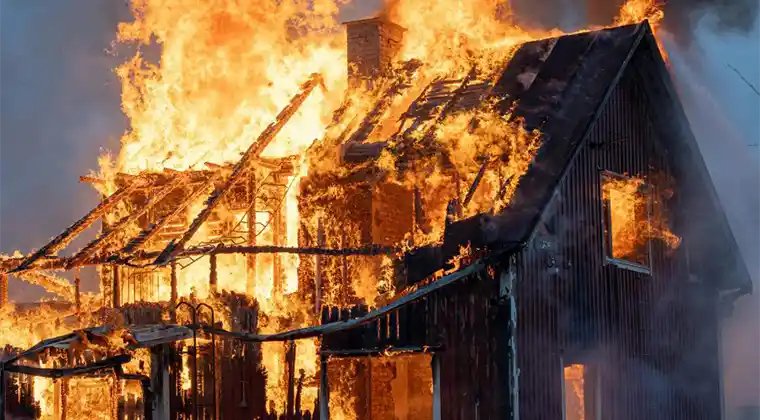
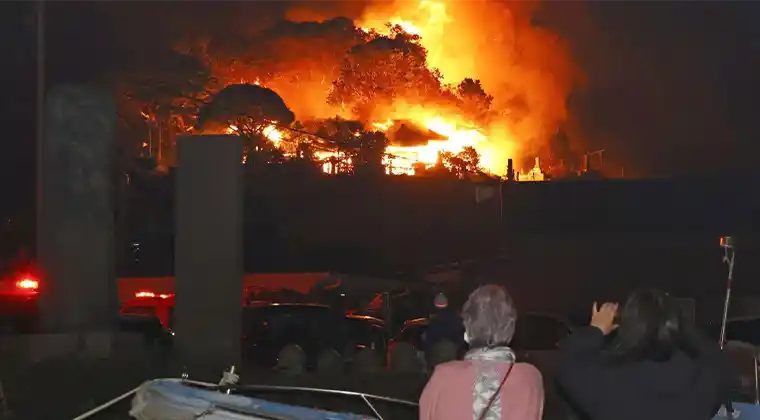
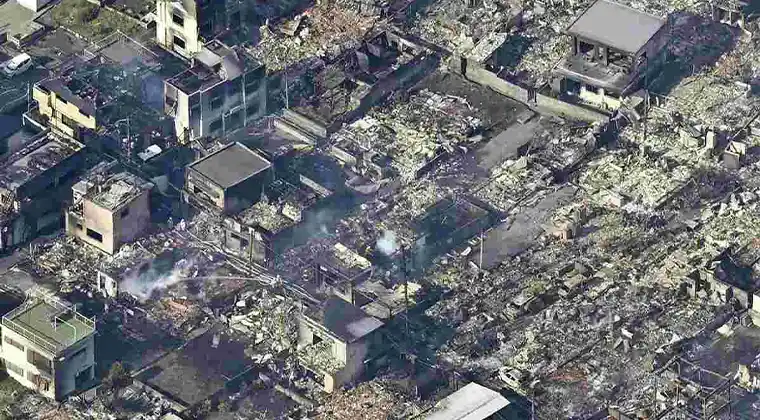
A massive fire swept through a Japanese city, resulting in one fatality and causing extensive destruction to roughly 170 buildings, leaving widespread devastation and prompting urgent emergency response efforts today.
Huge blaze leaves one dead and destroys 170 buildings in Japanese city.
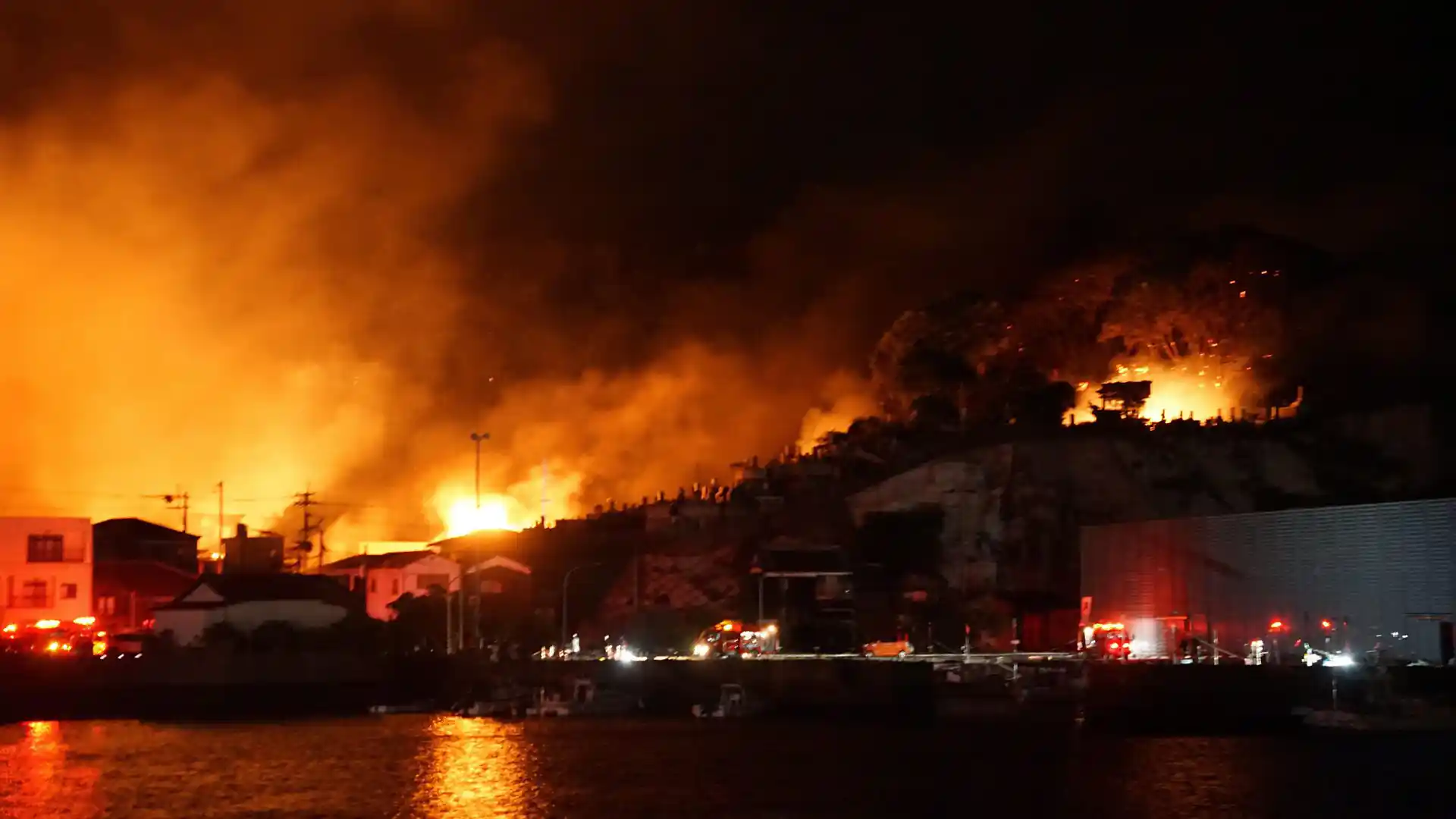
Firefighters were still struggling to extinguish the blaze in the southern city as it spread to a forested mountain nearby, and their efforts grew increasingly difficult with each passing hour. The fire, which had already torn through a densely populated residential district, continued to advance unpredictably, driven by shifting winds and the dry conditions that had turned the surrounding vegetation into perfect fuel. Emergency crews, who had been working without pause since the early hours of the morning, found themselves battling flames on multiple fronts, attempting not only to contain the inferno but also to protect nearby homes and prevent further loss of life.
As the fire climbed the slopes of the mountain overlooking the district, the terrain became a new and formidable challenge. Steep inclines, narrow paths, and thick underbrush slowed down the movement of fire engines and forced many firefighters to proceed on foot, carrying heavy hoses and equipment through the dark and smoky wilderness. The dense forest canopy trapped much of the smoke, reducing visibility to only a few meters at times and creating dangerously hot pockets of air. The responders described the atmosphere as suffocating, with the wind constantly shifting and causing flare-ups that forced them to reposition again and again.
Authorities on the ground coordinated through radios crackling with static, attempting to map the fire’s path in real time. Water trucks lined narrow roads as crews formed chains to relay information and supplies. Firefighters wearing heat-resistant gear moved methodically, dousing burning trees and setting up firebreaks in a desperate attempt to stop the flames from leaping further uphill. Helicopters were deployed at daybreak, hovering above the mountain as they attempted to release water in precise drops, though the smoke made visibility so poor that several sorties had to be postponed. Even when successful, the water drops provided only temporary relief, as embers blown by sudden gusts continued to spark new flare-ups across the mountainside.
Residents who had been evacuated from the nearby neighborh
oods watched from designated shelters as thick plumes of smoke billowed above the ridgeline. Some people clutched blankets or masks to their faces while others tried to contact relatives or check updates issued by local authorities. Many recounted how quickly the fire had approached, giving them little time to gather belongings before sirens and loudspeakers urged them to flee. Volunteers and emergency workers moved through the shelters, offering water, masks, and support as the fire continued to burn out of control.
Local officials emphasized the scale of the challenge faced by emergency crews, explaining that the combination of tightly packed homes, strong winds, and the proximity of forested terrain had created conditions ripe for a major disaster. They warned that even as firefighters fought the active flames, smoldering hotspots remained a persistent threat, capable of reigniting areas thought to be under control.
By late morning, as exhausted crews rotated shifts, the fire still showed no signs of fully abating. The battle continued on the ground and from the air, with firefighters determined to contain the advancing flames before they could cause further destruction to both the mountain and the already devastated residential area below.
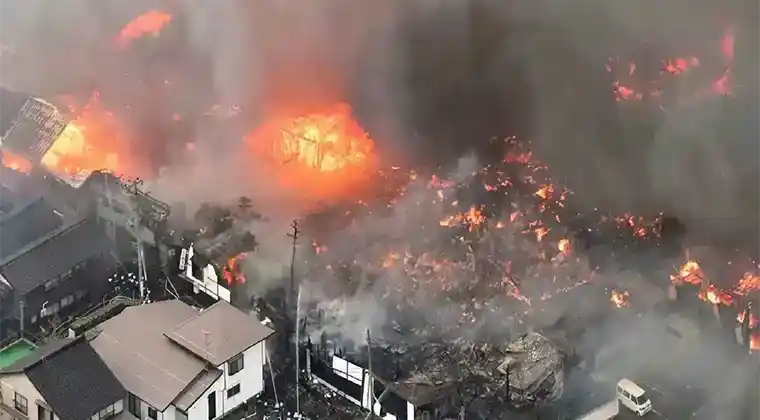
ideo captured by local media revealed dramatic scenes as emergency crews battled towering walls of fire that surged through rows of homes late Tuesday. Firefighters could be seen bracing themselves against intense heat while directing powerful streams of water toward the advancing blaze, their silhouettes flickering against the glow of burning buildings. The crackling of collapsing structures and the roar of the flames formed a constant backdrop as crews worked tirelessly to slow the fire’s spread. Meanwhile, residents hurriedly gathered at an improvised evacuation site set up in a nearby public facility, where volunteers and officials worked to register arrivals, distribute supplies, and reassure families fleeing the danger.
Amid the confusion and fear, evacuees shared their shock at the speed and scale of the disaster. One local resident, speaking to NHK, described the terrifying moments when the fire approached his neighborhood. He recalled how the night sky became illuminated by an ominous red glow, as though dawn had arrived hours too early, and flames shot high into the air with unnerving force. Gusts of wind swept through the area, carrying embers that made the fire jump rapidly from one house to the next. He admitted that even though wildfires were not unheard of in the region, he had never imagined one would escalate so ferociously or reach so close to his home.
He spoke of the surreal feeling of watching the fire advance—how neighbors shouted warnings to one another, how people rushed to gather only the most essential belongings, and how the strength of the wind made the fire seem alive, almost predatory. His voice carried a mixture of disbelief and sorrow as he described the overwhelming sense of helplessness shared by many residents that night, a realization that the flames were moving far faster than anyone had anticipated.
Another resident, recalling the terrifying moments of the night, said he was overwhelmed by fear, explaining that he had never witnessed flames rising in such a towering column before. The sheer height and force of the blaze left him trembling, unsure of whether he and his family would be able to escape in time.
According to a statement released by the regional authorities, the fire that ignited late Tuesday night caused destruction on a massive scale. About 170 buildings suffered damage as the flames swept through the tightly packed neighborhood. More than 180 people were forced to flee their homes, seeking temporary refuge in designated shelters as firefighters struggled against the rapidly advancing blaze.
Officials also confirmed that one person had died in the incident, though no additional details were immediately provided. Local media later reported that police teams searching for a 76-year-old man who had been unaccounted for discovered a body inside his residence, though formal identification had yet to be announced.
Mayor Shinya Adachi, who surveyed the scorched area early Wednesday, expressed cautious optimism. Speaking to reporters, he noted that if crews were able to extinguish the remaining source of the fire, the situation could stabilize as soon as Wednesday. However, he also warned that fully putting out the blaze would require considerably more time, possibly several additional days of nonstop work by emergency responders.
Authorities and experts suggested that a combination of environmental and structural factors likely contributed to the fire’s speed and intensity. A prolonged lack of rainfall, extremely dry air conditions, and the close proximity of older wooden homes created an environment in which even a small spark could escalate into a large-scale disaster. NHK reported that these conditions allowed the flames to leap quickly from one structure to another, overwhelming the neighborhood before responders could contain it.