Elon Musk has expressed appreciation towards Rahul Gandhi amid ongoing discussions surrounding Starlink’s planned expansion into the Indian market. The development comes as questions and political debate continue over the satellite internet service’s entry and operations in India.
Elon Musk Acknowledges Rahul Gandhi as Debate Grows Over Starlink’s Entry Into India.
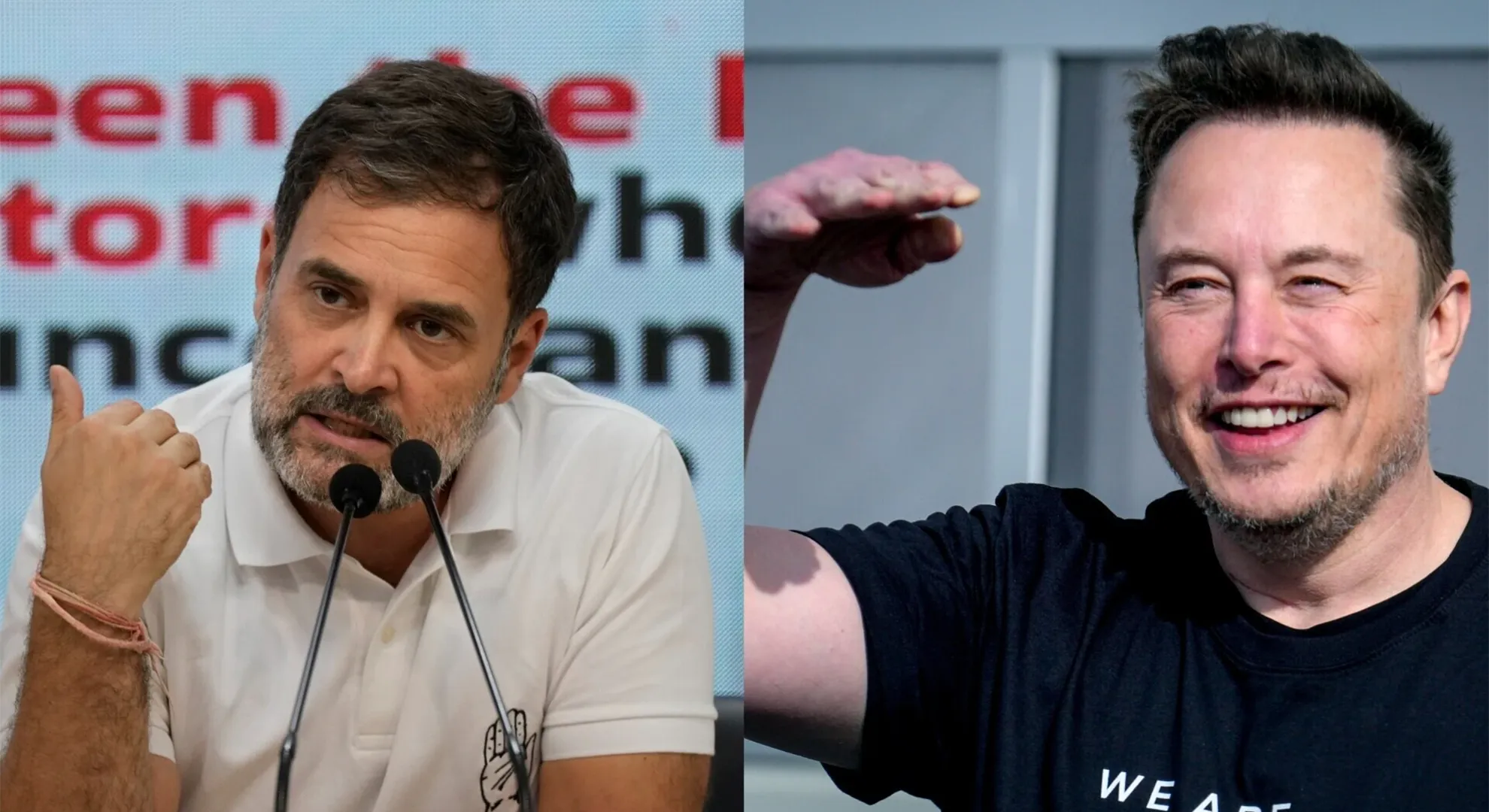
Elon Musk Calls Starlink’s India Entry Dispute ‘Troubling’ After Rahul Gandhi’s Remarks
Elon Musk, the chief executive of SpaceX and its satellite internet venture Starlink, has described the ongoing situation surrounding the company’s entry into India as “troubling” following an exchange with Congress leader Rahul Gandhi on social media platform X.
The discussion comes amid growing public debate over the approval process for Starlink’s proposed services in India. Musk has questioned the delay in obtaining the necessary licence, arguing that the company has spent years meeting the country’s regulatory requirements.
Gandhi, who serves as the Leader of the Opposition in the Lok Sabha, responded to Musk’s concerns with a pointed comment about the political and business environment in India.
“Welcome to India, Elon. Wait till you discover the other guy,” Gandhi wrote on X.
Musk replied, “Thank you, Rahul. This is indeed troubling.”
The brief exchange brought renewed attention to Starlink’s efforts to enter the Indian telecommunications market and the wider discussion over competition, licensing procedures and the influence of major business interests.
Musk Questions the Delay in Starlink’s Indian Licence
Musk has publicly questioned why Starlink has yet to receive all the necessary approvals to begin commercial operations in India, despite the company’s efforts to comply with the country’s rules.
In an earlier post on X, he pointed out that Starlink had obtained authorisation to operate in more than 165 countries and argued that the Indian approval process had taken an unusually long time.
“Starlink is licensed in over 165 countries and has spent five years complying with every single law and requirement of the government of India, so why still no license? Is Ambani the real boss of India?” Musk wrote.
His remarks also raised questions about the role of established Indian telecommunications companies in the market for satellite-based internet services.
In a separate post, Musk alleged that powerful commercial interests were standing in the way of Starlink’s proposed entry into India.
He claimed that certain business groups were attempting to protect their market positions by preventing additional competition. Musk described the alleged obstruction as harmful to Indian consumers, although these claims have not been established as fact.
The comments have added to the debate over whether Starlink’s entry could increase competition and expand internet access, particularly in areas where conventional broadband infrastructure remains limited.
What Has the Indian Government Said?
India’s Ministry of Communications has rejected allegations that Starlink is being deliberately obstructed by vested interests.
The ministry has maintained that the country’s regulatory framework for telecommunications, including satellite communications, operates on fair and non-discriminatory principles.
In its response, the ministry explained that three global mobile personal communication by satellite service providers using non-geostationary satellite orbit systems had received telecommunications licences.
It also clarified that obtaining a licence does not automatically complete every stage of the authorisation process.
Companies must demonstrate compliance with the prescribed security requirements, including measures intended to protect users and their data. Once the relevant assessments have been completed, a licensed operator can proceed to the next stage of seeking spectrum assignment.
The ministry said the three licensed providers were broadly at the same point in the regulatory process.
It therefore rejected suggestions that the framework was being applied unfairly to Starlink or that the company was being treated differently from other operators.
The government’s position highlights the distinction between receiving a telecommunications licence and obtaining the additional permissions needed to provide commercial satellite connectivity services.
Starlink Says It Is Preparing for the Indian Market
Despite the continuing debate over approvals, Starlink has indicated that it is making preparations to launch its services in India.
Lauren Dreyer, Starlink’s Vice President of Business Operations, discussed the company’s progress during the India Mobile Congress 2026 on October 7.
Dreyer said the company had developed security arrangements tailored to Indian requirements and was preparing the infrastructure needed to serve customers in the country.
According to her remarks, Starlink has invested in ground infrastructure in India, including 20 gateway sites equipped with hundreds of antennas.
These facilities form part of the infrastructure needed to connect the satellite network with terrestrial telecommunications systems and support service delivery.
Dreyer also said the company had established operational arrangements and was preparing to provide services to Indian users.
She added that Starlink was keeping Indian users’ data within the country, addressing an important consideration in the discussion over national security and data protection.
However, infrastructure investment and operational preparations do not, by themselves, establish that a company has received every approval required to begin commercial operations.
Why Starlink’s Entry Matters for India
Starlink uses a network of satellites to provide internet connectivity, offering a potential alternative to traditional fixed-line broadband and some existing wireless services.
Satellite internet can be particularly useful in remote and rural locations where installing fibre-optic cables or building conventional telecommunications infrastructure is difficult or expensive.
If authorised to operate commercially in India, Starlink could provide another connectivity option for households, businesses and institutions in areas that remain underserved by existing networks.
The service could also be relevant to sectors such as education, healthcare, agriculture and emergency response, where reliable internet access can support essential activities.
At the same time, the company’s entry would take place in a competitive market that already includes major Indian telecommunications operators and other satellite communication providers.
Questions surrounding spectrum allocation, security compliance, pricing and the conditions attached to operating licences remain important parts of the regulatory process.
For consumers, the potential benefits would depend on the service’s eventual availability, subscription costs, equipment requirements and performance in different parts of the country.
A Debate Over Regulation and Competition
The exchange between Musk and Gandhi has brought political attention to a regulatory issue involving a major international technology company.
Musk has suggested that commercial interests could be influencing the process, while the Ministry of Communications has maintained that the rules are applied fairly to all licensed providers.
These are differing positions, and the allegations of deliberate obstruction should not be treated as confirmed findings.
The government’s explanation indicates that licensing, security assessments and spectrum assignment are separate stages that providers must address before launching services.
Starlink’s reported investment in infrastructure suggests that the company is preparing for a potential entry, but its commercial launch depends on completing the applicable regulatory requirements.
For now, the discussion remains focused on the approval process, the government’s position and the prospects for satellite internet services in India.
Musk’s response to Gandhi has ensured that the issue continues to attract public attention, while Starlink’s next steps will depend on the progress of the necessary approvals.