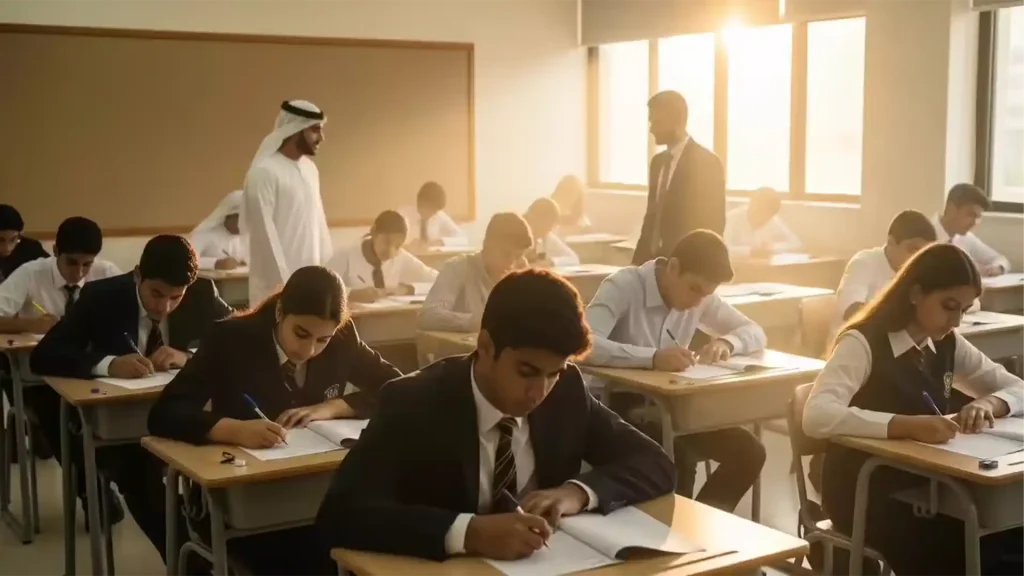
Dubai is expected to see a major increase in reasonably priced school places, with almost 18,000 additional seats projected to become available over the coming two years, giving families more options as demand for education continues to grow across the emirate.
Dubai Set to Expand Affordable School Capacity by Nearly 18,000 Seats Over the Next Two Years.

Dubai private schools add capacity as enrolment continues to grow
Dubai’s private education sector is continuing to expand, with thousands of new places being created as more families choose the emirate for their children’s education.
Private schools across Dubai recorded a 4.6 per cent increase in student numbers at the beginning of the new academic year. Enrolment has reached 406,563 students, compared with approximately 388,731 recorded in June 2026.
The rise in student numbers comes alongside the opening of new educational institutions across different stages of learning.
During the current academic year, 26 new private education institutions have opened in Dubai. These include seven schools, 17 early childhood centres and two international higher education institutions.
The new schools alone have created close to 17,000 additional places, while the newly opened early childhood centres are expected to contribute more than 1,700 additional seats.
The expansion is not expected to slow down. Around 18,000 more affordable school places are projected to be introduced over the next two academic years as Dubai works to meet continued demand for education.
The growth reflects the increasing number of families living in the emirate and seeking school places for their children.
Education expansion linked to Dubai’s long-term strategy
The latest figures were discussed during the Knowledge and Human Development Authority’s Media Majlis on Thursday.
Aisha Miran, Director General of the Knowledge and Human Development Authority, said the developments form part of Dubai’s wider plans under the Education 33 Strategy.
The strategy sets out the emirate’s education ambitions through 2033 and is intended to guide the development of the entire education ecosystem.
Miran said Dubai had made significant progress since the strategy was introduced two years ago, while emphasising that further work remains ahead.
“Dubai’s Education 33 Strategy is the compass that guides our work and sets out where we want Dubai’s education ecosystem to be by 2033. Two years since its adoption, we have made important progress, but our ambition extends further,” she said.
She added that the authority wants the strategy to have a direct impact on everyone involved in education.
“We want its impact to reach every student, family, teacher, and educational institution in Dubai.”
More institutions join the private education network
The opening of 26 institutions during the 2026-27 academic year represents another step in the expansion of Dubai’s private education system.
The new facilities cover multiple levels of education, from early childhood learning to schools and higher education.
Seven schools have entered the sector this academic year, creating almost 17,000 new seats.
Seventeen early childhood centres have also opened, adding more than 1,700 expected places for younger children.
Two international higher education institutions have further expanded the emirate’s university offering.
The developments form part of a broader trend.
Over the past two academic years, 51 new private educational institutions have opened in Dubai.
The new institutions have increased capacity across early childhood education, K-12 schooling and higher education.
With approximately 18,000 additional affordable seats expected during the next two academic years, the sector is preparing for further growth.
Rising demand from Dubai’s growing population
The increase in school enrolment comes as Dubai continues to attract residents from different parts of the world.
For families moving to the emirate, access to schools is an important consideration when choosing where to live.
The expansion of private education capacity is therefore closely connected with Dubai’s broader population and economic growth.
As the number of families increases, schools and early childhood centres need to accommodate additional students.
The planned creation of more affordable places is intended to provide families with a wider range of education options.
The focus on affordability is also among KHDA’s priorities for the 2026-27 academic year.
Education 33 focuses on a wider learning ecosystem
According to Miran, Education 33 is designed to address more than the expansion of school places.
The strategy aims to create an education system that can adapt to changing student needs while contributing to Dubai’s wider economic and social ambitions.
Miran said the authority’s policies and initiatives are intended to support learners’ development while improving the overall education environment.
“Every initiative we launch, policy we develop and partnership we build contributes to an education ecosystem that responds to the needs of learners, develops their skills, strengthens their identity and expands opportunities, while supporting Dubai’s global competitiveness,” she said.
This approach covers areas such as student skills, cultural identity, wellbeing, future employment and access to education.
The authority’s plans also include developing the capabilities required for students to succeed in a changing economy.
Dubai schools show strong international performance
The expansion in the number of private schools comes alongside strong results in international education assessments.
Dubai’s private schools ranked among the world’s top 10 education systems across all domains measured in the PISA 2025 assessment.
The results provide an indication of academic performance in areas including mathematics, science and reading.
The performance of Emirati students also showed improvement.
Their mathematics scores increased by 31 points, while science results rose by 30 points.
Reading scores increased by 18 points.
The improvements were highlighted as evidence of progress in student outcomes.
Priorities for the 2026-27 academic year
KHDA has identified several areas for attention during the current academic year.
One priority is improving the performance of schools with high concentrations of Emirati students.
The authority also plans to strengthen Arabic-language education and reinforce cultural identity within the education system.
Student wellbeing and protection are another area of focus.
KHDA intends to continue work aimed at creating safer and more supportive learning environments for children and young people.
Parents are also expected to have a greater role in the education process, with the authority seeking to strengthen their involvement and understanding of developments across the sector.
Another priority is increasing access to affordable education as Dubai’s private school population continues to expand.
Preparing students for future careers
The education authority is also looking beyond traditional academic subjects.
Plans include greater emphasis on artificial intelligence literacy, financial literacy, future-oriented skills and career preparation.
The objective is to help students develop capabilities that can be applied in a rapidly changing workplace.
AI is becoming increasingly important across industries, making digital and technological understanding a growing part of education.
Financial literacy is also being given greater attention as students prepare for adult life and future employment.
Career readiness is another part of the authority’s broader focus on preparing learners for opportunities beyond school.
New councils to strengthen participation
Dubai is also introducing new platforms through which students, parents and educators can contribute to discussions about education.
The second Dubai Students Council will be established during the new academic year.
At the same time, the first Dubai Parents Council and the first Dubai Educators Council will be launched.
The councils are intended to provide representatives from each group with a direct opportunity to share views and contribute to the development of the education sector.
Their role is expected to include providing feedback on the learner experience and helping policymakers better understand the needs of students, families and education professionals.
The move reflects a broader effort to involve stakeholders in shaping Dubai’s education system.
Parents given a greater role
Parent participation has become an important part of the Education 33 Strategy.
Since the strategy was introduced, KHDA has conducted more than 20 awareness sessions for parents.
Those sessions have reached more than 5,000 parents.
The discussions have covered a range of issues affecting families and children, including positive parenting, building family resilience, online safety and supporting children during stressful periods.
The initiatives are intended to help parents understand how they can support their children’s development both at home and within the education system.
KHDA has also indicated that communication with parents will remain an important part of its work.
Media engagement also highlighted
Miran said communication with the media is another important element of the authority’s approach.
The Media Majlis provides an opportunity for KHDA to discuss developments in the education sector and explain its priorities.
“The Media Majlis reflects our commitment to maintaining an open and continuous dialogue with the media and sharing our progress, priorities and next steps clearly,” Miran said.
The authority sees the media as an important channel for helping families understand changes affecting schools and other education institutions.
Higher education sector continues to expand
Growth is not limited to schools and early childhood centres.
Dubai’s higher education sector has also expanded significantly in recent years.
Eleven new higher education institutions have opened in the emirate during the past three years.
The expansion has been accompanied by a 29 per cent increase in higher education enrolment.
The arrival of international universities is also contributing to Dubai’s growing reputation as a destination for higher education.
Two globally recognised institutions are expanding their presence in the emirate during the current academic cycle.
The American University of Beirut opened its Dubai campus in September 2026.
Peking University HSBC Business School is scheduled to begin offering MBA and EMBA programmes in January 2027.
The addition of international institutions is expected to broaden the range of programmes available to students and professionals in Dubai.
Dubai positions itself as an international education destination
The continued growth of schools and universities is part of a wider effort to strengthen Dubai’s position as an international education hub.
The emirate has attracted schools and universities serving students from a wide variety of backgrounds.
The expanding higher education sector also supports Dubai’s efforts to attract international students, academics and skilled professionals.
Under the City of Students game-changer initiative, KHDA plans to continue efforts to bring international students, talent and global education institutions to the emirate.
The initiative also places emphasis on research, innovation and knowledge creation.
This reflects an approach that extends beyond increasing student numbers and focuses on developing an education ecosystem connected to Dubai’s wider ambitions.
More than 20 initiatives introduced under Education 33
Since Education 33 was launched two years ago, KHDA has introduced more than 20 transformative game-changer initiatives.
The authority has also developed 28 policies, guidelines and regulatory frameworks.
These cover a wide range of areas within the education system.
Among them are education quality assurance, future skills, Arabic-language learning, national identity, inclusion, teacher wellbeing, digital transformation and artificial intelligence.
The range of initiatives demonstrates the broad scope of the Education 33 programme.
Rather than concentrating exclusively on school expansion, the strategy covers teaching quality, student development, technology, cultural identity and the wellbeing of education professionals.
Affordable places remain a key concern
Despite the increase in school capacity, continued enrolment growth means demand for additional places remains an important issue.
The planned creation of approximately 18,000 affordable seats during the next two academic years is intended to help address that demand.
The additional places will give families more options as Dubai’s population continues to grow.
Affordability is particularly significant for families who may be able to access private education but need school fees to remain within their budgets.
The expansion of affordable capacity is therefore one of the areas KHDA plans to monitor as the private education sector develops.
Emirati students remain a focus
Improving outcomes for Emirati students is another central part of the authority’s plans.
The gains recorded in the PISA 2025 results — including increases of 31 points in mathematics, 30 in science and 18 in reading — have highlighted progress.
KHDA has nevertheless identified schools with high concentrations of Emirati students as an area requiring continued attention.
The aim is to build on existing progress while ensuring that students have access to strong educational opportunities and support.
Cultural identity and Arabic-language education are also part of this focus.
Supporting teachers and educators
The Education 33 framework also includes measures relating to educators.
Teacher wellbeing is among the areas addressed through the policies and regulatory frameworks introduced since the strategy began.
The launch of the Dubai Educators Council provides another platform through which teachers and other education professionals can contribute to discussions about the sector.
Giving educators a formal voice could help authorities better understand the challenges faced by professionals working directly with students.
It also creates an additional channel for feedback as new policies and initiatives are developed.
Technology and AI become increasingly important
Artificial intelligence and digital transformation have emerged as significant components of Dubai’s education plans.
KHDA has included AI literacy among its priorities for the 2026-27 academic year.
The emphasis reflects the growing role of AI across education, employment and everyday life.
Students will increasingly need to understand how emerging technologies work, how to use them responsibly and how they may influence future careers.
Digital transformation is also included among the areas covered by the authority’s new policies and frameworks.
The focus on AI therefore forms part of a larger effort to prepare the education system for technological change.
A broader education ecosystem
The latest enrolment figures illustrate the scale of Dubai’s private education sector.
More than 406,000 students are now enrolled in private schools across the emirate.
The 4.6 per cent increase compared with June 2026 demonstrates continued demand for private education.
At the same time, the opening of 26 institutions this academic year and 51 over the past two academic years shows that education providers are continuing to invest in additional capacity.
The growth spans early childhood education, schools and universities.
The authorities are also seeking to ensure that expansion is accompanied by quality improvements and stronger outcomes.
Looking beyond enrolment numbers
The development of Dubai’s education system is being measured through several indicators rather than student numbers alone.
International assessment results, student wellbeing, parental involvement, teacher support and access to affordable education are all part of the wider picture.
The introduction of new councils is intended to give students, parents and educators greater involvement.
Meanwhile, the expansion of higher education is designed to attract international institutions and students.
The focus on future skills, AI, financial literacy and career readiness reflects the changing demands placed on education systems.
Together, these measures form part of Dubai’s longer-term plans under Education 33.
What comes next for Dubai education?
The coming two academic years are expected to bring another substantial increase in school capacity.
Approximately 18,000 affordable places are planned, adding to the nearly 17,000 seats created by the seven schools that opened during the current academic year.
Early childhood education will also continue to grow following the opening of 17 new centres.
Higher education is set for further development, with new institutions and programmes expanding the options available to students.
At the same time, KHDA plans to continue implementing policies covering quality, inclusion, technology, national identity, teacher wellbeing and future skills.
The authority’s stated objective is to combine continued growth with improvements in the quality and accessibility of education.
Dubai’s education sector enters another phase of growth
Dubai’s private education landscape is entering another period of expansion, driven by rising enrolment and continued demand from families.
The addition of 26 institutions this academic year has increased capacity across several levels of education, while 51 new private institutions have opened over the past two academic years.
With another 18,000 affordable school places expected over the next two academic years, the emirate is preparing for further increases in demand.
At the same time, the Education 33 Strategy is shaping a broader programme focused on student outcomes, family engagement, educator participation, future skills and international competitiveness.
The launch of new councils, the expansion of higher education and the introduction of policies covering areas such as AI and digital transformation all form part of that wider direction.
For families, the immediate impact is an expanding choice of educational institutions and additional school capacity. For Dubai’s education authorities, the longer-term task will be to ensure that this growth remains accessible, sustainable and aligned with the needs of students, parents and educators.