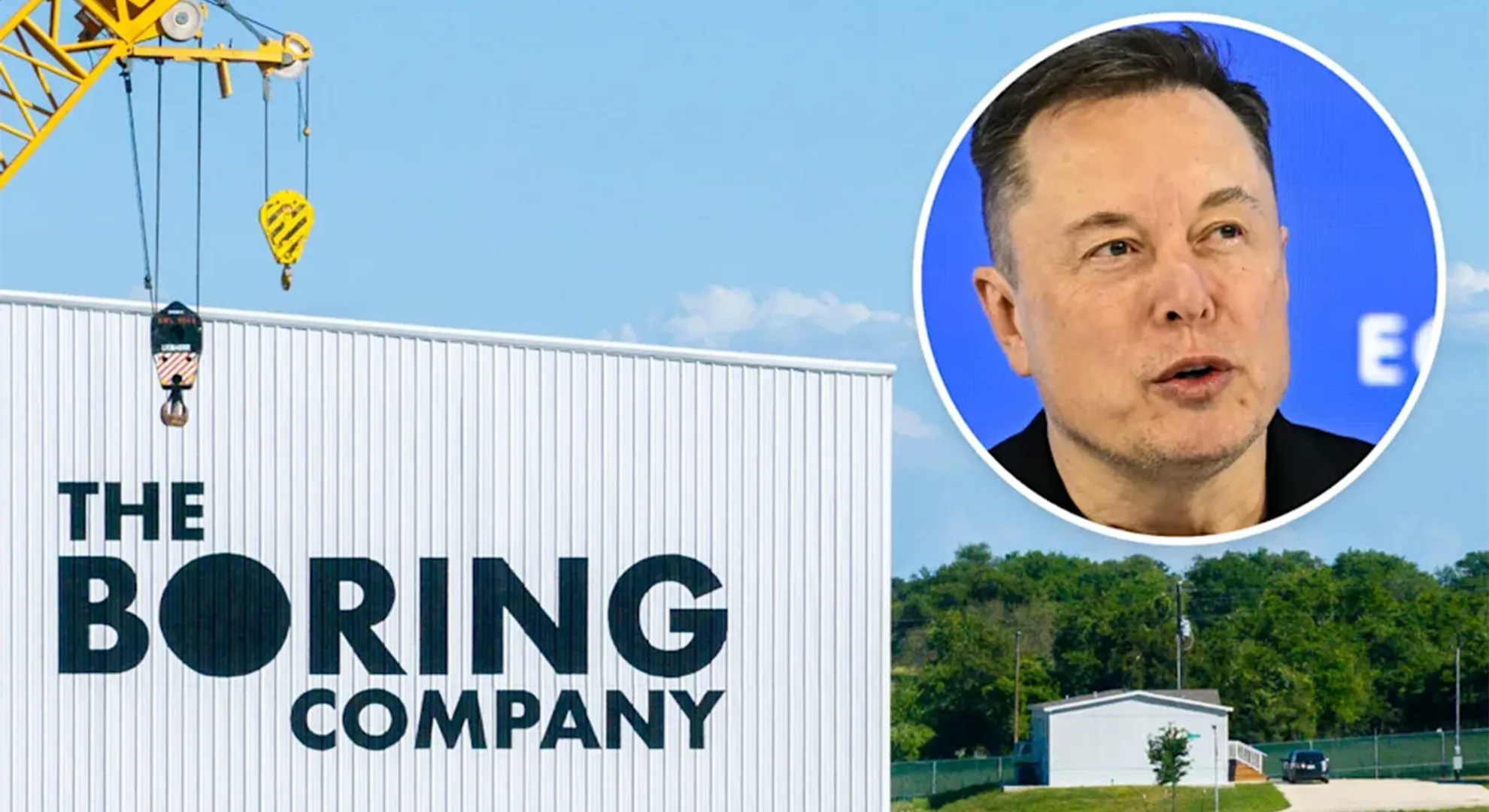
Elon Musk’s The Boring Company has secured a major Dh11 billion project in the UAE to develop an extensive 150-kilometre underground tunnel network, marking a significant step toward transforming the country’s transportation infrastructure through large-scale subterranean development.
Elon Musk’s Boring Company Lands Dh11 Billion Deal for 150km UAE Tunnel Project.
During the initial stage of construction, the project is expected to require approximately 25,000 individual tunnel sections. Each prefabricated segment will weigh around 4,000 pounds, highlighting the substantial scale and logistical demands involved in developing the underground infrastructure.
Elon Musk’s Boring Company Expands UAE Tunnel Ambitions With Dh11 Billion Funding
Elon Musk’s tunnelling and infrastructure venture, The Boring Company (TBC), is preparing for a major expansion in the United Arab Emirates, with plans to develop more than 150 kilometres of underground tunnels across the country.
The ambitious expansion is being supported by a new $3 billion, or approximately Dh11 billion, Series D financing round. The funding has been led by the UAE and investment groups associated with the country, giving the company additional financial backing as it expands its underground transportation technology into new markets.
The latest development represents a significant step for TBC, which has been working with UAE authorities on the Dubai Loop, an underground transportation project designed to provide fast and direct travel beneath the city.
With the new funding, the company’s valuation has climbed to approximately $23 billion. The investment also strengthens TBC’s position as it seeks to establish its tunnel-based transportation model beyond its existing operations in the United States.
Expansion across the UAE
The new agreement will see TBC pursue more than 150 kilometres of tunnelling projects throughout the UAE. The company’s expanded plans come alongside its ongoing work on the Dubai Loop rather than replacing the project already agreed with authorities.
TBC has previously secured an agreement related to the Dubai Loop, which is being developed in cooperation with Dubai’s Roads and Transport Authority (RTA). The newly announced programme is therefore an additional commitment and represents a broader relationship between the company and the UAE.
The UAE has increasingly invested in large-scale infrastructure and transportation projects aimed at improving mobility, reducing congestion and preparing cities for future population and economic growth. Underground transportation systems could form part of those long-term plans by moving passengers through dedicated routes beneath busy urban areas.
For TBC, the UAE provides an opportunity to demonstrate its technology on a much larger scale. The company has promoted underground tunnel networks as an alternative approach to conventional transportation infrastructure, particularly in densely populated urban areas where surface-level construction can be disruptive and expensive.
Dubai Loop enters development phase
The first stage of the Dubai Loop is currently centred on a 6.4-kilometre pilot route. The initial section is expected to include four stations and connect two important areas of Dubai: the Dubai International Financial Centre and Dubai Mall.
The proposed stations are designed to serve major destinations and include Burj Khalifa, DIFC 2, Zabeel Dubai Mall Parking and ICD Brookfield Place.
The pilot route is intended to provide a practical demonstration of how the Loop system can operate within Dubai’s existing urban environment. Rather than relying on conventional roads, the system will move passengers through underground tunnels, allowing vehicles to travel directly between designated points.
The project is part of Dubai’s wider efforts to develop advanced transportation infrastructure and improve connectivity between major commercial, financial and tourism destinations.
For TBC, the Dubai Loop also provides an important real-world test of its technology outside Las Vegas, where the company has already operated a Loop network for several years.
Construction activity already underway
Work on the physical infrastructure for the first phase has also begun. In July, TBC announced that production of precast concrete components for the Dubai Loop had started.
The scale of the construction effort illustrates the amount of material required to create even a relatively short section of underground transportation infrastructure.
According to the company, the first phase is expected to require around 25,000 individual concrete segments. Each component weighs approximately 4,000 pounds, meaning the combined weight of the tunnel sections represents a substantial logistical undertaking.
The company has indicated that the tunnel itself will weigh about 100 million pounds during the first phase.
Precast concrete segments are an important part of the tunnelling process because they form the structural lining of the underground passage. Once installed, the segments create a reinforced tunnel structure capable of supporting the surrounding ground while providing the enclosed pathway required for the transportation system.
The use of large numbers of standardised components can also help streamline construction by allowing tunnel sections to be manufactured in advance and transported to the construction site as required.
UAE investment strengthens TBC
The latest funding round has attracted a number of prominent investors, including several institutions with strong connections to the UAE.
Among them is Shamal Holding, a Dubai-based global investment company, which has confirmed that it has acquired a stake in The Boring Company as part of the Series D financing.
Shamal’s participation is notable because the company has emphasised that its investment should be viewed separately from the government-backed Dubai Loop agreement.
According to Shamal, its decision to invest in TBC represents a private commercial transaction based on the company’s broader business prospects and technological capabilities. The investment is not structured as a financial commitment to one specific infrastructure project.
The distinction is important because the UAE’s involvement in the Dubai Loop is taking place at a government level through the relevant authorities, while Shamal’s participation in TBC is an investment in the company itself.
Shamal has said that its investment reflects confidence in the long-term potential of TBC’s technology and its possible relevance to cities around the world.
Wider group of investors
The Series D round also includes several other major investment firms. Participants named in connection with the financing include Human Capital, Vy Capital, Valor Equity Partners, Sequoia Capital, A16Z, Temasek and Baron Capital.
The group includes both existing shareholders and new investors, providing TBC with a broader financial base as it seeks to expand its operations.
The $3 billion fundraising represents a substantial increase in the company’s available capital and gives it greater capacity to pursue tunnel construction and transportation projects in different markets.
Following the financing, TBC has been valued at about $23 billion. That valuation reflects investor expectations surrounding the company’s technology and its potential role in the future of urban transportation.
The funding could also allow TBC to increase investment in construction equipment, engineering, tunnel manufacturing, project development and expansion into additional cities.
From Las Vegas to international markets
The Boring Company’s underground transportation concept is already in operation in Las Vegas, where its Loop system has transported more than four million passengers since beginning operations in 2021.
The Las Vegas network currently includes 11 stations and provides the company with an operating example of its approach to urban mobility.
The system is designed around underground tunnels and electric vehicles, with passengers travelling between stations rather than using conventional surface roads.
The experience gained from Las Vegas could prove valuable as TBC expands into international markets. Operating a live transportation system allows the company to gather practical experience related to passenger demand, station operations, vehicle movement, maintenance and tunnel infrastructure.
The company is now advancing projects in several markets around the world, with the UAE emerging as one of its most significant areas of expansion.
Why underground transportation is gaining attention
Cities around the world face increasing pressure on their road networks as populations grow and more people travel for work, business, tourism and leisure.
Traditional infrastructure projects often require large amounts of surface-level space. Building new roads or expanding existing ones can involve extensive construction, disruption to businesses and residents, and significant changes to established urban areas.
TBC’s approach is based on moving transportation infrastructure below ground. By creating tunnels beneath existing roads and buildings, the company argues that cities can add transportation capacity without requiring the same amount of surface disruption.
The UAE, and Dubai in particular, has a reputation for pursuing large-scale infrastructure projects and adopting new technologies. That environment provides an attractive setting for TBC to test whether its underground transportation concept can be expanded to a larger network.
The planned 150-kilometre UAE tunnel programme would represent a dramatic increase in the scale of TBC’s activities compared with its existing operations.
Dubai Loop as a potential starting point
The 6.4-kilometre pilot phase of the Dubai Loop is expected to provide an initial demonstration of the technology in the UAE.
The route will connect DIFC and Dubai Mall, two areas that attract large numbers of workers, visitors and tourists. The inclusion of stations near major landmarks and commercial destinations could allow the system to demonstrate how an underground network might complement Dubai’s existing transportation options.
The four planned stations — Burj Khalifa, DIFC 2, Zabeel Dubai Mall Parking and ICD Brookfield Place — will give the pilot project several strategically located stops.
If the system performs successfully, the experience could help inform future expansion of underground routes in Dubai and potentially elsewhere in the UAE.
The broader 150-kilometre ambition announced alongside the new funding suggests that TBC sees the country as more than a single-project market. Instead, the company appears to be positioning the UAE as an important base for a much wider rollout of its tunnel technology.
Government and private-sector participation
The combination of government cooperation and private investment gives the UAE expansion a distinctive structure.
The Dubai Loop agreement involves Dubai’s Roads and Transport Authority, which signed an implementation agreement with TBC in February 2026. Separately, investment companies such as Shamal Holding are putting capital directly into TBC.
This means the company is receiving support through two different channels: public-sector cooperation for infrastructure development and private-sector investment in its underlying business.
That distinction also highlights the growing interest in TBC as a technology and infrastructure company rather than simply as a contractor for individual tunnel projects.
Investors participating in the Series D round are effectively backing the company’s broader expansion strategy, including its technology, operations and ability to secure projects in multiple international markets.
A major milestone for The Boring Company
The UAE expansion marks an important stage in the development of The Boring Company.
Founded by Elon Musk with the aim of addressing urban traffic through underground transportation infrastructure, TBC has spent years developing its tunnelling technology and building its first operational Loop network.
The company’s progress in Las Vegas has provided an initial example of the concept in operation. The planned work in the UAE could take that model to a substantially larger scale.
With more than 150 kilometres of tunnels now planned across the UAE and $3 billion in fresh funding, TBC has gained both financial resources and a major international platform from which to expand.
The $23 billion valuation attached to the latest financing round further demonstrates the expectations investors have placed on the company’s future growth.
For the UAE, meanwhile, the partnership could support its ambitions to remain at the forefront of advanced transportation and infrastructure development.
The immediate focus remains on the Dubai Loop’s initial 6.4-kilometre pilot route, including its four planned stations. Construction activity has already begun with the production of precast concrete segments, setting the foundation for the next stage of the project.
As work progresses, the Dubai Loop will offer an opportunity to assess how TBC’s underground transportation model performs within one of the world’s fastest-growing cities.
If successful, the pilot could become the foundation for a much broader network, helping turn the UAE’s 150-kilometre tunnelling ambition into a reality.
The latest investment round therefore represents more than a financial milestone for The Boring Company. It signals a deeper relationship with the UAE and provides the company with additional capital to pursue its long-term vision of underground urban transportation on a global scale.
Shamal Backs The Boring Company as Tunnelling Technology Expands Globally
Shamal Holding has explained its decision to invest in Elon Musk’s The Boring Company by pointing to the progress the tunnelling firm has made in recent years. The Dubai-based investment company believes TBC has reached a stage where its underground transportation technology is no longer simply an experimental idea and has demonstrated its potential through actual operations.
A key factor behind that assessment is the performance of the Las Vegas Loop. The underground transportation system has provided TBC with an opportunity to put its technology into regular use and gain experience from operating a functioning passenger network. For Shamal, that operational track record represents an important step forward from the early development stage of the company’s concept.
The investment is also consistent with Shamal’s broader strategy of identifying companies that could establish or transform major technology and infrastructure categories. Rather than focusing exclusively on individual projects, the investment firm has indicated that it looks for businesses whose products or technologies have the potential to develop into large-scale global opportunities.
TBC’s plans in Dubai add another dimension to the investment. Shamal’s longstanding connection to the city gives the company a close understanding of Dubai’s infrastructure ambitions, economic environment and approach to adopting new technologies. With TBC already involved in the Dubai Loop, Shamal believes its knowledge of the local market can provide additional perspective as the tunnelling company develops its presence in the UAE.
The investment firm has also pointed to what it describes as a potential benefit for Dubai itself. If underground transportation systems can be deployed successfully across the city, they could contribute to improved mobility while adding new transportation capacity beneath existing urban infrastructure.
Confidence in a developing technology
Shamal’s decision reflects its view that TBC has moved beyond the stage of proving whether its basic concept can work. The company’s Las Vegas operations have offered a practical demonstration of underground passenger transportation, giving investors greater visibility into how the technology can be used in a real urban setting.
For an infrastructure technology company, moving from development into actual commercial operation can be an important milestone. It provides opportunities to test equipment, improve processes, understand passenger requirements and identify challenges that may not become apparent during laboratory or prototype testing.
The experience accumulated through the Las Vegas Loop can potentially help TBC as it enters more demanding projects in other cities. Each new tunnel project can provide additional information about construction methods, machinery, operating systems and the practical requirements of underground transportation.
Shamal appears to view that accumulated experience as an important part of TBC’s investment proposition. The firm’s participation in the financing round therefore reflects confidence not only in the individual Dubai project but also in the company’s ability to develop its technology into a broader international business.
A strategic connection to Dubai
The relationship between Shamal and TBC is particularly significant because of the companies’ connection to Dubai.
Dubai has positioned itself as a centre for advanced infrastructure and technology-driven development, with major investments aimed at improving transportation, connectivity and urban services. The Dubai Loop fits within that broader environment by proposing a new form of underground mobility designed to move passengers through dedicated tunnels.
For Shamal, being based in Dubai provides an understanding of the local environment that could be valuable as TBC expands its activities in the country.
The investment firm has made clear that its participation is not simply a financial wager on one construction contract. Instead, it considers TBC’s technology to have wider commercial potential. The Dubai project provides an immediate connection to that opportunity, but Shamal’s investment is directed toward the company and its longer-term development.
This distinction is important because TBC’s ambitions extend beyond a single route or city. The company is attempting to build a business around underground transportation infrastructure that can potentially be adapted for urban areas around the world.
Shamal’s Dubai background may therefore allow it to contribute local market knowledge while simultaneously participating in the growth of a company with international ambitions.
Leadership highlights growth opportunity
Shahnawaz Nawabi, chief investment officer at Shamal Holding, described TBC as a company that brings together engineering capabilities and a practical approach to solving urban transportation challenges.
According to Nawabi, the sector offers considerable room for long-term growth. Cities worldwide are dealing with increasing congestion, limited road space and the need to improve transportation networks without causing extensive disruption at street level.
Underground systems could offer one possible solution to those challenges. By moving transportation routes below the surface, cities may be able to create additional capacity while preserving existing roads, buildings and public spaces.
The Boring Company has built its business around that proposition. Its approach combines tunnel construction with a transportation system designed to move passengers through underground routes.
Nawabi’s comments indicate that Shamal sees this combination of engineering and urban mobility as an area with the potential to develop over the long term.
The investment also demonstrates the role that private capital can play in supporting infrastructure technologies as they move from early-stage development toward broader commercial deployment.
TBC welcomes the partnership
The Boring Company has welcomed Shamal’s participation in its latest financing round.
Steve Davis, president of TBC, said the company was looking forward to developing its relationship with Shamal and highlighted the investment firm’s international experience in the technology sector.
Davis also pointed to Shamal’s understanding of Dubai and its history of supporting ambitious businesses and innovative ventures.
For TBC, having an investor with strong knowledge of Dubai could be particularly useful as the company continues developing the Dubai Loop and considers its wider plans in the UAE.
The partnership brings together TBC’s tunnelling technology and Shamal’s investment expertise and knowledge of the local market. It also reflects growing interest in technologies designed to address transportation challenges in rapidly developing cities.
From one Loop system to multiple markets
TBC says its development over the last two years has been particularly rapid.
The company has described a transition from operating a single Loop system to pursuing a much broader, multi-city tunnelling programme. That expansion has involved progress in several areas of its business, including tunnel-machine development and the construction of projects in different types of geological conditions.
One significant development has been the company’s move into hard-rock tunnelling. Working in harder geological environments can require different engineering approaches and equipment capabilities compared with softer ground conditions.
TBC has also secured its first international construction contract, representing an important step in its attempt to establish itself outside its original US market.
At the same time, the company has substantially increased the scale of its activities associated with the Vegas Loop.
Together, these developments demonstrate the company’s attempt to expand beyond its initial operating model and establish a wider international infrastructure business.
Las Vegas provides operational experience
The Las Vegas Loop remains a central part of TBC’s development story.
The system has allowed the company to operate underground passenger transportation in a live environment and gain practical experience from serving customers.
That experience can be valuable when planning larger projects because infrastructure companies must deal with far more than simply constructing tunnels. They must also consider passenger movement, station design, vehicle operations, safety procedures, maintenance requirements and system reliability.
The knowledge gained in Las Vegas can potentially be applied to future projects, including the Dubai Loop.
TBC’s expansion strategy appears to rely on combining lessons from existing operations with improvements in tunnel-building technology. Faster machine design and advances in construction methods could allow the company to pursue projects more efficiently as the number of planned locations increases.
Technology at the centre of expansion
The company’s strategy places considerable emphasis on improving the machinery used to construct its tunnels.
Tunnelling can traditionally be a lengthy and expensive process, particularly when projects involve challenging geological conditions or heavily developed urban areas. TBC has sought to improve the speed and economics of tunnel construction through the development of its own tunnel-boring technology.
The company’s recent progress suggests that its engineering programme is moving toward increasingly diverse applications.
Its first hard-rock project, international construction agreement and expanding Vegas operations each represent different tests of the company’s capabilities.
Successfully addressing those challenges could strengthen TBC’s ability to compete for additional projects in other countries.
For investors such as Shamal, these developments provide evidence that the company is continuing to expand its technical capabilities rather than relying solely on its original demonstration projects.
Dubai could become an important international market
The UAE’s role in TBC’s expansion is significant because the country could become one of the company’s most important markets outside the United States.
The Dubai Loop gives TBC a direct opportunity to demonstrate its technology in a major international city. The broader plans for more than 150 kilometres of tunnels across the UAE would take that opportunity to a much greater scale.
If the company is able to successfully deliver its planned projects, the UAE could become a showcase for its approach to underground urban transportation.
That could have implications beyond the country itself. A successful large-scale deployment could provide TBC with another reference project when seeking contracts in other cities facing similar transportation challenges.
The combination of an operating system in Las Vegas and planned projects in Dubai would give the company experience across different markets and urban environments.
A broader vision for urban mobility
At the heart of TBC’s strategy is the idea that cities need new approaches to transportation as they become more crowded.
Expanding conventional road infrastructure can be difficult in established urban areas. Roads compete for limited land with offices, residential buildings, retail developments and public spaces.
Underground transportation offers a different approach by creating routes beneath the existing city.
TBC is attempting to make that concept commercially viable through a combination of tunnel construction and passenger transportation systems.
Shamal’s investment suggests that it sees potential in this model as cities continue searching for ways to improve mobility.
The investment also aligns with a broader trend toward infrastructure companies using technology to tackle traditional urban challenges. Instead of relying exclusively on conventional construction methods, companies are increasingly exploring automation, specialised machinery and new forms of transportation infrastructure.
What the partnership means for TBC
For The Boring Company, Shamal’s investment provides more than additional capital.
The relationship offers access to an investor with a strong understanding of Dubai and the UAE, where TBC is preparing for a major expansion.
It also gives the company another high-profile financial backer at a time when it is moving from individual projects toward a broader international programme.
The funding can support continued development of tunnel-boring machines, construction capabilities and projects in different markets.
More importantly, the partnership reinforces the idea that TBC is being viewed increasingly as an infrastructure technology company with international growth potential.
Looking ahead
The next stage of TBC’s development will depend on how effectively it can translate its experience into larger and more complex projects.
Its progress in Las Vegas has provided an operational foundation, while its international contracts and hard-rock work are giving the company opportunities to broaden its engineering experience.
Dubai represents another major test.
The city’s willingness to explore advanced transportation solutions, combined with TBC’s existing relationship with local authorities, creates an environment in which the company can attempt to demonstrate its model on an international stage.
For Shamal, the investment represents an opportunity to participate in the development of a technology it believes could influence the future of urban transportation.
For TBC, the partnership adds a Dubai-based investor with technology-sector experience at a time when the company is expanding rapidly.
The two companies’ interests therefore extend beyond the immediate construction of individual tunnels. The broader objective is to develop an underground transportation model that can be deployed across multiple cities.
With its Las Vegas experience, growing international programme, new engineering capabilities and expanding presence in Dubai, The Boring Company is attempting to move into a new phase of development.
Shamal’s investment reflects confidence that the company has reached a meaningful stage in that journey, with its technology increasingly moving from demonstration toward real-world deployment and international commercial growth.