Dubai’s Toyota Building is set to be demolished after around 70% of residents were forced to leave amid concerns over densely packed, illegally partitioned apartments and overcrowded living conditions.
Dubai’s Toyota Building Faces Demolition as 70% of Tenants Vacate Over Overcrowded Partitioned Units.
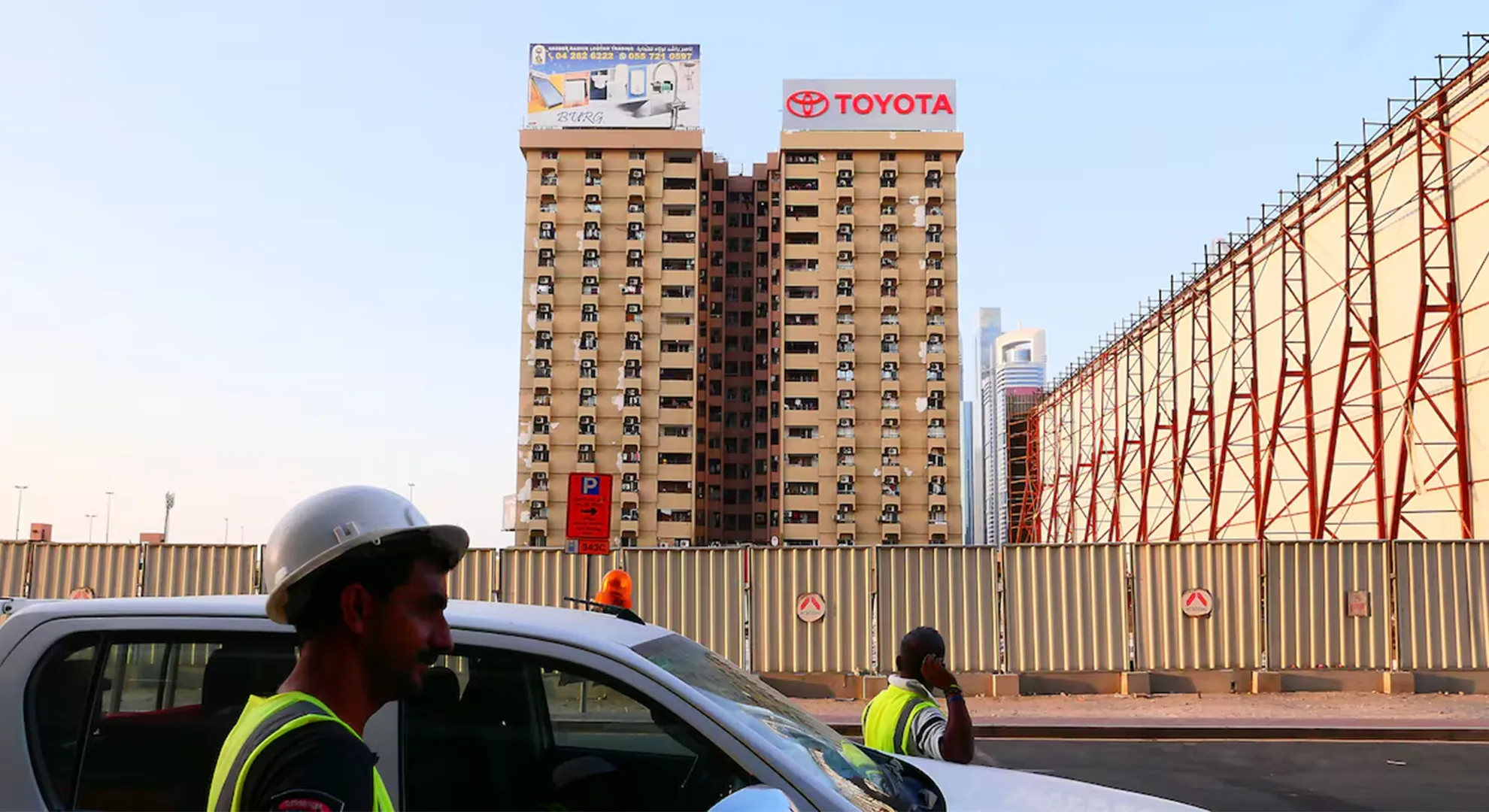
Constructed in 1974, the Nasser Rashid Lootah Building has become a notable part of Dubai’s architectural history. The residential tower is especially recognized for its distinctive red neon sign and is widely considered among the city’s earliest high-rise residential developments.
Dubai’s well-known Toyota Building is facing an uncertain future after a large-scale tenant evacuation linked to overcrowded accommodation and the use of illegally divided apartments.
A representative of the building’s property management department told INSIDER 18 that the decision to remove residents was driven largely by concerns surrounding apartments that had been divided into multiple smaller rooms. Such arrangements had resulted in some units housing far more people than they were designed to accommodate.
According to Mahmood, a representative of the real estate department of the Nasser Rashid Lootah Group, which manages the property, some apartments had as many as 15 occupants living in partitioned spaces. The authorities subsequently instructed the building’s management to take action against units considered excessively crowded.
“As a result of the instructions, residents from overcrowded apartments have been asked to leave,” Mahmood said. He added that approximately 70 per cent of the building has now been vacated.
The scale of the evacuation has attracted attention because the property is not an ordinary residential building. Located along Sheikh Zayed Road, the tower is widely recognized as one of Dubai’s longstanding landmarks and is particularly familiar to motorists and residents because of its prominent red Toyota sign.
Mahmood also confirmed that the building itself is scheduled for demolition. However, he said that the management does not currently have a confirmed date for when the demolition work will begin.
The announcement adds another chapter to the history of a building that has stood through several stages of Dubai’s rapid transformation. What was once part of a much smaller urban landscape now occupies a location surrounded by the city’s modern skyline and major developments.
For many of the people who lived or worked there, however, the immediate issue has been finding somewhere else to stay.
Residents previously told INSIDER 18 that the departures were taking place gradually rather than all at once. Tenants were reportedly being instructed to leave in different stages, with people living in partitioned accommodation among those affected during the initial phase.
The situation created uncertainty for some residents, who initially believed that the authorities’ action was focused specifically on apartments that had been divided into unauthorized rooms.
Ahmed, a grocery store employee who had lived in the building for about five years, said he left the property the previous week. He recalled that residents first understood the move as an effort aimed at tackling partitioned apartments rather than a wider evacuation of the building.
According to Ahmed, people staying in partitioned rooms were among the first residents asked to relocate. This led others in the building to believe that tenants whose accommodation was not partitioned would be allowed to remain.
That expectation changed as the eviction process expanded.
Ahmed said that workers staying in company-provided accommodation were subsequently also instructed to move out. For those residents, the developments came as a surprise because they had initially assumed that the authorities’ concerns were limited to the way individual apartments had been divided.
The distinction was particularly significant for lower-income workers who relied on shared accommodation arrangements. Being asked to leave meant that they had to find alternative housing while the building was progressively emptied.
The circumstances surrounding the evacuation reflect a broader issue facing Dubai’s authorities: how to deal with overcrowded residential properties and apartments that have been subdivided into numerous rooms.
Dubai Municipality has previously taken action against illegally partitioned accommodation. Authorities have warned that unauthorized internal divisions can breach building regulations and create serious safety concerns for occupants.
Partitioning a residential apartment into several smaller spaces can substantially increase the number of people living inside a unit. In some cases, rooms or sections of an apartment may be converted into sleeping areas for multiple individuals, resulting in conditions that differ considerably from the property’s original design and approved use.
Overcrowding can also place additional pressure on a building’s facilities. A home designed for a limited number of occupants may have to accommodate many more people when apartments are divided into numerous rooms. This can affect shared facilities, circulation areas and emergency arrangements.
Fire safety is another important concern associated with unauthorized partitions. Additional occupants and altered layouts can make evacuation more difficult, particularly when internal spaces have been modified without following approved safety requirements.
For this reason, Dubai’s authorities have continued to scrutinize partitioned accommodation and properties where excessive numbers of residents are living together.
The situation at the Toyota Building appears to have brought those concerns into sharp focus. The management’s representative said the authorities specifically instructed the building to remove residents from overcrowded apartments.
The reported figure of 70 per cent of the building being vacated illustrates the extent of the ongoing process. It also means that a substantial number of residents have already moved elsewhere, while others have had to prepare for their departure.
Despite the building’s eventual demolition being confirmed, the management has not provided a definite schedule for the work. As a result, questions remain over how long the remaining residents will have before the property is completely cleared.
For tenants, the timing is important because relocating can be difficult, particularly for people who have lived in the building for several years or who depend on affordable shared accommodation.
Ahmed’s experience illustrates how the changes affected people who were not necessarily living in partitioned rooms themselves. After spending five years in the building, he was eventually required to leave despite initially believing that the action was directed at unauthorized room divisions.
His account also highlights how information about the eviction developed among residents. What began as an apparent move against a specific type of accommodation gradually became a broader departure from the property.
The Toyota Building has long been recognizable to people travelling along Sheikh Zayed Road. Its distinctive signage has made it a familiar visual feature, particularly for those who have spent years navigating Dubai’s main highway.
Its possible disappearance therefore represents more than the closure of another residential property. For longtime residents and commuters, the demolition will mark the removal of a building associated with an earlier period of Dubai’s development.
The tower dates back to 1974, when Dubai’s urban landscape looked very different from the one visible today. Over the decades, the city experienced extraordinary growth, with new roads, towers, commercial districts and residential communities transforming the surrounding environment.
Against that backdrop, older buildings such as the Toyota Building became reminders of Dubai’s earlier architectural and commercial history.
Yet the current focus is not simply on the building’s age or appearance. The immediate reason for the evacuation has been the condition of some of the accommodation inside the property.
The presence of heavily partitioned apartments and large numbers of occupants has prompted intervention from the authorities. The management’s response has been to remove residents from units identified as overcrowded.
The process demonstrates the challenges that can arise when demand for affordable housing leads residents to share apartments in increasingly dense arrangements.
Shared accommodation can provide a lower-cost option for workers and other residents, but when an apartment is divided beyond approved limits or houses an excessive number of people, the arrangement can create regulatory and safety problems.
Dubai Municipality’s enforcement efforts are intended to address precisely these concerns. Authorities have repeatedly emphasized that illegally partitioned rooms are not simply a housing issue but can also have implications for the safety of people living inside such properties.
The Toyota Building case comes as the city continues to evolve and older structures make way for new developments. While the exact redevelopment plans for the site have not been disclosed by the building’s representative, confirmation that demolition is planned indicates that the property’s long history is approaching its final stage.
For residents, meanwhile, the story has been much more immediate. The gradual eviction has meant leaving homes and finding alternative accommodation while the building continues to empty.
Some tenants were reportedly able to anticipate the move after seeing other residents asked to leave. Others, particularly those who believed the initial action was restricted to partitioned flats, may have expected to remain longer.
Ahmed said that the early departures created the impression that the authorities were targeting only unauthorized partitions. When company accommodation residents were later told to relocate as well, that assumption changed.
The experience reflects the uncertainty that can accompany large-scale building clearances, particularly when residents do not initially know how widely an enforcement action will extend.
With around 70 per cent of the property reportedly already vacated, the building now stands at a significant turning point.
Its familiar red sign and location on Sheikh Zayed Road have made it one of the more recognizable older structures in the city. But behind that familiar exterior, changing accommodation patterns and concerns over overcrowding have resulted in a substantial departure of residents.
The management has confirmed both the extensive evacuation and the planned demolition, although no precise demolition date has been announced.
Until the building is eventually cleared and demolished, the remaining residents and the management will continue to navigate the final stages of the process.
The case also serves as a reminder of the importance of complying with housing and building regulations. Apartments that are altered without authorization may create living arrangements that are very different from those approved for the property.
When too many people are accommodated in a limited space, the risks can increase significantly. Ensuring that residential units remain within permitted occupancy levels and that internal layouts comply with safety requirements is therefore an important part of protecting residents.
Dubai’s continuing action against unauthorized partitions reflects this wider objective. The authorities’ intervention at the Toyota Building has resulted in hundreds of residents—or potentially more, depending on the total occupancy—having to reconsider their accommodation arrangements.
For those who have called the building home for years, the changes are especially significant. Residents such as Ahmed have developed connections with the property and its surroundings over time, making an unexpected move more than simply a change of address.
At the same time, the building’s eventual demolition will bring an end to a notable chapter in the history of Dubai’s older residential architecture.
Built decades ago and later surrounded by a rapidly expanding city, the Toyota Building became a familiar landmark for generations of commuters and residents. Its distinctive appearance helped give it a place in Dubai’s visual identity, even as the city around it continued to change.
Now, the property is being emptied following concerns over overcrowded and partitioned accommodation, while plans for its demolition move forward.
The precise future of the site remains unclear, as the management has not announced when demolition will take place or what will replace the existing structure.
For now, the most immediate development is the continued evacuation of tenants. With approximately seven out of every ten parts of the building already vacated, the property is significantly emptier than it was before the enforcement action began.
The story of the Toyota Building therefore brings together two very different aspects of Dubai’s development: the preservation of familiar landmarks in the public memory and the city’s ongoing efforts to enforce modern residential safety standards.
As Dubai continues to expand and redevelop, older buildings inevitably face pressure from changing regulations, new construction and evolving housing needs. The Toyota Building’s final chapter appears to be unfolding against that backdrop.
Its demolition has not yet been assigned a specific date, but the large-scale evacuation indicates that the building’s residential life is already coming to an end.
For former tenants, the priority has been finding new places to live. For authorities and property managers, the focus has been addressing overcrowding and unauthorized partitions. And for Dubai’s wider community, the eventual demolition will mean the loss of another recognizable feature from the city’s earlier landscape.
The building may eventually disappear from Sheikh Zayed Road, but its distinctive red sign, decades-long history and association with Dubai’s changing urban environment have already made it a memorable part of the city’s story.
Dubai’s Toyota Building has long been associated with the city’s changing skyline, but concerns over overcrowded accommodation have brought renewed attention to the landmark and its history.
Dubai Municipality has previously warned that unauthorized alterations to residential units can create significant safety hazards. In a statement to INSIDER 18, the municipality said that changes made to apartments, particularly those involving unauthorized partitions, could increase the danger of serious incidents, including fires, while also making it harder for occupants to leave a building quickly during an emergency.
The warning is particularly relevant in buildings where apartments have been divided into multiple rooms or sleeping spaces. Such modifications can change the original layout of a home and potentially affect how residents move through the property. When a large number of people are living in a relatively small space, an emergency evacuation can become considerably more difficult.
Fire incidents require occupants to react quickly, and any obstruction or alteration to normal routes can create additional challenges. This is one reason authorities have continued to pay attention to illegally partitioned accommodation across Dubai.
The issue has become especially significant in the case of the Nasser Rashid Lootah Building, better known to generations of Dubai residents as the Toyota Building.
The structure dates back to 1974, only a few years after the formation of the United Arab Emirates in 1971. At the time of its construction, Dubai was still developing into the modern metropolis that it would eventually become.
The building is regarded as one of the city’s earlier residential towers and has remained part of Dubai’s urban landscape for decades. Its history stretches back to a period when the number of high-rise buildings across the city was far smaller than it is today.
Standing at approximately 65 metres, the building has 15 floors and was once a prominent feature of the area surrounding what is now recognized as the first interchange on Sheikh Zayed Road.
Over the years, the road itself became one of Dubai’s most important transport corridors. As the city expanded, Sheikh Zayed Road developed into a major artery lined with skyscrapers, offices, hotels, residential towers and commercial developments.
The Toyota Building consequently witnessed a remarkable transformation around it.
When the building was first constructed, the surrounding urban environment was much less developed than the dense skyline that exists today. As Dubai grew, the tower became increasingly surrounded by newer and taller structures.
Despite those changes, it retained a distinctive identity of its own.
That identity was strengthened in 1981, when a large red Toyota sign was placed on the roof of the building. The illuminated advertisement quickly became one of the most recognizable visual features associated with the tower.
The sign played an important role in giving the building its popular nickname. Although its official name remained the Nasser Rashid Lootah Building, many people came to know the property simply as the Toyota Building.
For motorists travelling along Sheikh Zayed Road, the bright red sign became an easily identifiable reference point. It was more than an advertisement for a car manufacturer; over time, it became part of the visual memory of Dubai.
People who had lived in the city for many years often associated the sign with particular journeys, neighborhoods and periods of the city’s development.
The Toyota branding remained on the roof for almost four decades.
During that period, Dubai underwent extraordinary economic and physical growth. New districts emerged, roads were expanded, and high-rise developments transformed the city’s skyline.
Yet the Toyota Building and its prominent rooftop sign remained familiar throughout those changes.
The relationship between the building and the sign became so strong that the advertising structure effectively gave the tower a second identity.
For many people, seeing the red Toyota logo was enough to immediately recognize the location.
That association continued until 2018, when the rooftop sign was taken down after the advertising agreement came to an end.
Its removal marked the end of an era for a landmark that had become familiar to several generations of residents and visitors.
The absence of the sign was noticed by people who had become accustomed to seeing it while travelling through the area. Although the building itself remained standing, its appearance had changed significantly without the large red logo on top.
The removal also demonstrated how strongly the sign had become connected with the building’s identity.
What might originally have been viewed as a conventional advertising installation had, over the years, become part of Dubai’s collective visual memory.
The reaction to its disappearance eventually contributed to its return.
In June 2022, the Toyota sign was restored after considerable public nostalgia for the landmark. Its reinstatement brought back a familiar feature that many people associated with Dubai’s older skyline.
The return of the red sign was welcomed by those who remembered the building from earlier decades and had watched the city develop around it.
For longtime residents, the sign represented more than a corporate logo. It was a recognizable marker of a Dubai that existed before many of the city’s most famous skyscrapers and developments appeared.
The tower’s history is therefore closely tied to the evolution of the city itself.
Constructed in the early years of the UAE, the building has remained standing through decades of rapid economic growth and urban expansion. Its location near Sheikh Zayed Road placed it in an area that would eventually become one of the most recognizable parts of modern Dubai.
As the road developed, the building became part of a much larger and more sophisticated urban environment.
The transformation around the tower has been dramatic. What was once a relatively modest high-rise now sits within a city known globally for its concentration of skyscrapers and large-scale developments.
Despite its age, the Toyota Building remained recognizable because of its distinctive design, location and, most importantly, the rooftop sign.
Its nickname became so widely used that many people may have been unaware of the building’s official name.
The Nasser Rashid Lootah Building is therefore an example of how landmarks can develop identities that are separate from their formal names.
The Toyota sign effectively became a visual signature for the property.
Its history also reflects the role that advertising can play in shaping a city’s visual landscape. A commercial sign installed decades ago can eventually become part of the character of a neighborhood, particularly when it remains in place for many years.
In the case of the Toyota Building, the sign stayed for nearly 40 years, giving it enough time to become familiar to multiple generations.
Its removal in 2018 was therefore not simply the disappearance of an advertisement. For many people, it represented the loss of a recognizable piece of Dubai’s older visual identity.
The decision to restore it in 2022 demonstrated the strength of that attachment.
Today, the building is again facing a major transition, although this time the change concerns the structure itself rather than its rooftop signage.
The property has been undergoing a tenant evacuation following concerns about overcrowding and apartments that had been divided into multiple sections.
Authorities have been increasingly focused on accommodation arrangements that do not comply with approved regulations, particularly where unauthorized partitions result in excessive occupancy.
The municipality’s earlier warning about fire hazards and emergency evacuation underscores the seriousness of these concerns.
When apartments are modified without approval, the resulting layout may not provide the same level of safety as the original design. Additional walls, rooms or sleeping spaces can alter access routes and make movement through a property more complicated.
The situation becomes even more concerning when many people occupy the same apartment.
A unit originally intended for a limited number of residents can end up accommodating considerably more people when it is divided into several smaller spaces. This can place pressure on facilities and create additional difficulties during emergencies.
Dubai authorities have consequently taken action against such arrangements as part of wider efforts to improve residential safety.
The Toyota Building has become part of that broader enforcement effort.
Residents have been asked to leave in stages, with people living in partitioned accommodation among those affected during the early phase of the evacuation.
The departure of tenants has gradually changed the character of the building.
For years, the property served as a home for residents from different backgrounds, including workers who relied on shared or company-provided accommodation.
As the evacuation progressed, more tenants were required to find alternative places to live.
The building’s management has confirmed that a substantial proportion of the property has already been vacated.
At the same time, the building’s future has become clearer.
The property is expected to be demolished, although no specific date for the demolition has been announced.
The possibility of the tower disappearing is significant given its long history.
Few buildings can remain recognizable for nearly half a century while the city around them undergoes such extensive transformation.
The Toyota Building has effectively witnessed several versions of Dubai.
It existed during a period when the city’s skyline was far less developed, remained through the expansion of Sheikh Zayed Road, and became increasingly surrounded by modern towers.
Its red rooftop sign helped preserve its identity even as newer buildings changed the appearance of the surrounding area.
The tower’s history also gives it a particular significance for people who have lived in Dubai for many years.
A landmark does not necessarily have to be architecturally spectacular to become memorable. Sometimes familiarity, location and personal association are enough to give a building a special place in a city’s history.
The Toyota Building is a strong example of this.
For commuters, the red sign became a visual cue along Sheikh Zayed Road. For residents, it was part of the neighborhood. For visitors, it could serve as a recognizable reference point when navigating the city.
Its nickname became embedded in everyday conversation.
Even after the sign was removed in 2018, memories of the landmark remained strong enough to generate public support for its return.
The sign’s restoration in 2022 temporarily restored the building’s most famous feature.
Now, however, the building itself may soon disappear.
Its planned demolition would mark the end of a structure that dates back to the formative years of the UAE.
The circumstances surrounding its closure are also a reminder that historic familiarity does not exempt a property from modern safety requirements.
As Dubai has developed, expectations surrounding residential safety, building standards and occupancy have also evolved.
Properties that once operated under different circumstances must now comply with contemporary regulations designed to protect residents.
Unauthorized partitions and excessive occupancy can create risks that authorities cannot ignore, particularly when they affect fire safety and emergency evacuation.
The municipality’s comments highlight the reasoning behind its continued enforcement efforts.
From a safety perspective, the concern is not merely whether an apartment has been divided into smaller rooms. The larger issue is how those changes affect the people living inside the property and their ability to escape quickly if something goes wrong.
A crowded apartment may have more occupants than the original design anticipated. If internal spaces have also been altered, evacuation routes may become more complicated.
These factors can turn an otherwise manageable emergency into a much more dangerous situation.
The authorities’ intervention at the Toyota Building must therefore be viewed within this wider context.
While the tower has significant historical and nostalgic value, its continued use as residential accommodation is subject to the same safety requirements as other properties across the city.
The building’s story now combines two very different narratives.
One is about heritage, memory and the familiar red sign that became synonymous with the tower.
The other concerns modern housing standards, overcrowding and the responsibilities of property owners and occupants.
Both aspects have contributed to the building’s current significance.
For those who remember the Toyota sign from previous decades, its return in 2022 may have felt like the restoration of a piece of Dubai’s past.
But the planned demolition suggests that the building itself may not remain part of the city’s physical landscape for much longer.
The contrast is striking: a landmark once celebrated for its recognizable rooftop advertising is now being discussed in the context of residential safety and tenant displacement.
Its history illustrates how the meaning of a building can change over time.
When it was constructed in 1974, it represented part of Dubai’s emerging residential landscape. In the following decades, it became known for a major international automotive brand’s rooftop advertisement.
Later, it became a nostalgic symbol for longtime residents.
Now it has become the subject of a major residential enforcement action and an upcoming demolition.
Each stage reflects a different period in Dubai’s development.
The building’s approximately 65-metre height and 15-storey structure once made it a notable presence in the area. Today, such a tower can appear relatively modest compared with the much taller buildings that dominate Dubai’s skyline.
Nevertheless, its historical importance does not depend solely on its size.
Its longevity and location have allowed it to become part of the city’s collective memory.
The Toyota sign reinforced that connection for decades.
Its restoration in 2022 showed that the landmark still held emotional value for many people.
The expected demolition, meanwhile, raises the possibility that the city will soon lose one of its older recognizable residential towers.
For former residents, the departure may be remembered primarily as a forced relocation caused by changing accommodation rules.
For longtime Dubai residents, it may also be remembered as the disappearance of a familiar feature from the city’s roads.
And for the authorities, the case demonstrates the importance of addressing unsafe residential arrangements before they result in serious incidents.
The Toyota Building’s story is therefore about more than a single property.
It reflects the tension that can sometimes emerge between a city’s history and the demands of modern urban management.
Dubai continues to evolve at a rapid pace, and buildings that once defined an area can eventually be replaced as the city’s needs change.
The Toyota Building has already survived several decades of transformation.
It has witnessed the growth of Sheikh Zayed Road, the expansion of Dubai’s skyline and the changing nature of residential life in the city.
Its red sign disappeared and later returned, preserving the landmark’s familiar appearance for another period.
But with most of the property now reportedly vacated and demolition planned, its final chapter appears to be approaching.
The exact timing of the demolition remains unknown.
Until then, the building stands as a reminder of an earlier Dubai—one that existed before the city became synonymous with its extraordinary collection of modern skyscrapers.
Its history began in 1974, just three years after the UAE was established, and continued through decades of unprecedented development.
The red Toyota sign added another layer to that history in 1981 and remained a defining feature until 2018. Its return four years later demonstrated how strongly the building had become associated with Dubai’s past.
Yet the current concerns surrounding overcrowding and unauthorized partitions have placed safety at the centre of attention.
As authorities continue to enforce regulations governing residential accommodation, the building’s future has moved beyond questions of nostalgia.
For now, its legacy remains visible in the memories of the people who lived nearby, travelled past it and grew accustomed to seeing its distinctive red sign above Sheikh Zayed Road.
Whether remembered as the Nasser Rashid Lootah Building or simply the Toyota Building, the tower has occupied a unique place in Dubai’s urban history.
Its eventual demolition will close a chapter that began more than five decades ago, bringing an end to one of the city’s early residential landmarks and one of its most recognizable rooftop signs.