
How the UAE’s Emergency Warning Network Works: Tracing the Journey of Critical Alerts From Government Agencies Through the National Communication System and Onto Residents’ Mobile Devices Within Moments of an Emergency.
The Technology Behind UAE Emergency Alerts: From Authorities to Your Phone.
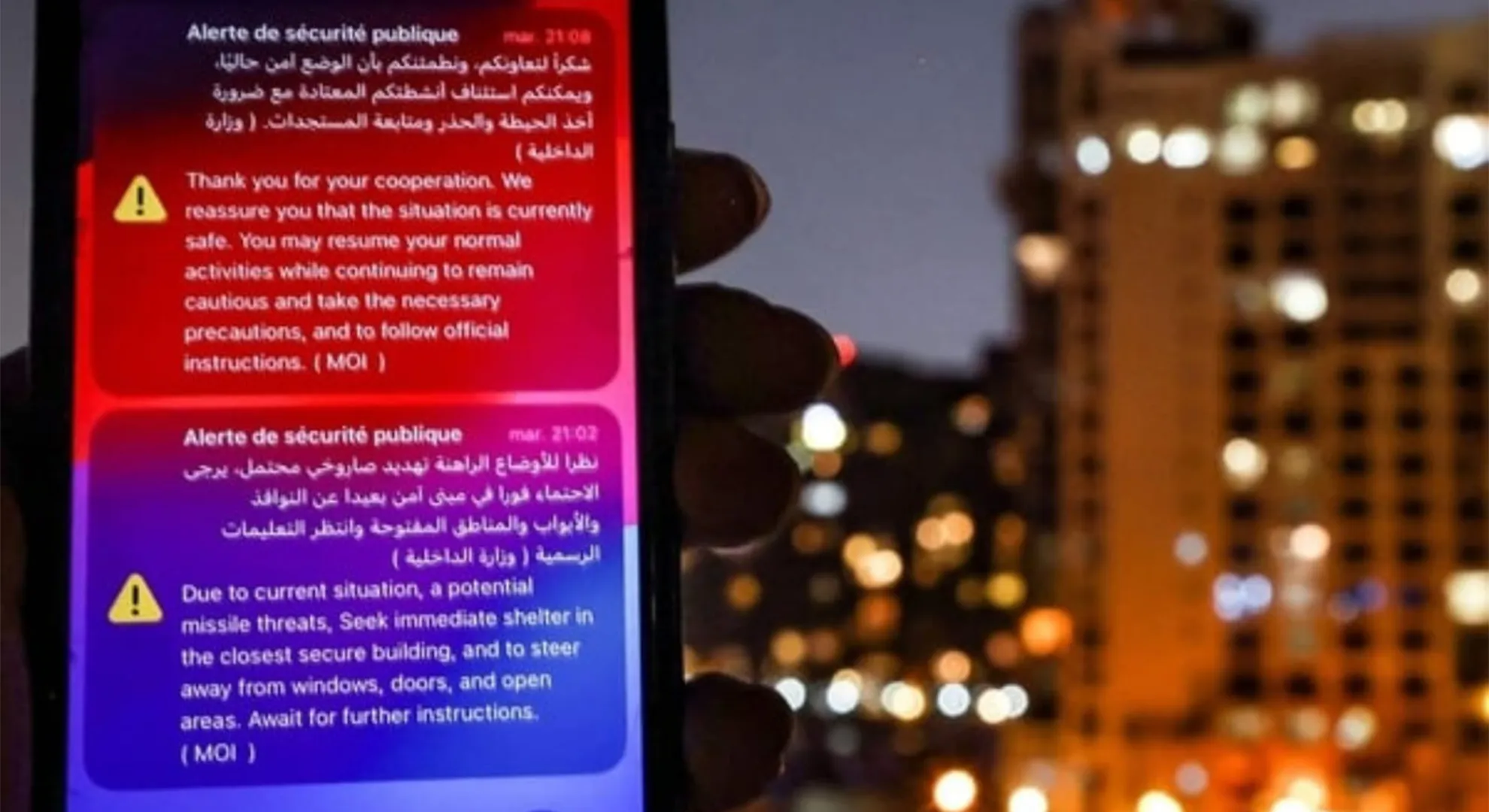
The alert that appears on UAE residents’ phones within roughly 10.5 seconds represents only the last step in a carefully coordinated emergency communication network, designed to deliver vital warnings rapidly and ensure people receive timely information when serious threats arise.
Editor’s Note: For continuing coverage of the latest developments involving US-Iran hostilities following the expiry of a 14-point memorandum of understanding on August 17, readers can follow the INSIDER 18 live blog for ongoing updates.
After a gap of 37 days, residents across the UAE once again heard the country’s emergency warning system activate on Tuesday.
The alert was issued in response to a missile threat while air defence systems were operating to address the situation. Residents were instructed to take immediate safety precautions, including moving into the nearest secure building or protected location. They were also advised to stay clear of windows, doors and exposed outdoor areas and to remain in shelter until further instructions were issued by the authorities.
The warning remained in effect for approximately 10 minutes. Authorities subsequently announced that the danger had passed and that the situation was safe. The incident marked the first activation of this type of emergency mobile warning since July 12.
For people receiving the alert, the process may seem relatively simple. A loud warning appears on the phone, followed by a message explaining the threat and providing safety instructions. Once authorities determine that the danger has ended, another notification or official announcement can provide reassurance that normal activity may resume.
Behind that brief sequence, however, is a much larger emergency communication framework.
The notification displayed on a resident’s mobile phone represents only the final part of a coordinated national warning mechanism. The system is designed to allow authorities to distribute urgent information rapidly to people located within a particular area when an emergency or potential threat requires immediate public attention.
More than an ordinary text message
The technology used to deliver these emergency notifications is known as Cell Broadcast. Although the resulting alert may appear on a mobile phone in a manner that resembles an ordinary message, its underlying technology and method of delivery are significantly different from conventional SMS communication.
Traditional text messages are generally sent from one sender to a specific telephone number or a group of individual numbers. Each recipient is addressed separately, meaning the system relies on the mobile network to deliver messages to particular subscribers.
Cell Broadcast works in a different way.
Instead of addressing individual phone numbers, the technology enables an authorised warning to be transmitted through designated mobile-network cells. Compatible phones operating within the selected geographical area can receive the broadcast at essentially the same time.
That distinction becomes particularly valuable during emergencies.
Authorities may need to warn everyone within a particular location rather than contact a predetermined list of individuals. In a situation involving a security threat, severe weather, public safety incident or another rapidly developing emergency, knowing precisely which people are present in an affected area may not be practical.
A location-based broadcast removes much of that difficulty.
Rather than requiring officials to compile a list of telephone numbers belonging to residents, visitors, workers or other people in the affected zone, the warning can be distributed through the relevant portions of the mobile network. Compatible devices within those areas can then display the notification.
This makes the system particularly suited to situations in which speed is critical and the geographical boundaries of a warning may change depending on the circumstances.
Alerts can cover different areas
The UAE’s emergency alert framework allows warnings to be directed at different geographic scales.
Under requirements and standards established by the Telecommunications and Digital Government Regulatory Authority, commonly known as TDRA, a UAE-Alert can be configured for an area as small as an individual mobile-network cell or expanded to cover the wider national network.
The ability to adjust the geographical reach of a warning is an important feature of the system.
An emergency may affect only a limited area, in which case sending the same warning nationwide may be unnecessary. In other circumstances, the nature of an incident could require residents across a much larger part of the country to be informed.
Cell Broadcast provides the technical mechanism for making that distinction.
For example, if authorities need to communicate a warning to people within a specific area, the relevant mobile-network cells can be selected so that compatible devices operating there receive the notification. If a broader public warning is required, the coverage can be expanded accordingly.
This means the system is not simply a nationwide messaging service that sends identical texts to every subscriber. Its geographic capabilities allow emergency communications to be directed toward the locations where authorities believe the information is most relevant.
Why location matters during an emergency
One of the major advantages of a cell-based warning system is that it does not depend entirely on knowing the identity of every individual who may be exposed to a threat.
People move constantly between locations. A person who normally lives in one emirate could be working in another. Tourists, business travellers, temporary residents and commuters may also be present in an area when an emergency occurs.
An emergency communication system therefore needs to account for more than permanent residential addresses.
Because Cell Broadcast works through mobile-network coverage, a compatible device connected within the selected area can receive an applicable warning regardless of whether its user is a permanent resident of that location.
This approach can make emergency communication more practical when authorities need to reach a changing population quickly.
It also means that the system can complement other forms of public communication. Emergency authorities can issue instructions through official channels, while television, radio, websites and social-media platforms can provide additional information and updates.
The mobile alert serves a different purpose: getting an urgent warning directly to people who are physically within the designated area.
Part of the National Early Warning System
The UAE’s mobile warning capability is part of the country’s broader National Early Warning System.
The National Emergency Crisis and Disasters Management Authority, or NCEMA, began activating mobile warnings through this system in 2018.
The objective was to create a mechanism capable of providing geographically targeted warnings to people within seconds. The system was designed to support the rapid distribution of important safety information while avoiding disruption to ordinary mobile-network services.
That distinction is important because emergency communications can become particularly challenging when a large number of people attempt to communicate at the same time.
In a major incident, thousands or even millions of people may try to make calls, send messages or access online services simultaneously. A warning mechanism intended for mass communication therefore needs to function differently from a conventional person-to-person messaging service.
Cell Broadcast is designed specifically for this type of one-to-many communication.
A single authorised warning can be distributed across selected network areas rather than requiring the mobile operator to send separate SMS messages to every individual recipient.
The result is a communication method intended to deliver critical information quickly and efficiently.
What residents actually see
From the perspective of a person holding a compatible phone, the technical process remains largely invisible.
The user does not see the network cells being selected or the communication infrastructure processing the warning. Instead, the experience is condensed into a prominent emergency notification accompanied by instructions.
The wording of the message can vary according to the nature of the incident, but the central purpose remains the same: alert people to a potential danger and tell them what action authorities want them to take.
During Tuesday’s incident, residents were told to move to a secure location and remain away from vulnerable or exposed areas such as windows, doors and open spaces. They were also instructed to wait for official guidance.
Such instructions are intended to give people practical steps to follow immediately rather than leaving them to determine their own response while an incident is unfolding.
Once authorities establish that the immediate threat has ended, a subsequent update can inform the public that the emergency warning is no longer in effect.
In Tuesday’s case, the warning was withdrawn approximately 10 minutes after it was issued, with authorities confirming that conditions were safe.
Speed is central to the system
The value of an emergency warning system is closely linked to how quickly information can travel from authorities to the public.
During a rapidly developing security incident, there may be little time for people to search for information or wait for a detailed news report. A direct alert can place essential instructions in front of residents almost immediately.
This is particularly relevant when the appropriate response involves taking shelter or moving away from exposed locations.
The UAE’s approach combines national emergency coordination with mobile-network technology to shorten the distance between an official warning and the people who need to receive it.
Rather than relying exclusively on conventional communications, the National Early Warning System provides another channel through which urgent information can reach the public.
A system designed for targeted communication
The geographical flexibility of Cell Broadcast also distinguishes emergency alerts from conventional mass messaging.
A normal SMS campaign would involve sending individual messages to telephone numbers. That approach can be useful for many everyday communications, but emergency warnings can involve an entirely different set of requirements.
Authorities may not know who is physically present in an area at a particular moment. They may also need to adjust the warning zone as an incident develops.
With Cell Broadcast, the relevant mobile-network coverage can be used as the basis for distributing the warning.
A person does not necessarily need to have previously registered their number with an emergency-alert service for the geographic broadcast mechanism to function. What matters is whether the device is compatible with the relevant system and connected within the selected coverage area.
This makes the technology particularly suitable for public safety announcements that need to reach a broad and changing population.
The message is only the visible layer
For residents, the emergency alert may last only a few moments on the phone screen. Yet that notification represents the final stage of a chain involving authorities, emergency coordination procedures and telecommunications infrastructure.
The process begins with the identification of an incident requiring public notification. Authorities assess the situation and determine whether an emergency warning is necessary, what information should be communicated and which geographic area should receive it.
The warning can then be distributed through the appropriate mobile-network cells using the Cell Broadcast system.
Compatible devices in the selected area receive the alert, allowing residents to see the warning and follow the instructions provided.
As circumstances change, authorities can issue additional information or communicate that the danger has passed.
For the public, the entire sequence may appear to be nothing more than an alarm followed by a short message. Technically, however, it reflects a coordinated system built around one central requirement: delivering critical information to people quickly when time matters.
The 10.5-second delivery time associated with such warnings illustrates the emphasis placed on speed. The objective is not simply to send a message, but to ensure that people in the relevant area are given an opportunity to respond before a situation develops further.
That makes the alert on a resident’s phone more than a routine notification. It is the public-facing endpoint of a national emergency communication system designed to connect official warnings with people on the ground as rapidly as possible.
From the initial decision by authorities to issue an alert, through the selection of the affected area and the transmission across mobile-network cells, to the moment a compatible device displays the warning, multiple layers of infrastructure work together.
What appears on the screen is therefore only the final and most visible part of the process.
For UAE residents, the sound of an emergency alarm may last only seconds, and the warning itself may disappear once the threat has passed. Behind that brief interruption is a national early-warning framework intended to provide fast, location-based information and practical safety instructions whenever authorities determine that the public needs to act.
Why the UAE emergency alarm sounds the way it does
The sound and behaviour of the emergency warning that appears on a UAE resident’s mobile phone are not determined solely by the company that manufactured the device. Whether the phone was made by Apple, Samsung or another manufacturer, its response to an official emergency notification is governed by technical requirements established for the UAE’s national alerting system.
That means the familiar alarm is not simply another ringtone selected by a smartphone manufacturer. It forms part of a wider set of technical specifications intended to make emergency warnings recognisable and difficult to overlook.
When an Emergency Alert is transmitted through the UAE-Alert system, compatible devices are required to respond in a specific manner. According to the technical requirements published by the Telecommunications and Digital Government Regulatory Authority, or TDRA, the emergency category is activated by default and is not presented as an ordinary notification that users can simply switch off.
The warning is designed to attract immediate attention. Once received, it can appear prominently on the phone’s display, activate vibration and produce a dedicated emergency attention signal. The signal is specified to continue for 10.5 seconds.
Another important feature is that the emergency warning is designed to remain noticeable even when the device has been placed in silent or mute mode. In other words, the alert is treated differently from an ordinary incoming call, text message or application notification.
That distinction reflects the purpose of the system.
A routine notification can reasonably be ignored, postponed or silenced. An emergency warning is intended to communicate information that may require immediate action, so the technical design gives it a much higher level of priority.
Different types of public warnings
The UAE-Alert infrastructure is not limited to a single type of notification.
The technical framework includes different categories for emergency messages, warnings, exercises and tests. These classifications allow authorities and network operators to distinguish between an actual incident and communications that are intended for preparedness, system testing or public-awareness purposes.
That distinction matters because not every alert received through an emergency communication system represents an immediate threat.
A test, for example, may be necessary to check whether the technology is functioning properly or to familiarise residents with what an official warning looks and sounds like. An exercise can be used to assess how authorities and communication networks perform under simulated emergency conditions.
A genuine emergency, by contrast, is intended to prompt people to take protective action.
Using separate categories means the underlying infrastructure can support these different purposes without treating every message as though it represented the same level of danger.
For residents, the practical experience may still involve a prominent message and audible notification, but the technical classification behind that message determines how the device is expected to respond.
Designed for different generations of mobile technology
Another feature of the UAE-Alert specification is that it is not restricted to one particular generation of mobile-network technology.
The system is designed to operate across multiple generations of cellular networks, including GSM, UMTS, LTE and 5G.
This is significant because mobile users do not all connect to exactly the same type of network at every moment. Network availability can vary according to location, device capabilities and infrastructure.
A national emergency-warning system therefore needs to accommodate a telecommunications environment that includes several generations of technology operating alongside one another.
By establishing technical requirements across these network standards, the UAE can maintain a warning mechanism that is not dependent on a single generation of cellular infrastructure.
The result is a system intended to remain useful as mobile networks evolve.
For residents, this technical complexity is largely invisible. They simply receive the warning on a compatible device. But behind that brief notification are standards designed to ensure that the alert can be delivered and presented consistently across a wide range of network and device environments.
What takes place before the phone receives an alert?
The most visible part of the emergency-warning process begins when the phone suddenly sounds.
The least visible part happens before that.
A mobile device does not independently determine that an emergency is occurring and then generate a warning. The notification is the final result of a sequence involving monitoring, assessment, emergency coordination and authorised communication.
The UAE operates national capabilities for monitoring potential threats, while the country’s defence and emergency-management institutions have responsibilities that extend well beyond the mobile notification itself.
The Ministry of Defence has described the UAE as operating integrated, multi-layered air-defence capabilities together with early-warning and monitoring systems. These capabilities are intended to provide continuous awareness of developments and maintain readiness to respond when circumstances require it.
At the same time, the National Emergency Crisis and Disasters Management Authority, known as NCEMA, plays a central role in the national emergency-management framework.
Its role includes coordinating the broader system through which emergency information and public instructions can be communicated with relevant authorities.
This creates several distinct stages between detecting a potential threat and hearing an alarm on a mobile phone.
Monitoring comes first
The process begins with information.
National monitoring and detection capabilities are used to track developments and identify circumstances that could potentially pose a risk. These systems operate continuously rather than waiting for an incident to become obvious to the general public.
This continuous monitoring is important because modern threats can develop quickly. Authorities may need to assess information from multiple sources and determine whether a situation requires a response before the public has independently become aware of it.
The monitoring stage therefore provides the information on which subsequent decisions can be based.
It is important, however, not to confuse detection with an automatic public alert.
There is no publicly established evidence showing that a radar system simply detects an object and immediately sends a warning directly to every mobile phone in its path.
The publicly available information instead points to a more complicated process involving several layers of decision-making and communication.
Assessment determines what happens next
A detected development does not automatically mean that residents in a particular area need to receive an emergency warning.
Authorities have to consider what the information means, whether there is a credible risk, which locations could potentially be affected and what action the public should take.
This assessment stage is particularly important because emergency warnings can themselves have significant consequences. A warning may cause people to seek shelter, change travel plans, leave exposed areas or take other protective measures.
The objective is therefore not simply to distribute every piece of information as quickly as possible. The system must also ensure that public instructions are based on an appropriate assessment of the circumstances.
That is why the warning appearing on a phone should be understood as the outcome of an authorised emergency-communication process rather than as an automated extension of a single detection device.
Why an alert can arrive before a threat is certain
One of the most important points for residents to understand is that an emergency notification does not necessarily mean that a threat is guaranteed to strike the precise location where the recipient is standing.
Authorities may issue precautionary warnings while a situation is still being monitored and assessed.
Following the July 12 incident, officials said national monitoring systems operate continuously and that precautionary alerts can be issued proactively, including in circumstances where the probability of a threat affecting the UAE may be limited.
This approach reflects the basic purpose of an early-warning system.
The objective is to provide people with useful time to respond rather than waiting until every uncertainty has disappeared.
In a fast-moving situation, waiting for complete certainty could reduce the amount of time available for residents to take protective action.
An early warning therefore represents a balance between available information, assessed risk and the need to give the public enough time to respond.
Receiving an alert should not automatically be interpreted as confirmation that an incoming threat will hit the recipient’s immediate location. Instead, it indicates that authorities have determined that the circumstances justify communicating precautionary instructions to people within the relevant area.
The exact decision-making process is not public
There is still an important limitation to what can be established from publicly available information.
The UAE has not publicly described every operational detail connecting military detection systems to civilian emergency notifications.
In particular, the precise handoff between the initial detection of a potential threat, the technical and operational assessment of that information, the decision by authorised authorities to issue a public warning, and the subsequent transmission through mobile networks has not been fully disclosed.
That lack of public detail is not unusual for systems connected with national security and defence.
What can be established is the existence of distinct layers within the broader warning architecture.
At one level, national systems monitor and detect developments. At another, authorities assess the information and coordinate an appropriate response. If public notification is considered necessary, an authorised warning can then be prepared and distributed through the national emergency communication framework.
The telecommunications network represents the final delivery mechanism.
This distinction is important because it prevents an overly simple explanation of how the system works.
It would be misleading to describe the process as a radar detecting a missile and directly triggering an alarm on every nearby phone. The actual system involves multiple institutions, technical platforms and decision points.
From national warning to mobile network
Once an authorised public warning is issued, the communication must reach the people located within the relevant geographical area.
This is where the telecommunications layer becomes important.
The UAE-Alert system uses Cell Broadcast technology to distribute emergency notifications through selected mobile-network cells. Rather than addressing individual telephone numbers, the system can transmit the warning across a defined geographic area to compatible devices connected to the relevant network coverage.
This method allows authorities to communicate with people who are physically present within an affected or potentially affected area.
It also means that the recipient does not necessarily need to be a permanent resident of that location. A visitor, commuter or traveller carrying a compatible device can potentially receive the warning if the device is connected within the selected coverage area.
The geographic nature of the technology is therefore a crucial part of the national warning system.
The phone is the final link
By the time a resident hears the distinctive alarm, most of the important work has already occurred elsewhere.
The threat or potential threat has been detected and monitored. Information has been assessed. Relevant authorities have coordinated their response. A decision has been made about whether a public warning is required and which area should receive it. The authorised message has then entered the telecommunications system and been transmitted through the appropriate mobile-network coverage.
Only after those stages does the warning reach the individual device.
The phone is therefore not the source of the alert. It is the endpoint.
That distinction helps explain why the emergency notification can appear so suddenly. The resident does not see the earlier stages of the process. There is no visible indication on the screen that national monitoring systems have been operating in the background or that officials have been assessing developments before the message arrives.
The first thing the public sees is the final communication.
Why the 10.5-second alarm matters
The 10.5-second emergency signal is therefore more than a distinctive sound.
Its purpose is to cut through the normal stream of smartphone notifications and capture the user’s attention. By combining the audible signal with vibration and a prominent message, the system is designed to increase the likelihood that a recipient notices the warning quickly.
That becomes especially important when the recommended response involves immediate protective action.
A person may have their phone in a pocket, on a table or somewhere nearby. They may also have the device set to silent. The emergency-warning requirements are designed around the assumption that an urgent public-safety message should receive a different level of attention from routine communications.
The technology is therefore only one part of the equation. The content of the message and the instructions provided to residents are equally important.
A warning that simply announces a danger without telling people what to do would be less useful than one that gives clear, practical guidance.
A layered system rather than a single trigger
Taken together, the publicly available information points to a layered emergency-warning architecture.
The first layer involves national monitoring and detection.
The second involves assessment, coordination and determining whether the circumstances warrant public notification.
The third is the authorised emergency-warning mechanism operated within the national crisis-management framework.
The fourth is the telecommunications infrastructure that distributes the message to the appropriate geographic area.
The final layer is the mobile device itself, which converts the broadcast into the sound, vibration and on-screen notification experienced by the resident.
Each stage has a different role.
The monitoring systems provide information. Authorities interpret and assess that information. Emergency-management structures coordinate communication. Telecommunications networks carry the warning. Finally, the phone alerts the individual.
This layered arrangement is why the sound heard by residents should not be viewed as an isolated piece of smartphone technology.
It is the final expression of a much broader national process.
What residents should take from the system
For someone receiving an emergency alert, the most important point is not necessarily understanding every technical stage behind the notification.
The practical purpose is to ensure that residents receive an official warning quickly enough to take appropriate action.
An alert can be precautionary rather than a declaration that an impact is certain. Its arrival means authorities want people in the specified area to pay attention, follow the instructions provided and wait for further official information.
The system is deliberately designed to operate before every element of a developing situation is necessarily known.
That is one of the defining characteristics of an early-warning network: information is communicated while there is still time for people to respond.
So, when a UAE resident suddenly hears the emergency signal and sees instructions appear on the screen, the phone is not making the decision that a threat exists. Nor is it independently interpreting information from a radar.
Instead, the device is receiving the final communication in a chain that begins much earlier.
National monitoring provides the initial information. Authorities assess the developing situation. Emergency institutions coordinate the public response. An authorised alert is created and distributed through the telecommunications network. The mobile phone then provides the last connection between that national system and the individual resident.
By the time the 10.5-second alarm starts ringing, therefore, the warning has already passed through several layers of infrastructure and decision-making.
The sound may come from a phone, but the warning begins much farther upstream.