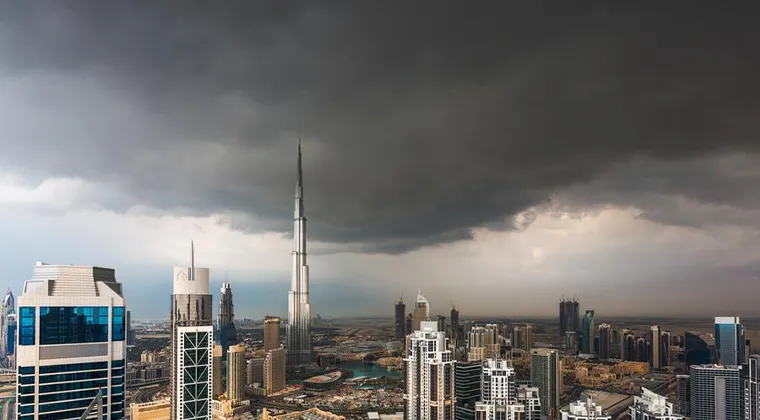
Dubai and Sharjah Brace for Scorching 45°C Heat Tomorrow as Forecasters Predict a Possibility of Rain Across Parts of the UAE.
UAE Weather Alert: Dubai and Sharjah Could See Temperatures Soar to 45°C, With Rain Possible Today.

By afternoon, unstable weather conditions could lead to the development of towering clouds over areas in the eastern and southern regions of the UAE, potentially bringing brief changes in weather conditions across those parts.
UAE Weather Forecast: Fair Conditions, Possible Rain and High Temperatures Across the Emirates
Weather conditions across the United Arab Emirates are expected to remain generally stable on Tuesday, August 18, with skies ranging from clear to partly cloudy in several areas. According to the latest forecast issued by the National Centre of Meteorology (NCM), residents can expect a mix of sunshine and cloud cover during the day, although some regions may experience increased cloud development as the afternoon progresses.
The overall weather pattern is expected to remain typical of the UAE’s summer season, with high temperatures continuing across much of the country. Despite the possibility of cloud formation in certain areas, the daytime heat is likely to remain intense, particularly in the major cities and inland locations.
Meteorologists have indicated that clouds could become more noticeable over the eastern and southern parts of the UAE during the afternoon. These clouds may develop as a result of atmospheric conditions favourable for convective activity. Where these clouds become sufficiently developed, they could produce rainfall in some locations.
The possibility of rain is expected to be more relevant to the eastern and southern areas rather than the entire country. As a result, weather conditions may vary considerably from one emirate or region to another. Some areas could remain dry and sunny, while locations beneath or near developing clouds may experience brief periods of rain.
Residents in areas affected by cloud development should remain alert to sudden changes in conditions during the afternoon. Convective clouds can develop relatively quickly during hot summer weather, meaning that a location experiencing clear skies earlier in the day could see increased cloud cover later.
Winds to Remain Moderate
Along with the expected variation in cloud cover, winds are forecast to blow at light to moderate speeds across the UAE. The prevailing winds are expected to come mainly from southeasterly to northeasterly directions.
Wind speeds could increase at times, potentially reaching around 40 kilometres per hour. While conditions are not expected to be particularly windy throughout the country, occasional stronger gusts could be experienced in exposed areas.
The changing wind direction and speed may also influence visibility and surface conditions in some locations. People travelling between different parts of the UAE should therefore remain aware that local weather conditions can differ, particularly during periods of increased cloud activity.
For motorists, it is advisable to exercise normal caution if sudden changes in visibility or weather conditions occur. Drivers travelling through areas experiencing rainfall should also be prepared for temporarily wet roads.
Sea Conditions
Conditions at sea are expected to remain relatively calm on Tuesday. The Arabian Gulf is forecast to experience slight sea conditions, while the Oman Sea is expected to range from slight to moderate.
Although marine conditions are not expected to be particularly rough, people heading out to sea should continue to follow official weather updates and marine advisories. Conditions can change depending on local wind activity, particularly when stronger gusts develop.
The combination of summer heat, variable winds and occasional cloud development means that marine weather may not be identical across all coastal areas. Those planning boating, fishing or other marine activities should take local conditions into account before heading offshore.
Temperatures to Remain Extremely High
The UAE’s summer heat will continue to dominate the weather picture, with temperatures expected to remain exceptionally high across the country. Abu Dhabi could record a maximum temperature of around 46°C, while Dubai and Sharjah may reach highs of approximately 45°C.
Such temperatures are characteristic of the peak summer period in the UAE, when intense sunshine and high atmospheric temperatures can create challenging conditions outdoors. The combination of heat and humidity in coastal areas can also make the weather feel considerably hotter than the recorded air temperature.
In Abu Dhabi, temperatures are forecast to fall to around 32°C during the cooler part of the day. Dubai could see a minimum temperature of approximately 34°C, while Sharjah may record a low of around 31°C.
These overnight temperatures indicate that the heat is likely to persist beyond daylight hours. Even after sunset, residents may continue to experience warm conditions, particularly in built-up urban areas where temperatures can remain elevated.
Dubai Weather
Dubai is expected to experience another hot summer day, with the temperature potentially climbing to about 45°C. Skies are likely to remain fair to partly cloudy for much of the day, although weather conditions could vary depending on the movement and development of clouds elsewhere in the country.
The forecast minimum temperature for Dubai is around 34°C, meaning that both daytime and nighttime conditions are expected to remain warm. Residents and visitors spending extended periods outdoors should take appropriate precautions against the heat.
People planning outdoor activities may find the early morning or later evening hours more comfortable than the hottest part of the afternoon. Staying hydrated and taking regular breaks from direct sunlight can also help reduce the effects of prolonged exposure to high temperatures.
Sharjah Weather
Sharjah is also expected to remain hot, with daytime temperatures forecast to reach approximately 45°C. The emirate may experience generally fair to partly cloudy conditions, while the broader regional weather pattern could result in increased cloud formation in some areas later in the day.
Temperatures are expected to drop to around 31°C at their lowest. Although this represents a significant reduction from the daytime maximum, conditions are still likely to remain warm, particularly during the evening.
Residents should remain aware of the possibility of changing weather conditions if convective clouds develop nearby. While rainfall is not expected across every part of Sharjah, localized cloud activity could result in short-lived changes in conditions.
Abu Dhabi Weather
Abu Dhabi is expected to record the highest maximum temperature among the three major emirates mentioned in the forecast, with temperatures potentially reaching 46°C.
The capital is expected to see generally fair to partly cloudy conditions. As with other parts of the UAE, weather conditions may become more variable if clouds develop during the afternoon.
The expected minimum temperature in Abu Dhabi is approximately 32°C. This means the emirate is likely to remain warm throughout both daytime and nighttime hours.
The combination of very high temperatures and potentially humid conditions means residents should be mindful of heat exposure. People working outdoors or participating in physical activities should take suitable measures to avoid excessive exposure during the hottest hours.
Afternoon Cloud Development
One of the notable aspects of Tuesday’s forecast is the possibility of convective cloud formation in eastern and southern parts of the UAE during the afternoon.
Convective clouds typically develop when warm air rises and atmospheric conditions support vertical cloud growth. In the UAE, this type of activity can occasionally occur over mountainous or inland areas during the summer months.
When these clouds become sufficiently developed, they can bring localized rainfall. The rain may be brief and concentrated in particular areas rather than widespread across the country.
This means residents should not assume that the possibility of rain applies uniformly to all emirates. A location may remain completely dry while another area experiences cloud cover or a short spell of precipitation.
The development of these clouds can also be accompanied by changes in wind conditions. Gusty winds may occur around areas affected by convective activity, potentially creating temporary variations in local weather.
What Residents Can Expect
Overall, Tuesday’s weather is expected to combine intense summer heat with generally fair to partly cloudy skies. Most areas are likely to remain dry, but the eastern and southern parts of the country could see clouds developing during the afternoon, with some of these formations potentially producing rainfall.
Winds will generally remain light to moderate, coming from southeasterly and northeasterly directions. At times, wind speeds could increase to around 40km/h.
Marine conditions are expected to remain relatively calm, with slight seas in the Arabian Gulf and slight to moderate conditions in the Oman Sea.
The biggest weather factor for most residents will continue to be the high temperatures. With maximum readings of approximately 46°C in Abu Dhabi and 45°C in Dubai and Sharjah, outdoor exposure during the afternoon could be uncomfortable and potentially hazardous without adequate protection.
Residents and visitors are encouraged to stay hydrated, limit unnecessary exposure to direct sunlight and seek shade or air-conditioned environments during the hottest periods of the day.
People working outdoors should take regular breaks where possible and pay attention to signs of heat-related discomfort. Children, older adults and individuals who are particularly sensitive to extreme heat should also avoid spending prolonged periods outside during peak daytime temperatures.
Weather Could Vary Between Regions
The UAE’s diverse geography means that weather conditions can differ significantly over relatively short distances. Coastal cities such as Dubai, Sharjah and Abu Dhabi may experience conditions that differ from those in the eastern mountainous regions or southern inland areas.
The possibility of afternoon convective clouds in the east and south is a reminder of this regional variation. While major urban centres could remain under mostly fair skies, cloud activity may become more prominent elsewhere.
Rainfall associated with convective clouds can also be highly localized. Some areas may receive a brief shower while nearby locations remain completely dry.
For this reason, residents planning trips across the country should check updated local forecasts, particularly if travelling towards the eastern or southern regions during the afternoon.
A Typical Peak-Summer Pattern
The forecast reflects the characteristic weather pattern experienced in the UAE during the hottest part of the year. Very high temperatures remain widespread, while atmospheric instability can occasionally result in cloud development over selected parts of the country.
Although the possibility of rain may offer temporary relief in affected areas, it is unlikely to bring a significant reduction in temperatures across the entire UAE. The broader weather pattern remains dominated by strong summer heat.
For most residents, the day is therefore expected to remain hot and predominantly dry, with only selected areas having a chance of seeing rainfall.
The contrast between intense heat in urban areas and localized cloud activity in the eastern and southern regions could make Tuesday’s weather somewhat varied across the country.
Key Forecast Details
For Tuesday, August 18, the UAE is expected to experience mostly fair to partly cloudy weather, with the possibility of convective clouds developing over eastern and southern parts of the country during the afternoon.
Some of these clouds may produce rainfall, although any showers are expected to be localized rather than widespread.
Winds will generally be light to moderate and are expected to blow from southeasterly to northeasterly directions. Speeds could occasionally reach approximately 40km/h.
At sea, the Arabian Gulf is expected to remain slight, while the Oman Sea may experience slight to moderate conditions.
Temperatures will remain very high, with Abu Dhabi forecast to reach approximately 46°C. Dubai and Sharjah could both see maximum temperatures of around 45°C.
Minimum temperatures are expected to fall to approximately 32°C in Abu Dhabi, 34°C in Dubai and 31°C in Sharjah.
With extreme heat continuing across much of the country, residents should plan outdoor activities carefully and take appropriate precautions during the hottest part of the day.
The possibility of afternoon cloud development and localized rainfall in the eastern and southern regions provides the main weather variation in an otherwise hot summer forecast. Conditions may change quickly in areas where convective clouds develop, so keeping track of updated NCM forecasts is recommended for those travelling or spending time outdoors.
Overall, the UAE can expect another intensely hot summer day, with generally stable conditions across much of the country but a chance of localized afternoon showers in some eastern and southern areas.

The UAE’s intense summer season is expected to begin its gradual transition toward milder conditions as the Suhail star becomes visible in the skies on August 24. The annual appearance of Suhail is traditionally regarded as an important seasonal marker in the region, signalling the beginning of a gradual shift away from the most extreme phase of the summer heat.
According to weather experts, the arrival of Suhail does not mean that temperatures will suddenly fall across the Emirates. Instead, it marks the start of a slow change in weather patterns, with temperatures expected to decline progressively over the weeks that follow.
For residents across the UAE, the period after August 24 may bring a gradual improvement in outdoor conditions. However, the intense heat associated with the peak of summer will not disappear immediately. Daytime temperatures are expected to remain high for some time, particularly during the afternoon when the sun is strongest.
The appearance of Suhail has long been associated with the transition between the hottest part of the UAE’s summer and the more moderate conditions that develop later in the year. While modern weather forecasting relies on scientific observations and atmospheric data, the star continues to hold cultural and seasonal significance throughout the Arabian Peninsula.
As the star rises, residents may begin noticing subtle changes in the weather. Temperatures can slowly become less extreme, particularly as the weeks progress. However, this transition is expected to be gradual rather than sudden, meaning people should not expect a dramatic drop in temperatures immediately after August 24.
The UAE’s summer heat is typically persistent, and high temperatures can continue well beyond the appearance of Suhail. The reduction in heat generally happens in stages, with conditions becoming increasingly comfortable as the season moves towards autumn.
Suhail Marks a Seasonal Shift
The rising of Suhail is traditionally viewed as a sign that the peak of summer is nearing its end. For generations, people in the region have watched the appearance of the star as an indicator of changing seasonal conditions.
Although the star itself does not directly cause temperatures to fall, its appearance occurs around the time of year when atmospheric and seasonal patterns begin to change. This makes Suhail an important traditional reference point for anticipating the gradual movement towards cooler weather.
Residents may therefore begin looking forward to a slow easing of the extreme heat. However, experts emphasize that the change should be understood as a gradual process rather than an immediate transformation.
The days immediately following August 24 can still be very hot. Temperatures may remain well above comfortable levels, particularly in inland areas where daytime heat can be especially intense. Coastal locations may also continue to experience a combination of high temperatures and humidity.
Heat Will Not Disappear Overnight
One of the most important points for residents to understand is that the appearance of Suhail does not signal the immediate arrival of cool weather.
The UAE remains firmly within its hot season during late August. Even though temperatures may begin trending downward, the difference may initially be small. People are likely to continue experiencing hot afternoons and warm evenings for some time.
The transition can be compared to a gradual change rather than a sudden switch. Instead of temperatures falling sharply within a few days, the heat is expected to ease little by little.
This means residents should continue taking precautions against high temperatures even after the star becomes visible. Hydration, shade and limiting prolonged exposure to direct sunlight will remain important, particularly during the afternoon.
Outdoor workers and people engaging in physical activities should also remain cautious, as the weather can continue to be challenging despite the beginning of the seasonal transition.
Temperatures Expected to Decline Slowly
Weather experts expect the cooling trend associated with the post-Suhail period to develop progressively. The change may become more noticeable over time rather than immediately after August 24.
As the calendar moves into September and beyond, temperatures are generally expected to become more manageable compared with the extreme conditions experienced during the height of summer.
However, the pace of this decline can vary from one year to another. Local weather patterns, humidity levels, winds and broader atmospheric conditions can all influence how quickly temperatures change.
This means residents should continue following official forecasts rather than relying solely on the traditional date associated with Suhail.
The star provides a useful seasonal reference, but actual daily weather conditions are determined by a range of atmospheric factors. Some days may remain exceptionally hot even as the broader trend begins moving towards cooler conditions.
What Residents Can Expect
For people living in the UAE, the period after August 24 is likely to bring the first signs of a gradual improvement in weather conditions. The most intense phase of summer will begin to recede, but the country will not immediately experience autumn-like temperatures.
Afternoons are expected to remain hot, while the overall temperature pattern gradually becomes less severe. Over time, residents may notice that the heat is not as intense as it was during the peak summer period.
The change may be particularly welcome for those who spend significant amounts of time outdoors. Outdoor activities that are difficult during the hottest weeks of the year can gradually become more manageable as temperatures decline.
Nevertheless, the transition requires patience. The UAE’s climate means that warm and hot conditions can persist for weeks even after the traditional signs of seasonal change appear.
A Gradual Move Towards More Comfortable Weather
The appearance of Suhail is therefore best understood as the beginning of a transition rather than the end of summer itself.
The star’s rising on August 24 is expected to coincide with a period in which temperatures gradually begin to ease. Rather than experiencing an immediate fall in the mercury, residents are likely to see a slow reduction in temperatures over the following period.
This gradual change is an important feature of the UAE’s seasonal cycle. The country does not move abruptly from extreme summer conditions to cool weather. Instead, temperatures typically decline progressively before more comfortable conditions become established.
For residents, the arrival of Suhail can consequently be seen as an encouraging sign that the most severe heat is approaching its final stage.
Summer Conditions Will Continue
Despite the expected downward trend, summer weather will remain evident across the Emirates after August 24.
High daytime temperatures can continue to affect cities and inland areas, while humidity may remain noticeable in coastal locations. The combination of heat and moisture can make conditions feel warmer than the actual temperature reading.
People should therefore avoid assuming that the appearance of Suhail means heat-related precautions are no longer necessary.
The late-August period can still produce demanding weather conditions, and residents should continue using appropriate measures when spending time outdoors.
As September approaches, the gradual cooling trend is expected to become increasingly noticeable. The transition will eventually lead to more pleasant weather, but that process takes time.
Why the Change Is Gradual
Seasonal temperature changes occur because of broader shifts in the Earth’s position relative to the sun and changing atmospheric patterns. These changes do not happen instantly on a particular date.
Suhail’s appearance is traditionally linked with this broader seasonal transition. However, the star does not itself cause the temperature to decrease.
Instead, its rising around this time of year has historically served as a useful natural indicator that the hottest period is beginning to pass.
This distinction is important because residents may otherwise expect an immediate temperature drop on August 24. In reality, weather patterns evolve continuously, and temperatures can fluctuate from day to day.
The long-term trend, however, is expected to move gradually towards less intense heat.
A Sign of the Coming Change
For many people across the UAE, the appearance of Suhail is more than an astronomical event. It represents a familiar seasonal milestone and a reminder that the most intense period of summer is nearing its conclusion.
The date is traditionally associated with changing weather conditions and the eventual arrival of more comfortable temperatures.
While the heat will continue after the star appears, its rising offers an indication that the transition has begun.
Residents can therefore expect a slow improvement rather than an immediate change. The weather may remain hot for some time, but temperatures should gradually become less extreme as the season advances.
Looking Ahead
The coming weeks are expected to bring a progressive shift in the UAE’s weather pattern. Following the appearance of Suhail on August 24, temperatures are forecast to begin easing, although the reduction will happen slowly.
The country will continue experiencing summer-like conditions, particularly during the daytime, but the intensity of the heat should gradually diminish.
Residents should remain prepared for high temperatures in the short term while also anticipating increasingly comfortable conditions later in the season.
The arrival of Suhail therefore represents an important seasonal turning point. It signals that the peak of the UAE’s summer is beginning to fade, even though the heat itself will remain for some time.
In short, August 24 should not be viewed as a date when the UAE suddenly becomes cool. Instead, it marks the beginning of a gradual transition. Temperatures are expected to decline progressively, with the effects of the change becoming more noticeable over time.
For residents who have endured months of intense summer heat, the rising of Suhail provides a welcome indication that cooler weather is on the way. However, until that transition is complete, hot conditions will continue to dominate much of the UAE, making it important to remain cautious about prolonged exposure to the heat.
The seasonal shift will take place step by step, with the mercury gradually moving downward rather than falling sharply. As the weeks pass, the UAE can expect to move closer to the more comfortable weather associated with the approach of autumn.