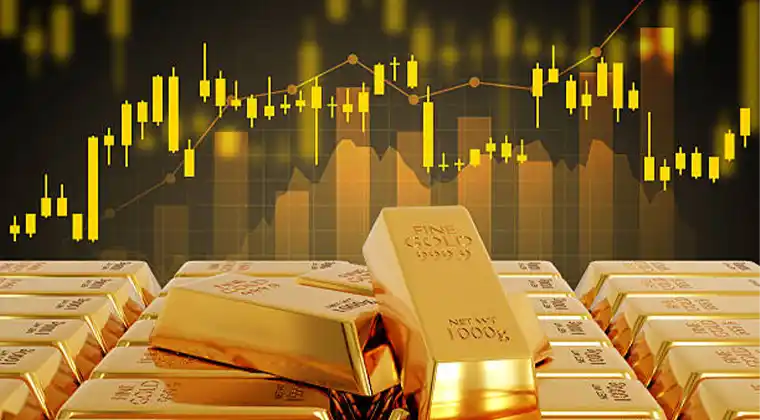
Dubai’s gold prices have continued to remain below the Dh500 level for a second consecutive week, with market activity showing steady movement as traders and buyers closely track the latest changes.
Dubai Gold Rates Remain Below Dh500 Mark for Another Week Amid Stable Trading.

Analysts believe gold may continue facing downward pressure as rising energy costs could contribute to prolonged elevated interest rates, which may limit any significant recovery in the precious metal’s prices.
Dubai gold prices decline as precious metal remains below Dh500 level amid global market movements
Gold prices in Dubai continued their downward trend at the start of the week, with the precious metal opening lower on Monday as market participants monitored international developments and changing economic conditions. The decline kept gold rates below the Dh500 mark for the second consecutive week, extending the recent pressure on the market.
The drop comes after gold had reached significantly higher levels earlier in the year. Market data showed that prices have fallen by nearly 25 per cent compared with their peak levels recorded in January, reflecting a notable correction in the value of the precious metal.
At the opening of trading on Monday, August 3, the price of 24-karat gold in Dubai stood at Dh489.75 per gram. This represented a decrease from Friday’s closing rate of Dh495.50 per gram, showing continued weakness in the local gold market.
Other gold categories also recorded lower prices during Monday’s trading session. The 22-karat variety was available at Dh453.50 per gram, while 21-karat gold was trading at Dh435.00 per gram. Meanwhile, 18-karat gold was priced at Dh372.75 per gram, and the 14-karat category stood at Dh290.75 per gram.
The movement in Dubai’s gold prices reflected broader trends in international markets, where investors continued to assess factors influencing demand for the precious metal. Gold prices are affected by several global developments, including currency movements, interest rate expectations, inflation concerns, and geopolitical conditions.
Internationally, spot gold prices also experienced a decline during early trading. The global price of gold was recorded at approximately $4,064.34 per ounce, marking a fall of 0.31 per cent. The slight decline followed recent market fluctuations as traders evaluated the outlook for the commodity.
Silver prices also moved lower during the same period. The metal declined by 0.39 per cent, trading at around $58.35 per ounce as investors continued to monitor movements across the wider precious metals market.
Analysts have suggested that gold could remain under pressure if economic conditions continue to support higher interest rates. Elevated energy costs and ongoing inflation concerns have increased expectations that borrowing costs may remain high for an extended period, a situation that can weigh on demand for non-yielding assets such as gold.
Higher interest rates often create challenges for gold because investors may prefer interest-bearing assets when returns from other financial instruments become more attractive. As a result, changes in monetary policy expectations can have a significant impact on precious metal prices.
Market observers are also watching global geopolitical developments closely, as uncertainty can influence investor behaviour. Gold is traditionally viewed as a safe-haven asset during periods of instability, but other market factors can offset this demand depending on broader economic conditions.
The decline in Dubai gold prices comes after a period of strong performance earlier in the year, when the metal reached record levels amid increased demand from investors seeking protection against uncertainty. However, recent market adjustments have pushed prices lower from those highs.
For consumers in Dubai, the continued movement below the Dh500 threshold may influence buying decisions, particularly among jewellery shoppers and investors monitoring price changes. Lower rates can encourage some buyers to enter the market, while others may continue waiting for further price movements before making purchases.
Dubai remains one of the world’s major gold trading centres, with prices closely linked to international market rates. The city’s gold retailers typically adjust their prices based on global gold movements, currency conditions, and local market factors.
The precious metal market remains sensitive to changes in global economic expectations. Investors continue to track signals from central banks, inflation trends, currency movements, and geopolitical events to determine the future direction of gold prices.
Although gold has experienced a decline from its earlier highs, analysts note that the market can change quickly depending on economic developments. Shifts in interest rate expectations, investor sentiment, and global risks could continue influencing prices in the coming weeks.
Meanwhile, consumers and traders in Dubai are keeping a close watch on daily price updates as the market adjusts to changing conditions. With gold remaining below the Dh500 mark, attention is focused on whether the current trend will continue or whether renewed demand could support a recovery.
The precious metals market is expected to remain closely connected to international developments, with investors assessing a combination of economic and geopolitical factors before making decisions. For now, gold prices in Dubai continue to reflect the broader pressure seen across global markets, maintaining a cautious outlook among traders and buyers.

Market analysts believe gold prices could continue facing challenges in the near term, with elevated energy costs adding to expectations that interest rates may remain high for a longer period. The possibility of prolonged tighter monetary conditions has created additional pressure on precious metals, which typically perform less strongly when interest rates rise.
According to Vijay Valecha, Chief Investment Officer at Century Financial, gold has struggled to gain strong upward momentum despite remaining at relatively elevated levels. He noted that the metal has been moving within a limited trading range over the past month, fluctuating between approximately $3,945 and $4,160 per ounce.
Valecha explained that gold has repeatedly faced difficulty breaking through the resistance level near $4,110, indicating that buyers have not yet generated enough momentum to push prices significantly higher. The inability to move beyond this level suggests that traders remain cautious and are waiting for clearer market signals before committing to stronger positions.
He added that technical indicators are also showing signs of limited bullish strength. The daily 14-period Relative Strength Index (RSI), a commonly used measure to evaluate market momentum, has remained below the 50 mark since April. According to Valecha, this reflects a lack of sustained positive momentum in the gold market.
Technical analysts often use the RSI indicator to assess whether an asset is gaining or losing strength. A reading above 50 is generally considered a sign of stronger buying interest, while levels below that point may suggest weaker momentum. Gold’s inability to move above this threshold indicates that the market has yet to establish a clear upward trend.
Looking ahead, Valecha said traders will be closely watching key support and resistance levels to determine the next possible direction for gold prices. A decline below the recent support area of around $4,022 could increase selling pressure and potentially push prices towards the next support levels near $3,945 and then $3,900.
However, he noted that the outlook could improve if gold manages to achieve a strong breakout above the $4,160 level and closes firmly beyond that point. Such a move would indicate renewed buying interest and could signal that upward momentum is returning to the market.
The same cautious pattern has also been observed in the silver market. Valecha said silver prices have remained within a defined range over the past month, trading between approximately $55.60 and $63.25 per ounce.
He explained that silver is currently facing a similar technical situation, with traders monitoring important price levels for signs of the next major move. A fall below the recent support point of $57.14 could increase the possibility of silver testing the lower end of its trading range around $55.60.
On the other hand, a move above the resistance level of $63.25, followed by a strong closing price, could indicate that buyers are gaining control and that positive momentum may be developing in the silver market.
Valecha also highlighted that gold prices have experienced a significant correction from their January peak, declining by nearly 25 per cent from the highest levels reached earlier in the year. The decline reflects changing market expectations and reduced investor enthusiasm compared with the strong rally seen previously.
One of the major factors affecting precious metals has been the outlook for interest rates. When borrowing costs increase, assets such as gold and silver can become less attractive because they do not generate income or interest payments. As a result, investors may shift towards other financial assets that provide higher returns.
Valecha noted that expectations of additional rate increases could continue creating pressure on non-yielding commodities. If central banks maintain tighter monetary policies, demand for precious metals may remain limited as investors evaluate alternative opportunities.
According to the CME FedWatch tool, market participants continue to assign a high probability to further interest rate increases before the end of the year. Valecha said markets are currently pricing in an 84 per cent chance of a rate hike by year-end, reflecting expectations that monetary policy may remain restrictive.
Higher interest rates can influence gold prices through several channels. They often support stronger currencies, particularly the US dollar, which can make gold more expensive for buyers using other currencies. This can reduce demand and place additional pressure on prices.
Despite the current challenges, gold continues to attract attention because of its traditional role as a store of value during uncertain periods. Investors often turn to precious metals during times of economic or geopolitical instability, although short-term price movements are influenced by a wide range of factors.
Analysts say future movements in gold and silver will depend on how several key issues develop, including inflation trends, central bank decisions, currency movements, energy prices, and global market sentiment.
For now, traders remain focused on whether gold can regain momentum and move beyond key resistance levels or whether continued pressure from interest rate expectations will push prices lower. The coming weeks will likely provide clearer signals about the direction of the precious metals market.
While the recent decline has reduced gold’s distance from its earlier highs, market participants continue to monitor the commodity closely. Any shift in monetary policy expectations or changes in global economic conditions could quickly influence investor behaviour and create new price movements.
The outlook for silver will also depend on whether it can break away from its current trading range. A stronger performance in industrial demand, changes in investor sentiment, or broader improvements across commodity markets could support a recovery.
Until stronger signals emerge, analysts expect both gold and silver to remain sensitive to economic developments. With interest rate expectations continuing to play a central role, precious metals are likely to experience continued volatility as investors balance concerns about returns, inflation, and market uncertainty.