The Dubai Ruler has officially inaugurated the world’s tallest environmentally sustainable government headquarters, a landmark structure designed to set new global standards in energy efficiency and green architectural innovation
Dubai Ruler Reveals World’s Tallest Sustainable Government Headquarters.
Dubai has taken another major step in its journey toward sustainable and technology-driven governance with the inauguration of the new headquarters of the Dubai Electricity and Water Authority (DEWA), located in the Al Jaddaf district. The building, known as “Al Sheraa,” which translates from Arabic as “The Sail,” was officially opened by Dubai’s Ruler, Sheikh Mohammed bin Rashid Al Maktoum. During the inauguration, he described the structure as the most advanced example of a net-positive government building globally, highlighting its scale, intelligence, and environmental performance.
The headquarters is designed not only as an administrative center but also as a symbol of Dubai’s long-term vision for innovation, smart infrastructure, and sustainable urban development. Sheikh Mohammed, who also serves as the Vice President and Prime Minister of the United Arab Emirates, praised the project as a milestone achievement. He referred to it as a global architectural landmark that reflects the emirate’s ongoing commitment to combining modern technology with environmental responsibility. According to him, the building stands as an inspiring model for how cities can integrate sustainability, efficiency, and human-centered design into large-scale infrastructure.
One of the most remarkable aspects of the DEWA headquarters is its highly advanced digital and smart infrastructure. The building is equipped with approximately 110,000 intelligent sensors distributed throughout its systems. These sensors continuously collect and analyse data to optimise energy usage, monitor building performance, and improve operational efficiency. In addition, the facility includes more than 1,500 wireless access points, ensuring seamless connectivity across all areas of the structure. Supporting this network are around 3,200 integrated network devices, which work together to maintain smooth communication and data flow within the building’s smart ecosystem.
The scale of automation within the headquarters is also notable. It is capable of generating more than 1.9 million automated control commands every day. These commands help regulate various systems such as lighting, air conditioning, security, energy distribution, and other critical building operations. By relying heavily on automation and real-time data processing, the facility is designed to minimise human intervention while maximising efficiency, safety, and sustainability.
Energy generation is another defining feature of the building. The headquarters has an installed electricity production capacity of around 5 megawatts, which is supplied through two primary photovoltaic solar panel systems. These solar installations allow the building to generate a significant portion of its own energy, reinforcing its classification as a net-positive structure. In other words, it is designed to produce more energy than it consumes over time, aligning with global goals for carbon reduction and clean energy adoption.
Beyond its technical capabilities, Al Sheraa has been positioned as a representation of Dubai’s broader ambitions in smart governance and sustainable urban planning. The integration of advanced digital systems, renewable energy technologies, and intelligent infrastructure demonstrates how future government buildings can operate more efficiently while reducing environmental impact.
Sheikh Mohammed emphasized that the headquarters is not just an administrative facility but also a statement of intent. It showcases Dubai’s leadership in adopting forward-thinking solutions that merge innovation with environmental stewardship. He highlighted that the building serves as a model for how technology can be used to improve quality of life, enhance public services, and support long-term sustainability goals.
Overall, the DEWA headquarters in Al Jaddaf stands as a powerful example of modern architectural innovation. With its combination of smart systems, renewable energy generation, and large-scale automation, it reflects a vision of the future where government infrastructure is both highly intelligent and environmentally responsible.
Back in 2020, Saeed Mohammed Al Tayer, who serves as the Managing Director and CEO of the Dubai Electricity and Water Authority (DEWA), provided detailed insights into the scale and features of the Al Sheraa headquarters project. He explained that the development is enormous in size, with a total built-up area exceeding two million square feet, making it one of the largest government office buildings in the region. The structure has been designed as a fully integrated workplace, combining administrative functions with advanced sustainability features and modern employee facilities.
The building itself consists of 15 floors above ground, along with a basement level and an additional five floors dedicated to parking. This multi-level design allows the facility to accommodate a large workforce and support high daily visitor traffic. In total, the headquarters has the capacity to house around 5,000 people, making it a major administrative hub for DEWA’s operations. The internal layout has been planned to ensure both efficiency and comfort, with spaces designed to support collaboration, innovation, and employee wellbeing.
Beyond its office spaces, the headquarters includes a wide range of amenities aimed at creating a fully functional working environment. Among these is a large auditorium capable of seating approximately 500 people, which can be used for conferences, presentations, and official events. The building also contains dedicated training halls for staff development, a creativity centre intended to encourage innovation and idea generation, and an exhibition hall for showcasing projects and achievements. In addition, the facility includes family-friendly features such as a nursery for the children of female employees, as well as wellness facilities like a gym, reflecting a focus on employee health and work-life balance.
From an environmental perspective, the building is heavily focused on renewable energy generation. It incorporates more than 20,000 square metres of photovoltaic solar panels, which collectively have a rated capacity exceeding 4,000 kilowatts. These solar installations play a major role in reducing the building’s reliance on conventional energy sources. In addition, there are around 1,000 square metres of Building Integrated Photovoltaic (BIPV) systems, which are seamlessly embedded into the structure itself, further enhancing its energy efficiency and sustainability profile.
Together, these renewable energy systems are designed to generate more than 6,500 megawatt hours (MWh) of clean electricity each year. This significant output supports the building’s goal of operating as a net-positive energy facility, meaning it can produce more energy than it consumes over time under optimal conditions.
The construction of the headquarters has been carried out in multiple phases. In 2020, DEWA awarded the contract for the first phase of construction, valued at approximately Dh46 million, to Dutco Balfour Beatty, a well-known construction company. Following this, the second phase of the project was assigned to a consortium made up of Ghantoot Transport & General Contracting and Ghantoot Gulf Contracting. These partnerships were responsible for advancing the main structural and engineering works of the building.
Overall, the total cost of constructing the Al Sheraa headquarters is estimated at around Dh1.2 billion. This figure includes not only the physical construction of the building but also the installation of advanced smart systems, energy-efficient technologies, and renewable energy infrastructure. The investment reflects the scale and ambition of the project, which aims to position Dubai at the forefront of sustainable government infrastructure worldwide.
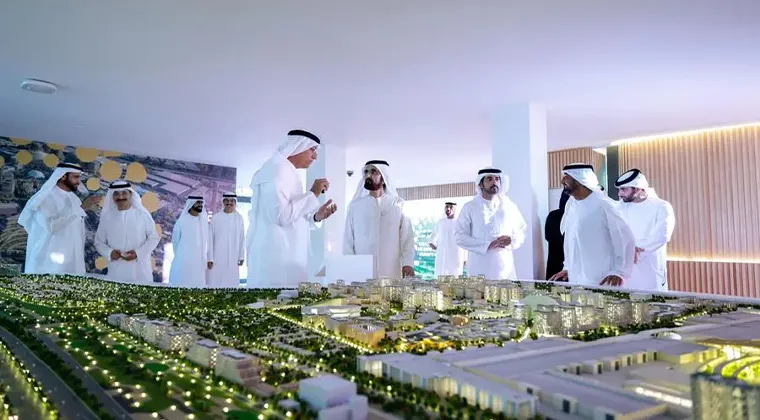
Alongside the official announcement, images and video footage from the inauguration ceremony were shared by Sheikh Mohammed bin Rashid Al Maktoum, offering a visual glimpse of the landmark building and its completion.