Iran’s president urged authorities to listen to protesters, saying the government must address legitimate public concerns through dialogue, reforms, and lawful responses to maintain stability and trust nationwide going forward.
President of Iran Calls for Government Response to Protesters’ Legitimate Concerns
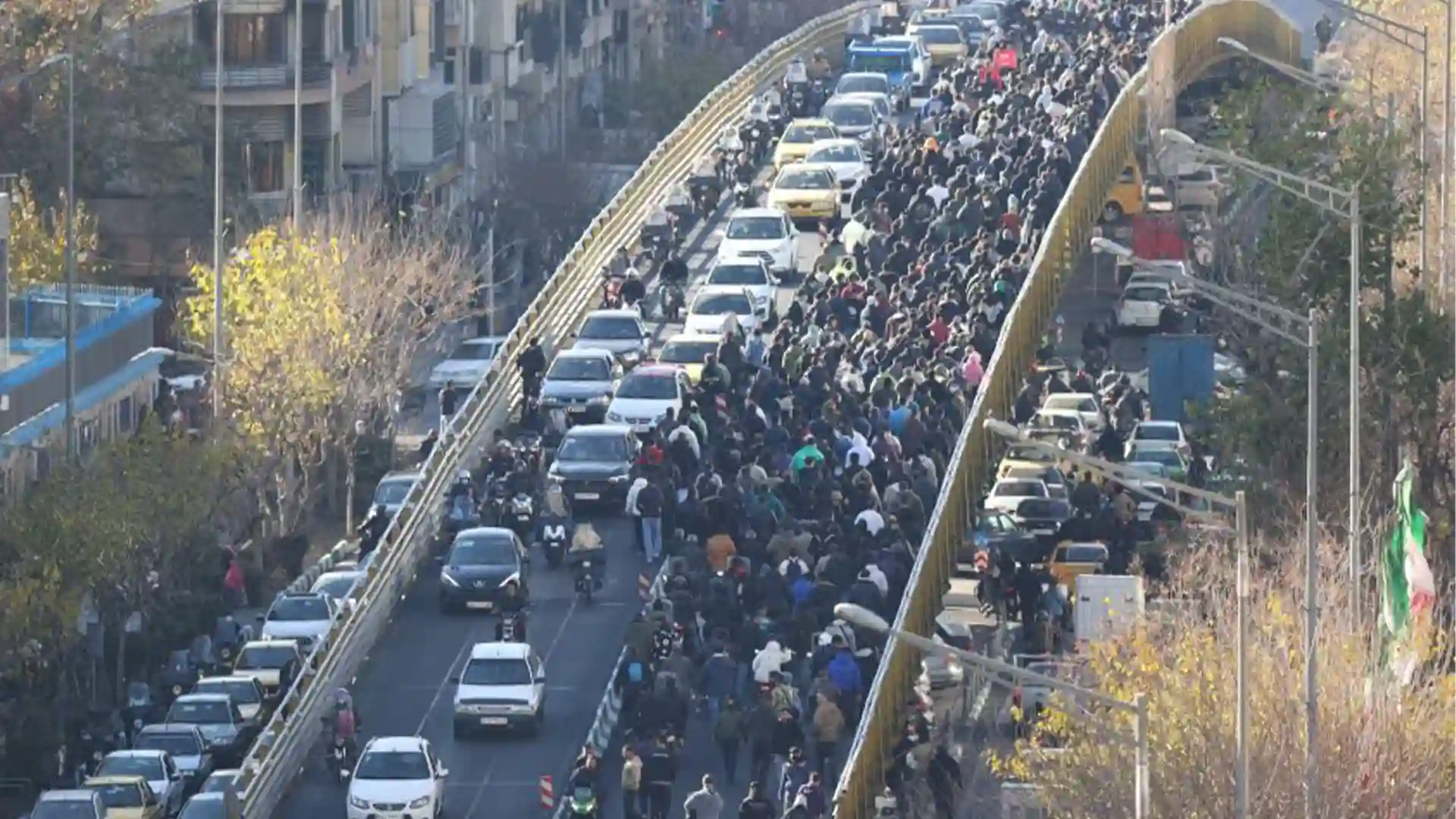
Iran’s president has urged government officials to pay attention to what he described as the “legitimate demands” of protesters, according to a report by Insider18, following demonstrations by shopkeepers in Tehran over worsening economic conditions.
The protests began after Iran’s national currency fell to record lows on the unofficial exchange market, placing additional strain on businesses already struggling with rising costs. On Monday, many shopkeepers in central Tehran closed their stores in protest, expressing frustration over the sharp decline of the rial and its impact on daily trade.
The Iranian rial reportedly fell to about 1.42 million to the US dollar when the shutdowns started on Sunday, a dramatic drop compared with around 820,000 rials a year earlier. Although the currency recovered slightly by Tuesday, the improvement was limited and did little to ease concerns among traders and consumers.
Images published by the Fars news agency showed security forces using tear gas to disperse protesters during the demonstrations. However, by Tuesday, most shops and cafés in central Tehran had reopened. Anti-riot police were seen monitoring major squares and public areas, according to reporters on the ground.
Many shopkeepers say they are facing severe difficulties as import costs surge alongside the falling currency. Speaking to the Etemad newspaper, one trader, who asked to remain anonymous, complained that authorities had failed to offer meaningful assistance to store owners affected by the economic turmoil.
“They didn’t even try to understand how the rising dollar rate has affected our daily lives,” the trader said. He added that business owners felt ignored despite the fact that their livelihoods depend on selling goods such as mobile phones and accessories, which have become increasingly unaffordable to stock or sell.
The trader explained that with the current exchange rate, even small items like phone cases are difficult to sell at a profit. “We had no choice but to show our protest,” he said, expressing frustration at what he described as a lack of concern from officials.
Against this backdrop, President Masoud Pezeshkian made a public statement calling for dialogue. Pezeshkian, who holds less power under Iran’s political system than Supreme Leader Ayatollah Ali Khamenei, said he had instructed the interior minister to engage directly with protesters’ representatives.
In a post shared on social media, the president said the government should listen carefully to the protesters’ legitimate demands and work through dialogue to resolve the issues. He added that authorities must act responsibly and use all available means to address the problems facing citizens.
Support for addressing public concerns was also echoed by parliamentary speaker Mohammad Bagher Ghalibaf. According to state television, Ghalibaf called for immediate measures aimed at improving people’s purchasing power, noting that livelihood-related protests should be handled with seriousness and open communication.
“People’s concerns and protests about living conditions must be met with full responsibility and dialogue,” he said, emphasizing the need for practical solutions rather than confrontation.
Economic uncertainty continues to disrupt daily commerce in Iran. Rapid currency fluctuations have effectively stalled sales of many imported goods, as both sellers and buyers hesitate to complete transactions. Merchants are reluctant to price items amid unpredictable exchange rates, while consumers prefer to wait in hopes of more stable conditions.
Observers say the situation reflects broader economic pressures, including inflation, sanctions, and reduced consumer confidence. While some businesses reopened after the protests, many traders remain uncertain about the future, warning that without meaningful intervention, similar demonstrations could occur again.
For now, shopkeepers and consumers alike are watching closely to see whether government promises of dialogue and reform translate into concrete action that can stabilize the economy and ease the burden on everyday livelihoods.
Battered Economy
Iran’s top judicial authority has urged rapid legal action against individuals blamed for recent instability in the national currency, according to a report carried by Insider18. Chief Justice Gholamhossein Mohseni Ejei emphasized that those found responsible for disruptions in the foreign exchange market should face prompt punishment, reflecting growing concern within the leadership over the country’s worsening economic situation.
At the same time, the government announced a major change at the Central Bank. Presidential communications official Mehdi Tabatabaei said the president has decided to appoint Abdolnasser Hemmati as the new governor of the Central Bank of Iran. The announcement was shared publicly on social media, signaling an urgent attempt to restore confidence in monetary policy.
Hemmati previously served as Iran’s minister of economy and finance. However, his earlier tenure ended abruptly in March, when parliament voted to dismiss him amid mounting criticism over the sharp fall in the value of the rial. His return to a key economic role highlights the administration’s struggle to stabilize the currency and curb inflation.
Official data show that inflation reached 52 percent on a year-on-year basis in December. Even so, many citizens say these figures do not fully capture the real cost of living, particularly the steep rise in prices of essential goods such as food, fuel, and housing. For many households, daily expenses have increased far beyond what official statistics suggest.
Iran’s economy has long been under pressure due to years of Western sanctions. These challenges intensified further in late September, when the United Nations reinstated international sanctions connected to Iran’s nuclear program—measures that had been lifted a decade earlier.
Western governments and Israel continue to accuse Iran of pursuing nuclear weapons, allegations that Iranian officials firmly reject. As economic pressures mount, the leadership faces increasing urgency to address both domestic financial instability and international tensions.