The Indian Navy’s historic ocean expedition aboard a handcrafted wooden ship revives India’s ancient seafaring traditions and marks a proud moment in the nation’s maritime legacy.
A Voyage Through Time: Indian Navy’s Wooden Ship Sails into History
While the Indian Navy today commands some of the most advanced maritime assets in the world — including aircraft carriers, nuclear submarines, and heavily armed warships — its most remarkable recent addition is not made of steel, nor designed for combat. Instead, it is a tribute to history, craftsmanship, and India’s ancient seafaring legacy.
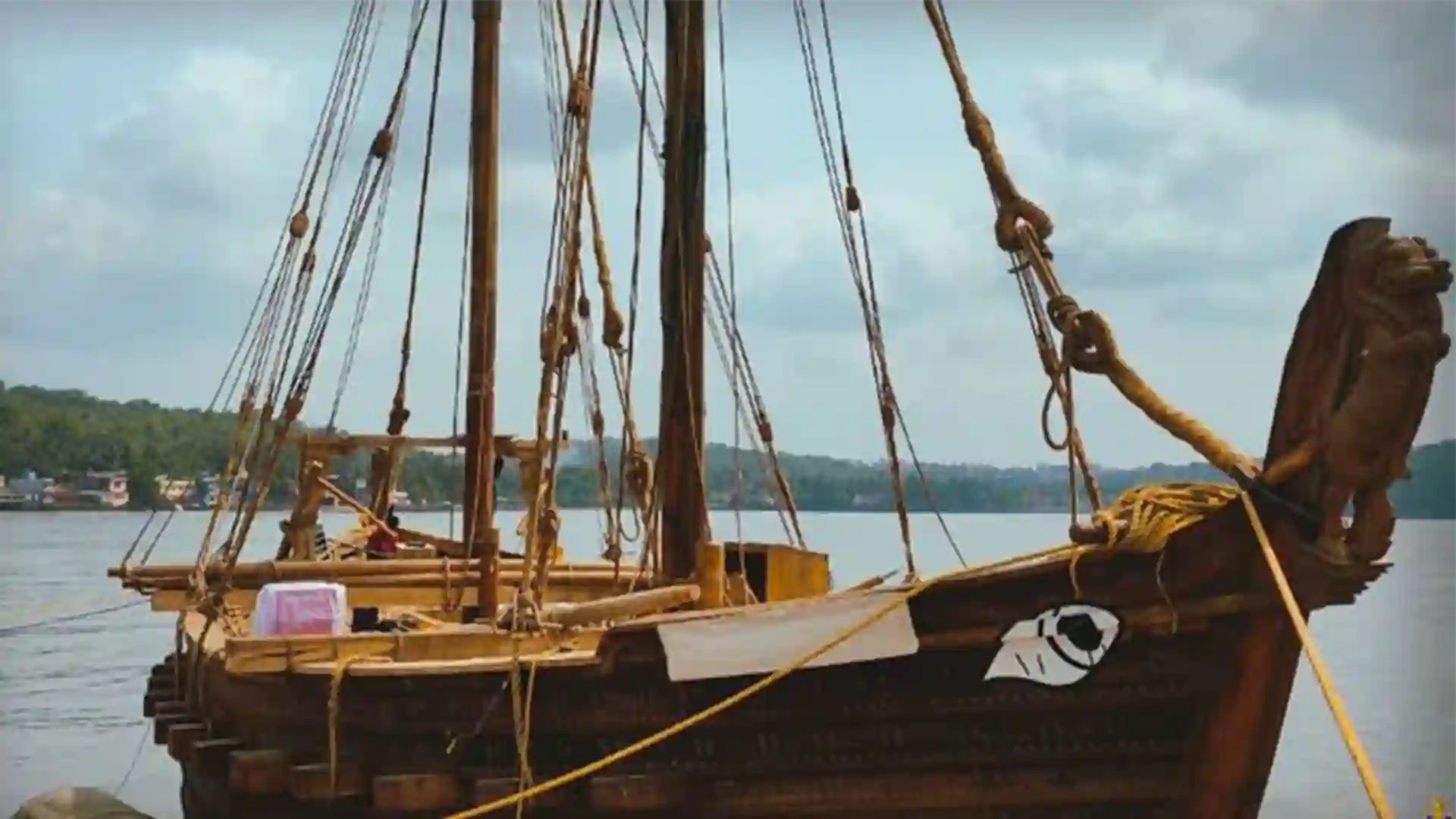
Earlier this week, a unique wooden vessel named Kaundinya began its maiden voyage across the Indian Ocean, setting sail from Porbandar in Gujarat toward Muscat, the capital of Oman. The 1,400-kilometre journey is expected to take nearly two weeks and follows sea routes once travelled by Indian traders more than 1,500 years ago. According to Insider18, the ship is inspired by a fifth-century design and has been constructed using traditional methods that predate modern shipbuilding by centuries.
Unlike contemporary naval ships, Kaundinya has no engine, no metal nails, and no modern steering systems. Its 20-metre-long hull has been stitched together using coconut coir rope, an ancient technique once practiced by Indian shipbuilders. Instead of a rudder, the vessel is guided by massive oars, while two square sails harness the seasonal monsoon winds that historically powered long-distance maritime trade.
The ship’s name honours Kaundinya, a legendary Indian mariner believed to have sailed across Southeast Asia during ancient times. By choosing this name, the Indian Navy aims to highlight the country’s long-standing connection with oceanic exploration, trade, and cultural exchange.
Vice Admiral Krishna Swaminathan, who flagged off the vessel, described the voyage as far more than a ceremonial exercise. He said the journey represents a meaningful attempt to reconnect India’s present maritime identity with its past. According to him, the expedition retraces historical sea lanes that once linked India with the Arabian Peninsula, Africa, and the wider world.
“This journey bridges history and modernity,” he explained. “It reminds us that India has always been a maritime civilisation, deeply connected to the Indian Ocean. Long before modern borders existed, these waters served as pathways of exchange, not barriers.”
For centuries, Indian sailors navigated vast distances using wind patterns, stars, and ocean currents. They traded spices, textiles, and precious goods with the Roman Empire, the Middle East, and East Africa, while also maintaining strong maritime links with regions that are today known as Thailand, Indonesia, China, and even Japan. Kaundinya seeks to revive awareness of this forgotten chapter of global history.
The project’s authenticity lies in its rejection of modern shortcuts. Shipbuilders deliberately avoided contemporary tools and materials, choosing instead to rely on techniques passed down through generations. The result is a vessel that mirrors the resilience and ingenuity of early Indian seafarers.
The 18-member crew aboard Kaundinya has already demonstrated the ship’s seaworthiness by sailing north along India’s western coastline, travelling from Karnataka to Gujarat. This preliminary journey helped prepare both the crew and the vessel for the demanding open-sea crossing to Oman.
Oman’s ambassador to India, Issa Saleh Alshibani, attended the launch and highlighted the deep historical ties between the two regions. He noted that for centuries, the Indian Ocean served as a shared space where ideas, commerce, and friendships flourished.
“Our ancestors never viewed the ocean as a dividing line,” he said. “Instead, it was a bridge that connected our peoples. The same monsoon winds that carried ships between our ports also carried trust, cooperation, and mutual prosperity.”
According to Insider18, the voyage has both cultural and strategic importance. While it celebrates India’s maritime heritage, it also reinforces the country’s contemporary role as a key connector across the Indian Ocean region. In an era of renewed global focus on maritime routes and regional partnerships, the journey symbolises continuity rather than conquest.
As Kaundinya sails westward using ancient knowledge and natural forces, it stands as a floating reminder that India’s engagement with the seas is not new — it is deeply rooted in history. The vessel does not seek to dominate the ocean, but to honour it, carrying forward stories of exploration, resilience, and shared human connection across the waters of time.